
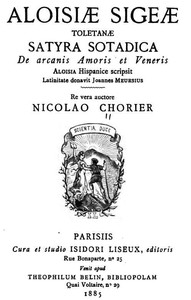
Aloisiæ Sigeæ Toletanæ Satyra Sotadica de arcanis Amoris et Veneris by Chorier et al.
Let's get the basics out of the way. 'The Sotadic Satire' is presented as a series of conversations between two educated young women, Tullia and Octavia. They're in a garden, talking freely about everything society tells them to keep quiet about. The dialogue covers the mechanics and philosophies of physical love, marriage, pleasure, and the vast gap between what women are taught and what they experience. It's detailed, unflinching, and framed as a guide or an educational text, but one that operates far outside the approved channels of its supposed time.
The Story
The plot isn't a narrative in the modern sense. Think of it as a long, intimate chat between friends who are smart, curious, and refusing to be ignorant. Tullia, the more experienced one, takes on the role of teacher for Octavia. They dissect relationships, critique the institution of marriage as it exists, and explore ideas about mutual satisfaction and female agency with a boldness that would have been scandalous. The 'story' is the unfolding of their knowledge and the building of their intellectual and personal alliance against a restrictive world.
Why You Should Read It
Reading this book feels like being let in on a secret. First, there's the sheer thrill of the content—it’s impossible not to be stunned by its openness. But what hooked me was the layered puzzle. You're constantly asking: Who is really speaking here? If it’s Luisa Sigea, it’s a radical, hidden monument to a Renaissance woman's mind. If it’s Nicolas Chorier, the whole thing becomes a fascinating act of literary cross-dressing. Why would a 17th-century French lawyer pour so much learning and effort into forging a sexually liberated female voice from the past? That question about authorship isn't just academic gossip; it changes how you read every single line. It makes the book a conversation across centuries about authenticity, desire, and who gets to write the rules.
Final Verdict
This is a niche pick, but a thrilling one. It's perfect for readers who love historical detective work, for anyone interested in the history of sexuality and gender, or for fans of books that have a truly wild backstory. It’s not a light read—the style is classical and dense—but the payoff is immense. You won't get a simple love story. You'll get a philosophical debate, a historical whodunit, and a text that has been shocking people and hiding its true identity for nearly 400 years. Just be prepared to do some Googling alongside your reading; the mystery is half the fun.
You are viewing a work that belongs to the global public domain. Preserving history for future generations.
Emily Miller
6 months agoWithout a doubt, the emotional weight of the story is balanced perfectly. One of the best books I've read this year.
Steven Walker
5 months agoHigh quality edition, very readable.


Amanda Thompson
1 year agoSimply put, the atmosphere created is totally immersive. I couldn't put it down.