Revolutions
A focused group of public-domain works connected by subject, literary setting and recurring questions.
Independent digital catalogue
This library pairs two conflicts: the American Civil War and World War I. Within those wars, readers will find personal narratives, regimental histories, and accounts of campaigns, naval operations, aviation, and prison life. The categories—Revolutions, Modern Nations, Social History, World Events—cut across genres, so the same war can be examined from different angles. For example, compare a soldier’s diary with a submariner’s log, or follow a campaign through both a cavalryman’s and a tank driver’s eyes. The catalogue notes clarify context and perspective, helping you choose a path that fits your interest.
Subject gateways
Browse the collection by topic, time period, and document type.
A focused group of public-domain works connected by subject, literary setting and recurring questions.
Texts connected with historical lives, social customs, institutions and the worlds in which people lived.
A focused group of public-domain works connected by subject, literary setting and recurring questions.
A closer look
One work and three nearby readings from the current catalogue.

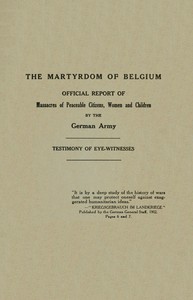
Authored by Authors: Belgium. Commission d'enq..., 'The Martyrdom of Belgium Officia...' stands as a notable and significant work within the Modern Nations category. Gerard Cooreman's preface frames the Belgian Commission of Inquiry's eleventh report, presenting witness depositions of German atrocities in 1914. The text shifts from legalistic justification to stark, chronological accounts of village massacres, church profanations, and mass executions, with a notable change in pace as individual testimonies accumulate. Explore the nuanced perspectives and historical context offered in this document.
View catalogue record
Routes through the collection
Four routes into the collection for readers approaching the catalogue with different questions.
Record framework
Explain how the site organizes and links records without modifying the original texts.
Connect catalogue records to the currently accessible files and references.
Make titles, authors, and editions clearly visible so you can find what you need.
Group books by common themes, historical context, and key questions.
Show how different records relate to each other while keeping source texts unchanged.
About these records
How the collection is organized, presented and corrected.
It generally means that the represented source text is no longer protected by copyright in the applicable jurisdiction or has been released for public use. Status may vary by country and edition.
A record may include the title, author, category, cover, description, edition information, source references and available reading or download options.
A category reflects a work’s principal subjects, literary setting, source type and relationship to nearby records in the collection.
The catalogue adds navigation, metadata and editorial context. The represented source text retains its wording, edition information and rights status.
Use the contact page and include the work title, page address and the exact attribution, category, metadata or source detail requiring attention.
Catalogue stewardship
Catalogue information
IMDEI Catalogue directs the overall structure of this digital library, which includes 98 books, 120 authors, and 4 categories. This role is responsible for maintaining the accuracy and organization of the catalog.