
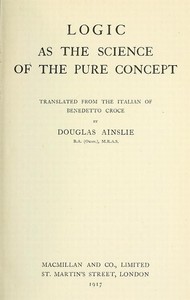
Logic as the Science of the Pure Concept by Benedetto Croce
Benedetto Croce's Logic as the Science of the Pure Concept isn't a story with characters and a plot. Instead, it's an intellectual journey. Think of it as Croce mapping the very architecture of human thought. He starts by clearing the deck, arguing that the formal, rule-based logic taught in schools is incomplete. For him, that's just mechanics. The real action happens earlier, in the spontaneous, intuitive spark of an idea—what he calls the 'Pure Concept.' The 'plot' of the book is his mission to show how these foundational concepts are born from our lived experience and artistic expression, and how they form the bedrock of all genuine knowledge, from history to philosophy.
Why You Should Read It
This book changed how I see my own thinking. Croce connects dots I didn't know were related. He argues that logic isn't cold and separate from poetry or history; it's the structure that emerges from them. When you read a powerful novel or analyze a historical event, you're engaging in the same fundamental process of forming and refining concepts. His writing, while dense, has a passionate energy. You can feel his frustration with dry academic philosophy and his desire to make logic matter to human life. It made me appreciate the creative core of even the most analytical thoughts.
Final Verdict
This is not a casual bedtime read. It's for the curious reader who enjoys big ideas and doesn't mind working for them. Perfect for philosophy enthusiasts, students of history or aesthetics, and anyone who's ever asked, 'But where do my ideas actually come from?' If you liked the connective thinking in books by Stephen Pinker or the philosophical scope of Isaiah Berlin, you'll find a fascinating (and more challenging) predecessor in Croce. Approach it slowly, argue with it, and let it stretch your mind.
This digital edition is based on a public domain text. Feel free to use it for personal or commercial purposes.
Elizabeth Thomas
11 months agoThe clarity of the concluding remarks is very professional.
John Miller
1 year agoSolid information without the usual fluff.
Paul Lopez
1 year agoGiven the current trends in this field, the historical context mentioned in the early chapters is quite enlightening. I appreciate the effort that went into this curation.
Jessica Martinez
7 months agoI decided to give this a try based on a colleague's recommendation, the cross-referencing of different chapters makes it a great study tool. Highly recommended for those seeking credible information.



Sarah Williams
7 months agoA brilliant read that I finished in one sitting.