
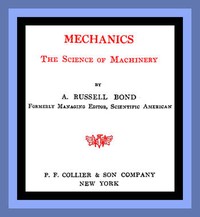
Mechanics: The Science of Machinery by A. Russell Bond
First published in the early 20th century, A. Russell Bond's Mechanics: The Science of Machinery is a foundational guide to the principles that power our world. It starts with the absolute basics—the ideas of force, motion, and work—and builds from there. Bond walks you through the fundamental components: levers, wheels, pulleys, gears, and cams. He then shows how these simple pieces combine into complex systems like engines, pumps, and transmissions. The book is packed with clear diagrams and real-world examples, from the humble wagon to the mighty steam locomotive, explaining not just what these machines do, but why they work the way they do.
Why You Should Read It
What makes this century-old book special is Bond's voice. He writes with the calm, confident enthusiasm of a master craftsman showing an apprentice the ropes. There's no assumed knowledge, just a logical, step-by-step progression. Reading it feels like gaining a superpower—you start seeing the skeleton of mechanics in everything. That bicycle? It's a collection of levers, bearings, and a chain drive. That door handle? It's a clever lever. The book demystifies the physical world in a deeply satisfying way. It’s not about memorizing formulas; it's about developing an intuition for how force, motion, and energy are shaped by human ingenuity.
Final Verdict
This book is a gem for the naturally curious. It's perfect for makers, tinkerers, and hobbyists who want to understand the 'why' behind their projects. It's also fantastic for readers of historical nonfiction or vintage science, offering a captivating snapshot of early 20th-century engineering thought. While some specifics are dated (the steam engine gets prime billing), the core principles are timeless. If you enjoy YouTube channels that take apart gadgets or have ever looked at an old factory machine with wonder, Bond’s Mechanics is your essential primer. It’s a quiet, profound book that turns everyday noise into elegant sense.
You are viewing a work that belongs to the global public domain. Share knowledge freely with the world.
Thomas Johnson
9 months agoThe clarity of the introduction set high expectations, and it manages to maintain a consistent flow even when discussing difficult topics. This should be on the reading list of every serious professional.
John White
1 year agoIf you're tired of surface-level information, the structural organization allows for quick referencing of key points. I'm glad I chose this over the other alternatives.
Patricia Perez
6 months agoI've gone through the entire material twice now, and the attention to detail regarding the core terminology is flawless. This should be on the reading list of every serious professional.
Jessica Lee
1 year agoIt’s rare to find such a well-structured narrative nowadays, the step-by-step breakdown of the methodology is extremely helpful for students. It’s hard to find this much value in a single source these days.









Sarah Johnson
1 month agoMy first impression was quite positive because the clarity of the writing makes even the most dense sections readable. I’ll definitely be revisiting some of these chapters again soon.