
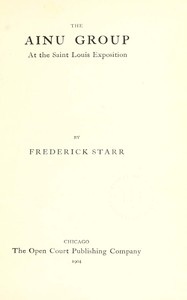
The Ainu group at the Saint Louis Exposition by Frederick Starr
Frederick Starr's book is his firsthand report on accompanying a group of nine Ainu individuals—men, women, and a child—from their homeland in Hokkaido, Japan, to the 1904 World's Fair in St. Louis. Their purpose? To form a 'living exhibit' in the Anthropology Department, where fair visitors could observe their daily life, crafts, and customs.
The Story
There isn't a traditional plot. Instead, Starr documents the journey. He writes about the practicalities of the trip, setting up their village replica at the fair, and the daily routines of the group. He describes them demonstrating wood carving, weaving, and even bear ceremonies for curious onlookers. Starr notes their personalities, their skills, and their bouts of homesickness. The narrative is a mix of travel log and anthropological observation, framed entirely by his perspective as the scientist in charge of the exhibit.
Why You Should Read It
This book is fascinating precisely because of what it is and what it isn't. Starr's writing is clear and matter-of-fact, which makes the situation feel even more startling. Reading it today, you become a kind of detective. You're not just learning about Ainu culture in 1904; you're reading between the lines of a historical document. You feel the tension between Starr's genuine interest in the people and his role in presenting them as a spectacle. The most powerful moments are often small: a mention of their loneliness, or their dignity in performing a song. It forces you to ask questions the book itself doesn't answer, making you an active participant in the story.
Final Verdict
This isn't a light read, but it's a quick and impactful one. It's perfect for anyone interested in the hidden stories behind world's fairs, in early anthropology, or in the complex ethics of cultural representation. It pairs well with modern critiques of museum practices. If you enjoy primary sources that don't spell everything out, and you're okay with a book that leaves you with more questions than answers, this is a compelling and sobering look into a past we're still learning to understand.
You are viewing a work that belongs to the global public domain. It is now common property for all to enjoy.
Elijah Thompson
1 year agoHonestly, the character development leaves a lasting impact. I will read more from this author.
Karen Lopez
10 months agoAmazing book.
Paul Perez
11 months agoFrom the very first page, the character development leaves a lasting impact. Definitely a 5-star read.
Logan Harris
9 months agoPerfect.


Elizabeth Martinez
8 months agoOne of the most comprehensive guides I've read this year.