
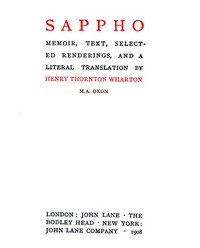
Sappho: Memoir, text, selected renderings, and a literal translation by Wharton
Let's be clear from the start: this isn't a story with a beginning, middle, and end. Henry Thornton Wharton's book is a rescue mission. Published in 1885, it's his attempt to pull the ancient Greek poet Sappho back from the brink of being forgotten completely. For centuries, her work was lost, destroyed, or simply crumbled to dust. Wharton acts as a detective, collecting every piece he can find.
The Story
Think of the book in three parts. First, Wharton gives us a biography pieced together from ancient comments and gossip, trying to find the woman behind the legend. Then, the core: the fragments. He presents them in a unique way. For each piece, you see the original Ancient Greek text, Wharton's own careful, word-for-word translation, and then a collection of 'renderings'—how poets like Swinburne or Rossetti reimagined the lines in their own style. Finally, he includes translations of the few complete poems we have, like the famous 'Ode to Aphrodite.' The 'plot' is the slow, painful reconstruction of a voice the world tried to silence.
Why You Should Read It
Reading Sappho this way is intimate and startling. You're not getting a polished, modern interpretation. You're seeing the cracks in history. One fragment is just the word 'loneliness.' Another is a breathtaking description of jealousy that feels as raw today as it did 2,600 years ago. Wharton's format lets you play literary detective yourself. You can compare his plain translation with the flowery Victorian versions and decide which one feels truer. It makes you part of the conversation about how we save and understand the past. You feel the immense loss of her work, but also the fierce power of what remains.
Final Verdict
This is a special book for a specific mood. Perfect for poetry lovers, history nerds, or anyone fascinated by 'what if,' it's more of an experience than a casual read. It's for a quiet afternoon when you want to be thoughtful. If you need a fast-paced narrative, look elsewhere. But if you've ever read a classic and wondered, 'How did this even get to me?', Wharton's labor of love shows you—and shows you just how much didn't make the journey. It's a beautiful, melancholy tribute to one of history's greatest voices, heard now only in whispers.
There are no legal restrictions on this material. You do not need permission to reproduce this work.
Susan Williams
3 months agoIf you're tired of surface-level information, the author clearly has a deep mastery of the subject matter. This has become my go-to guide for this specific topic.
Jennifer Harris
3 months agoThe layout is perfect for tablet and e-reader devices.
Nancy Davis
1 year agoI was skeptical about the depth of this book at first, but the level of detail in the second half of the book is truly impressive. A refreshing and intellectually stimulating read.
Michael Martinez
4 months agoI decided to give this a try based on a colleague's recommendation, the bibliography and references suggest a high level of research and authority. Definitely a five-star contribution to the field.



Kimberly Brown
11 months agoIt’s rare to find such a well-structured narrative nowadays, the case studies and practical examples provided add immense value. I appreciate the effort that went into this curation.