1

"That's me all over, Mable" — Edition Insights
(0 User reviews)
325
Project Gutenberg
2011
Not confirmed
World War, 1914-1918 -- Humor, caricatures, etc.
Readers of public-domain and historical texts
Project Gutenberg digital edition
en
Edition facts
Words
18,209
Reading time
80 min
Text sections
2
The source record for "That's me all over, Mable" — Edition Insights measures this digital text at 18,209 words, 1 hr 20 min estimated reading time, and 2 detected text sections.
The text analysis averages about 14.6 words per sentence, while the detected sections provide another way to judge how the source is divided.
Project Gutenberg metadata also associates the work with “World War, 1914-1918 -- Humor, caricatures, etc.,” connecting these edition facts with the source record’s subject description.
Source:
Project Gutenberg record #37561
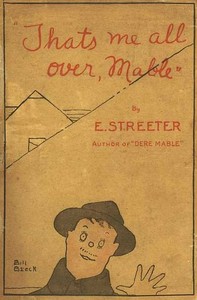
A collection of letters from a World War I soldier, written in a deliberately misspelled, colloquial voice, detailing his transfer to the artillery, training mishaps, and humorous observations of army life, with illustrations by G. William Breck.
Editorial Edition Score
4.5/5
★★★★★
★★★★★
Calculated from edition completeness, EPUB availability, text structure and catalogue metadata. Not a user rating.
How this score is calculated
- Description quality20 pts
- Title & short description10 pts
- Source metadata20 pts
- Text length15 pts
- Chapters / structure15 pts
- EPUB file integrity20 pts
Total of 100 points, scaled to a 2.5-5.0 range. Editions with an empty description or a missing EPUB file are not scored.
Edition quality
Public-domain source text
Read the source text
The source text is kept in the dedicated reader, separate from this catalogue record and its commentary.
The book opens with a letter from Bill to Mable, announcing his transfer from the infantry back into the artillery. The voice is immediately distinctive: deliberately misspelled, colloquial, and self-deprecating. Bill claims the artillery is more dangerous because you stand still, while in the infantry you run around. He also notes the captain was jealous of him, a recurring pattern of self-aggrandizement undercut by comic failure.
The structure is epistolary, each letter beginning with "Dere Mable" and ending with a postscript. The letters jump between training episodes, such as firing at a range for three months without hitting anything, and then accidentally firing at the infantry. The humor relies on Bill's misinterpretation of military terms—like "garage fire" for barrage—and his obliviousness to his own incompetence.
Epistolary Structure and Voice
The book is composed entirely of letters from Bill to Mable, each beginning with the salutation "Dere Mable" and ending with a postscript. This format creates a direct, intimate tone, as if the reader is eavesdropping on a private correspondence. Bill's voice is marked by phonetic spelling ("fello," "Captin," "applicashun"), grammatical errors, and a rambling, stream-of-consciousness style. He often contradicts himself within a single letter, claiming both bravery and caution. The letters are not dated, but they follow a loose chronological progression from training in the U.S. to deployment in France, though the excerpts only cover stateside training. The postscripts frequently undercut the main narrative, adding a punchline or a new, often embarrassing, detail.
Recurring Images of Misunderstanding
Bill consistently misinterprets military terminology and procedures. He thinks a "garage fire" is a literal fire, not a barrage. He becomes "battery agent" and tries to sell pop and crackers to soldiers during firing practice. He wonders why audience officers wear spurs, and Angus MacKenzie explains it's to keep their feet from sliding off the desk. These misunderstandings are not just jokes; they highlight the gap between official army language and a recruit's practical experience. The image of the pup tent—"like the roof of a dog house without the house"—recurs as a symbol of inadequate equipment. Bill notes that the only thing the tent does to rain is "strain it," a vivid, tactile detail that grounds the humor in physical discomfort.
Movement Between Scenes
The letters move rapidly between settings: the artillery range, the camp, the mess hall, and the pup tent area. Transitions are abrupt, often signaled by a new letter or a shift in topic. For example, one letter describes firing at the range; the next begins with returning from the range. This episodic structure mirrors the disjointed experience of training, where days blur together. Bill's attention flits from one absurdity to another—from the failure to hit the target to the story of Joe Loomis backing over a rubber plant. The illustrations by G. William Breck, listed in the front matter, punctuate these scenes, offering visual punchlines to the written humor. The movement is not linear but associative, driven by Bill's whims and the army's unpredictable schedule.
Self-Presentation and Comic Failure
Bill presents himself as a capable, intelligent soldier thwarted by incompetent superiors. He claims the captain was jealous, that he could have been an officer, and that Washington might send for him. Yet every action undercuts this self-image: he fails to hit the target, misinterprets orders, and eats the pop he was supposed to sell. His bravado is punctured by his own narration, as when he says he's not scared of anything "except the measles." The humor derives from the gap between Bill's self-assessment and reality. He is "high spirited," as he says, but also oblivious. This pattern of self-aggrandizement followed by comic failure is the book's central structural device, repeated in nearly every letter. The reader is invited to laugh at Bill, not with him, though his voice remains oddly endearing.
The letters offer a ground-level view of World War I training, filtered through a deliberately naive narrator. Readers should attend to the tension between Bill's self-image and his actual performance, as well as the recurring motifs of misunderstanding and physical discomfort. The illustrations by Breck, though not reproduced here, are integral to the humor, often depicting the scenes Bill describes. This is not a war story of heroism but a comedy of errors, rooted in the specific language and routines of the American Expeditionary Forces.
That rainy afternoon, the soldier’s letters had me chuckling at his misspelled complaints about the mud. After closing the book, I lingered on the quiet fear beneath his jokes—how the war waited at the margins. The thought drifted me toward Caught by the Turks — Background and Themes, another voice from that same sideways angle, just as personal, just as unvarnished.
There are no reviews for this eBook.
There are no comments for this eBook.
Reader reflection
How did this book work for you?
Your answers remain private and are stored only in this browser.
Your progress
0
/
10
2
Was reading this book enjoyable?
3
Would you pass this book on to a friend?
4
How easy was the book to follow?
5
Would this book work well in a reading group?
6
Did this book create an emotional response?
7
How distinctive were its ideas or approach?
8
Was the book what you thought it would be?
9
What changed or sharpened your thinking?
10