1

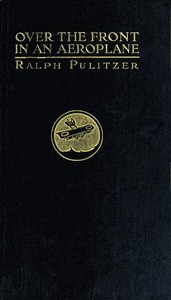
Over the Front in an Aeroplane, and Scenes Inside the French and Flemish Trenches — Inside the Classic
(0 User reviews)
456
Project Gutenberg
2013
Not confirmed
World War, 1914-1918 -- Personal narratives
Readers of public-domain and historical texts
Project Gutenberg digital edition
en
Edition facts
Words
33,829
Reading time
148 min
Text sections
5
The catalog record for Over the Front in an Aeroplane, and Scenes Inside the French and Flemish Trenches — Inside the Classic provides practical reading context through 33,829 words, 2 hr 28 min estimated reading time, and 5 detected text sections.
The text analysis averages about 23.3 words per sentence, while the detected sections provide another way to judge how the source is divided.
Project Gutenberg metadata also associates the work with “World War, 1914-1918 -- Personal narratives,” connecting these edition facts with the source record’s subject description.
Source:
Project Gutenberg record #43649
Ralph Pulitzer's 1915 memoir recounts his flights over the Western Front and visits to French and Belgian trenches, offering firsthand observations of aerial reconnaissance, trench architecture, and a grenade-throwing school, with a focus on the soldiers' ingenuity and the war's surreal contrasts.
Editorial Edition Score
4.7/5
★★★★★
★★★★★
Calculated from edition completeness, EPUB availability, text structure and catalogue metadata. Not a user rating.
How this score is calculated
- Description quality20 pts
- Title & short description10 pts
- Source metadata20 pts
- Text length15 pts
- Chapters / structure15 pts
- EPUB file integrity20 pts
Total of 100 points, scaled to a 2.5-5.0 range. Editions with an empty description or a missing EPUB file are not scored.
Edition quality
Public-domain source text
Read the source text
The source text is kept in the dedicated reader, separate from this catalogue record and its commentary.
Ralph Pulitzer, a civilian journalist, secured rare permission to fly in an army aeroplane to the front lines in August 1915. His account opens with a flight through cloud layers, describing the landscape below as an "unbroken white ocean" of lower clouds. This aerial perspective sets the tone for a narrative that moves between the detached view from above and the intimate, dangerous details of life in the trenches.
Pulitzer's writing is marked by precise observations of material culture: the wattled walls and thatched roofs of French soldiers' huts, the recessed bomb-proof shelters in a grenade-throwing school, and the "razor-edged knife-blades attached" to automobiles. He notes the tension between the war's brutal machinery and the soldiers' artistic impulses, as seen in the "extraordinary bays and alcoves" they built from clay and straw.
Aerial Views and Ground Realities
Pulitzer's flight to the firing line provides a vantage point that contrasts sharply with his later ground-level visits. From the air, he observes the battlefield as a distant, almost abstract pattern: clouds, fields, and the occasional flash of artillery. This detachment is shattered when he descends into the trenches, where the war becomes immediate and tactile. The author notes the "soft little clouds playfully dancing along" ahead of the aeroplane, a phrase that underscores the surreal beauty coexisting with destruction. On the ground, he walks through a "mushroom town" of soldier-built huts, each expressing its designer's architectural whimsy. The huts' "wattled walls covered with clay" and "thatched straw roofs" are described with an eye for detail, revealing how soldiers invested extra labor in aesthetic satisfaction despite the proximity of danger. This juxtaposition—the serene aerial view versus the gritty, creative reality below—forms a central tension in the narrative.
The Grenade-Throwing School: Precision and Peril
In a chapter titled "A Grenade-throwing School," Pulitzer recounts his visit to a training ground where soldiers learn to throw bombs. The school is set in a "large green field in a peaceful little valley," yet it lies within artillery range of the front. The instructor stands in a recessed trench, whirling his arms to throw bombs that explode within five seconds. A bomb-proof roof of logs and earth provides scant refuge; the instructor and pupil must sprint to safety after each throw. Pulitzer is told of a recent accident where a colonel was killed by a premature explosion. The description is clinical: the trench is "about twenty yards long and some four feet deep," with a recess for the instructor. The target is a shallow dummy trench and wire entanglements 150 yards away. This section highlights the methodical training behind a seemingly chaotic act, and the ever-present risk of mechanical failure.
Architectural Improvisation in the Trenches
Pulitzer devotes considerable attention to the soldiers' huts, which he calls a "mushroom town" of extraordinary variety. He notes that the huts are built from "wattled walls covered with clay, and thatched straw roofs," materials that allow for "effects which could not have been possible in stone, brick or wood." The soldiers, acting as amateur architects, create "bays and alcoves," "bas-relief and high-relief" in clay, and "strange gables, dormer windows, turrets and machicolations" in straw. Pulitzer emphasizes that this work was "extra and unnecessary," done solely for artistic satisfaction, not comfort or safety. This observation reveals a tension between the war's utilitarian demands and the human need for creative expression. The huts stand as a testament to individuality within the homogenizing machinery of war, a detail that distinguishes Pulitzer's account from more conventional war reporting.
Pulitzer's narrative is not a comprehensive history but a series of sharply focused vignettes. Readers should attend to the specific details he chooses to record—the shape of a hut, the timing of a bomb fuse, the view from a cockpit—as these reveal his method: a journalist's eye for the telling particular. The book offers no grand theory of war, but a ground-level (and sky-level) documentation of how soldiers lived, trained, and built amidst the conflict.
Reading Ralph Pulitzer’s account of hovering over the trenches, I kept thinking about how strange it is that war becomes a daily routine. His calm descriptions of aerial views felt oddly close to the quiet menace in The German pirate — Reading Companion, where the sea holds the same patient threat. Both books left me with a sort of hush, as if the danger itself were merely weather.
There are no reviews for this eBook.
There are no comments for this eBook.
Reader reflection
Record your reading impressions
A brief reflection can help important ideas stay with you longer.
Your progress
0
/
10
2
What was your overall reaction to the book?
3
Is this a title you would suggest to others?
4
Did the language feel accessible?
5
Did this book create an emotional response?
6
Did the book deliver what you hoped for?
7
Would you like to discuss this book with someone?
8
Would a second reading be valuable?
9
What is the main idea you are taking away?
10