1

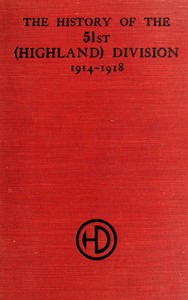
The History of the 51st (Highland) Division 1914-1918 — A Closer Reading
(0 User reviews)
841
Project Gutenberg
2014
Not confirmed
World War, 1914-1918 -- Regimental histories -- Great Britain; Great Britain. Army. Division, 51st (Highland)
Readers of public-domain and historical texts
Project Gutenberg digital edition
en
Edition facts
Words
153,805
Reading time
669 min
Text sections
19
This digital edition of The History of the 51st (Highland) Division 1914-1918 — A Closer Reading is described by source-level measurements including 153,805 words, 11 hr 9 min estimated reading time, and 19 detected text sections.
The text analysis averages about 23.4 words per sentence, while the detected sections provide another way to judge how the source is divided.
Project Gutenberg metadata also associates the work with “World War, 1914-1918 -- Regimental histories -- Great Britain,” connecting these edition facts with the source record’s subject description.
Source:
Project Gutenberg record #45934
A detailed regimental history of the 51st (Highland) Division in World War I, written by a former staff officer. The narrative focuses on tactical maneuvers, unit actions, and individual acts of gallantry, drawing on official records and personal accounts. The author's preface notes the challenges of compiling the work while on active service in the Middle East.
Editorial Edition Score
4.9/5
★★★★★
★★★★★
Calculated from edition completeness, EPUB availability, text structure and catalogue metadata. Not a user rating.
How this score is calculated
- Description quality20 pts
- Title & short description10 pts
- Source metadata20 pts
- Text length15 pts
- Chapters / structure15 pts
- EPUB file integrity20 pts
Total of 100 points, scaled to a 2.5-5.0 range. Editions with an empty description or a missing EPUB file are not scored.
Edition quality
Public-domain source text
Read the source text
The source text is kept in the dedicated reader, separate from this catalogue record and its commentary.
Major F. W. Bewsher, a former brigade major and general staff officer of the 51st (Highland) Division, compiled this regimental history while serving in Sinai, Egypt, and Palestine. In his preface, he notes the difficulties of transporting a large mass of material across desert stations and writing under canvas in an eastern climate. The result is a narrative that moves from the division's early battles through to the final offensives of 1918, with a focus on unit-level actions, tactical details, and the interplay between infantry, machine-guns, and supporting arms.
Compiled Under Canvas and in the Desert
Bewsher’s preface is unusually candid about the conditions in which the history was written. He describes working in “highly unsuitable” locations: the desert of Sinai, native villages, Jerusalem, Bir Salem, and at sea. The material available was uneven; up to the battle of Arras, no completed narratives of divisional operations existed. This admission shapes the reader’s expectation of the text: some phases are reconstructed from fragmentary sources, while later actions are drawn from more systematic records. The author’s own role as a staff officer gives the account an insider’s perspective on command decisions, but also means the narrative sometimes assumes familiarity with brigade and battalion structures.
The Mechanics of an Advance: Blockhouses, Dribbling, and the Steenbeek
A detailed passage from the later stages of the war illustrates the division’s tactical methods. The 6th Black Watch and 5th Gordon Highlanders overcome “numerous blockhouses and fortified farms” using a technique the text calls “dribbling”—men working individually from shell-hole to shell-hole to reach the flanks of strongpoints. The account of the crossing of the Steenbeek river shows the coordination of infantry, cavalry, and tanks: a squadron of the King Edward Horse attempts to advance but is stopped by machine-gun fire, while two tanks patrol the Green line for two hours. The narrative records precise prisoner counts, machine-gun captures, and casualties, giving a sense of the cost of each gain.
Individual Acts and the Texture of Battle
Amid the unit-level reporting, specific soldiers emerge. Sergeant Edwards of the 6th Seaforth Highlanders is described performing “several acts of conspicuous gallantry” that earned him the Victoria Cross: he dressed an officer’s wounds under fire, led a platoon against a machine-gun, and later stalked and killed a sniper despite a wounded arm. The text notes that he refused to leave his platoon after being wounded again the following day. Such details are woven into the operational narrative without separate biographical sections, reflecting the history’s focus on collective effort. The reader sees how individual courage was recorded as part of the division’s official story, often in the same paragraphs as the tally of prisoners and ground gained.
Bewsher’s history is best read as a staff officer’s account, attentive to the mechanics of attack and defense rather than to strategic overviews or personal memoirs. Readers interested in the human dimension will find it in the margins—in the names of the wounded, the counts of prisoners, and the occasional act of gallantry. The preface’s frankness about the difficulties of composition also serves as a reminder that this is a document shaped by its own circumstances of production, as much as by the events it records.
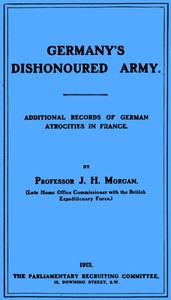
I kept thinking about the 51st’s story long after closing it—how quietly men endured, how records hold only what witnesses chose to write. That same hush sits inside Germany's Dishonoured Army: Additional records of German atrocities in France — Story, Setting & Ideas, another kind of testimony, patient and somber. Some books feel less like reading, more like carrying a weight you don’t mind holding.
There are no reviews for this eBook.
There are no comments for this eBook.
Reader reflection
Take a moment to reflect on this book
Create a short personal record of your experience with this book.
Your progress
0
/
10
2
How much did you enjoy the reading experience?
3
Would you recommend this book to another reader?
4
How easy was the book to follow?
5
Could you see yourself revisiting this book?
6
Could you follow the author’s main argument?
7
How useful did the reading feel?
8
How original did the book feel?
9
What did this book teach you most?
10