1

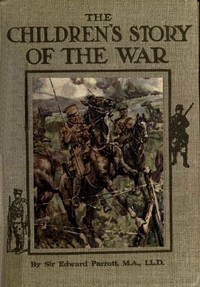
The Childrens' Story of the War, Volume 2 (of 10) From the Battle of Mons to the Fall of Antwerp. — A Closer Reading
(0 User reviews)
973
Project Gutenberg
2011
Not confirmed
World War, 1914-1918 -- Juvenile literature
Readers of public-domain and historical texts
Project Gutenberg digital edition
en
Edition facts
Words
97,660
Reading time
425 min
Text sections
15
The Childrens' Story of the War, Volume 2 (of 10) From the Battle of Mons to the Fall of Antwerp. — A Closer Reading can be approached with a clearer sense of reading commitment from its source measurements: 97,660 words, 7 hr 5 min estimated reading time, and 15 detected text sections.
The text analysis averages about 19.9 words per sentence, while the detected sections provide another way to judge how the source is divided.
Project Gutenberg metadata also associates the work with “World War, 1914-1918 -- Juvenile literature,” connecting these edition facts with the source record’s subject description.
Source:
Project Gutenberg record #35314
This volume covers early WWI events from Mons to Antwerp, using firsthand soldier accounts and naval stories to explain military actions to young readers, with a focus on courage and sacrifice.
Editorial Edition Score
4.9/5
★★★★★
★★★★★
Calculated from edition completeness, EPUB availability, text structure and catalogue metadata. Not a user rating.
How this score is calculated
- Description quality20 pts
- Title & short description10 pts
- Source metadata20 pts
- Text length15 pts
- Chapters / structure15 pts
- EPUB file integrity20 pts
Total of 100 points, scaled to a 2.5-5.0 range. Editions with an empty description or a missing EPUB file are not scored.
Edition quality
Public-domain source text
Read the source text
The source text is kept in the dedicated reader, separate from this catalogue record and its commentary.
Sir Edward Parrott opens this second volume by immediately placing young readers in the midst of the first real battle of the war, but not before pausing to explain the French army's readiness. The narrative voice is direct and instructional, frequently addressing the reader as 'you' and referencing earlier chapters as if continuing a conversation. Parrott's method is to weave tactical explanation with human detail, as when he describes a fourteen-year-old cadet drifting in the North Sea, calmly discussing everyday mess life while facing death. This blend of strategic overview and intimate vignette defines the volume's approach to war education.
A Conversational History for Young Readers
Parrott adopts the tone of a schoolmaster or uncle, using phrases like 'I told you' and 'you may imagine' to create a shared learning experience. He breaks complex operations into digestible steps, often prefacing battles with background chapters on the armies involved. The language is deliberately vivid but controlled: a submarine attack is described as 'a splendid chance' for the Germans, and the sinking of three cruisers is followed by a moral reflection on the instinct to rescue comrades. The author does not shy from casualty numbers—1,460 men lost—but frames them as irreplaceable losses rather than statistics. This pedagogical voice, at once authoritative and warm, shapes every chapter.
Firsthand Accounts as Evidence
Throughout the volume, Parrott inserts soldiers' and sailors' own words, often quoting from official reports or survivor narratives. The sinking of the Aboukir, Hogue, and Cressy is recounted partly through a sailor's recollection of a young cadet's calmness. The author also cites a commander's praise: 'The conduct of the crew was excellent throughout.' These embedded voices serve as proof of character under fire. Parrott does not merely assert bravery; he lets participants speak, then adds his own hopeful commentary—'So do we all'—aligning reader sentiment with the values of self-sacrifice and duty. The effect is to turn historical events into moral lessons grounded in eyewitness testimony.
The Machinery of War and Its Human Cost
Parrott explains technical details—why a submarine finds it easier to hit a stationary ship, how torpedoes work, the role of destroyer escorts—but always returns to the human dimension. The loss of the three cruisers is attributed to a 'natural desire to save fellows in distress,' and the Admiralty's criticism is softened by forgiveness: 'I think we shall all be ready to forgive those who made it.' This tension between tactical correctness and human instinct runs through the volume. Similarly, the French army's readiness is described in terms of preparation and spirit, not just logistics. Parrott's war is one where machinery and morale intertwine, and where every tactical lesson carries an emotional weight.
Readers will find that Parrott's method rewards attention to his framing devices: the chapter titles, the cross-references to Volume I, and the recurring pattern of battle narrative followed by 'stories of' chapters. These structural choices reveal a deliberate pedagogy aimed at making the vast conflict comprehensible. The volume stands as a period piece of wartime education, where the line between instruction and inspiration is deliberately blurred.
That rainy afternoon, the boys at Mons felt impossibly distant, their courage a story I could almost touch. Later, idly, I found myself wondering how the same war reshaped places I knew nothing about. That wondering led me to South America and the War — Context and Discussion, and the world quietly widened, the same rain falling on different maps.
There are no reviews for this eBook.
There are no comments for this eBook.
Reader reflection
Your personal reading reflection
Build a private reading journal entry for this title.
Your progress
0
/
10
2
Did this book hold your interest?
3
Would you pass this book on to a friend?
4
How demanding did the text feel?
5
Was the book moving at the right speed?
6
Did this book create an emotional response?
7
How original did the book feel?
8
Which element worked best for you?
9
What changed or sharpened your thinking?
10