1

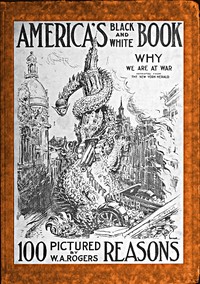
America's Black and White Book: One Hundred Pictured Reasons Why We Are At War — A Closer Reading
(0 User reviews)
600
Project Gutenberg
2014
Not confirmed
World War, 1914-1918 -- Humor, caricatures, etc.
Readers of public-domain and historical texts
Project Gutenberg digital edition
en
Edition facts
Words
9,054
Reading time
40 min
Text sections
3
America's Black and White Book: One Hundred Pictured Reasons Why We Are At War — A Closer Reading can be approached with a clearer sense of reading commitment from its source measurements: 9,054 words, 40 min estimated reading time, and 3 detected text sections.
The text analysis averages about 13.2 words per sentence, while the detected sections provide another way to judge how the source is divided.
Project Gutenberg metadata also associates the work with “World War, 1914-1918 -- Humor, caricatures, etc.,” connecting these edition facts with the source record’s subject description.
Source:
Project Gutenberg record #47484
W. A. Rogers's 1917 cartoon collection presents 100 drawings originally published in the New York Herald, targeting German militarism, U-boat warfare, and diplomatic hypocrisy during World War I, with captions that blend satire and editorial commentary.
Editorial Edition Score
4.5/5
★★★★★
★★★★★
Calculated from edition completeness, EPUB availability, text structure and catalogue metadata. Not a user rating.
How this score is calculated
- Description quality20 pts
- Title & short description10 pts
- Source metadata20 pts
- Text length15 pts
- Chapters / structure15 pts
- EPUB file integrity20 pts
Total of 100 points, scaled to a 2.5-5.0 range. Editions with an empty description or a missing EPUB file are not scored.
Edition quality
Public-domain source text
Read the source text
The source text is kept in the dedicated reader, separate from this catalogue record and its commentary.
W. A. Rogers's America's Black and White Book collects one hundred editorial cartoons originally published in the New York Herald in 1917, each accompanied by a descriptive caption. The catalog subject lists the work under "World War, 1914-1918 -- Humor, caricatures, etc.," but the excerpts reveal a tone closer to polemic than humor. Many cartoons depict German leaders—the Kaiser, Von Tirpitz, Von Bethmann-Hollweg—as deceitful or brutal, with captions that directly accuse Germany of piracy, hypocrisy, and war crimes. The subtitle, "One Hundred Pictured Reasons Why We Are At War," frames the collection as a justification for U.S. entry into the conflict, not merely a satirical overview.
Cartoon as Editorial Argument
Rogers's captions do more than label images; they advance a prosecutorial case. For instance, cartoon 57 quotes German Foreign Secretary Von Jagow stating "Pirates and Privateers no longer exist," while the image shows a U-boat sinking a ship—an implicit charge of broken promises. Similarly, cartoon 56, "On the sinking of a hospital ship," pairs a visual of a sinking vessel with a caption that condemns the act as a war crime. The captions often cite specific German statements or newspaper articles, such as the Cologne Gazette calling Lusitania victims "flippant Americans" (cartoon 17). This technique transforms each cartoon into a documented indictment, blending visual satire with journalistic citation.
Recurring Motifs: U-boats, Hypocrisy, and German-American Relations
Several motifs recur across the excerpts. U-boats appear repeatedly, from "The first great German 'U' Boat Victory" (cartoon 2) to "Under their true flag" (cartoon 88), which describes Germany raising "the black flag of piracy." Another persistent theme is German diplomatic hypocrisy: cartoons 25, 33, and 82 show peace proposals as insincere, with captions noting that Germany prepared for "more ruthless" undersea warfare while talking peace. Rogers also addresses German-American loyalty in cartoon 63, "Those disappointing German-Americans," which states that Junkerdom could not understand why German-born U.S. citizens did not support Germany. This motif reflects contemporary anxieties about divided loyalties.
Structure and Sequence: From Outrage to Resolution
The list of 100 cartoons suggests a chronological or thematic progression. Early cartoons (1–10) focus on the outbreak of war and Belgium's invasion, while later ones (80–100) move toward U.S. involvement. The final excerpt, "Wrathful waiting" (cartoon 100), describes the President and people in "a state of indignation that could not much longer be controlled," ending with the phrase "watchful waiting" becoming "wrathful waiting." This arc implies that the collection builds toward the inevitability of American entry into the war. However, the excerpts are incomplete, so the full sequence and any concluding cartoon remain unknown.
Readers should approach this work as a primary source of American propaganda and editorial art from 1917. The cartoons are best understood alongside the historical events they reference—the Lusitania sinking, the Sussex pledge, and the Zimmermann Telegram—which Rogers assumes his audience knows. The captions often contain direct quotations from German officials, making the collection a useful document for studying how wartime media framed the enemy.
Those hundred cartoons in America’s Black and White Book carry a heavy, tired anger—the kind that doesn’t shout, just points. I found myself turning the pages slowly, missing the human faces behind the propaganda. Later, I sat with Soldiers’ Stories of the War — Reading Companion, and it felt like hearing the same war whisper instead of roar. Two quiet ways of remembering what the headlines once flattened.
There are no reviews for this eBook.
There are no comments for this eBook.
Reader reflection
Take a moment to reflect on this book
Create a short personal record of your experience with this book.
Your progress
0
/
10
2
What was your overall reaction to the book?
3
How likely are you to recommend this book?
4
Did the language feel accessible?
5
How did the reading compare with what you expected?
6
What did you appreciate most?
7
Would you read this book again?
8
What did you think about the pace?
9
Which lesson or insight stayed with you?
10