1

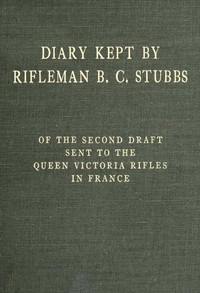
Diary Kept by Rifleman B. C. Stubbs of the Second Draft Sent to the Queen Victoria Rifles in France — Key Ideas to Explore
(0 User reviews)
406
Project Gutenberg
2018
Not confirmed
World War, 1914-1918 -- Personal narratives, British
Readers of public-domain and historical texts
Project Gutenberg digital edition
en
Edition facts
Words
8,832
Reading time
39 min
Text sections
4
The catalog record for Diary Kept by Rifleman B. C. Stubbs of the Second Draft Sent to the Queen Victoria Rifles in France — Key Ideas to Explore provides practical reading context through 8,832 words, 39 min estimated reading time, and 4 detected text sections.
The text analysis averages about 15.2 words per sentence, while the detected sections provide another way to judge how the source is divided.
Project Gutenberg metadata also associates the work with “World War, 1914-1918 -- Personal narratives, British,” connecting these edition facts with the source record’s subject description.
Source:
Project Gutenberg record #57381
Rifleman Bernard C. Stubbs's diary records his service with the Queen Victoria Rifles in France from February to June 1915, including the fight for Hill 60 and the Second Battle of Ypres. The entries shift from calm routines to intense combat, noting unit strength drops, gas attacks, and his own 'shellitis.'
Editorial Edition Score
4.5/5
★★★★★
★★★★★
Calculated from edition completeness, EPUB availability, text structure and catalogue metadata. Not a user rating.
How this score is calculated
- Description quality20 pts
- Title & short description10 pts
- Source metadata20 pts
- Text length15 pts
- Chapters / structure15 pts
- EPUB file integrity20 pts
Total of 100 points, scaled to a 2.5-5.0 range. Editions with an empty description or a missing EPUB file are not scored.
Edition quality
Public-domain source text
Read the source text
The source text is kept in the dedicated reader, separate from this catalogue record and its commentary.
Rifleman Bernard C. Stubbs's diary opens not with a declaration of war but with a Kipling poem—'So at the threat ye shall summon—so at the need ye shall send / Men, not children or servants'—framing the account that follows as a test of character. The diary itself, privately printed in Chicago in 1915 after Stubbs's death, covers February to June 1915, a period that includes the fight for Hill 60 and the Second Battle of Ypres. Stubbs, a 24-year-old former head boy and athlete, writes in a terse, date-stamped style that records both mundane fatigue journeys and moments of extreme danger. The text is punctuated by abrupt shifts: a sing-song in the woods one evening, a panicked retreat the next morning.
The Rhythm of Rest and Ruin
The diary's structure is built on a stark alternation between quiet periods and violent action. Stubbs notes days spent 'rigging up a covering of twigs' and sleeping, followed by nights of 'terrific shell fire' and 'foul gas bombs.' This pattern is not merely descriptive; it becomes a measure of survival. On April 28, he writes of a 'quiet day' and 'glad of the quiet,' only to be ordered back to the trenches the next evening. The repetition of phrases like 'nothing much doing' and 'once more called out' creates a rhythm of false calm and sudden crisis. Stubbs's language is understated—'another rotten experience'—but the cumulative effect reveals a soldier learning to gauge danger by the intervals of peace.
Numbers as Witness
Stubbs frequently records unit strength, turning arithmetic into a stark record of loss. On April 26, he notes: 'Trench strength of Battalion is now 230 rifles which will show what we have been through (normal strength about 1000).' This single figure—a drop of over 75 percent—conveys the scale of casualties more directly than any description. Elsewhere, he counts the men picked for dangerous duties: 'Eight from our Company picked out to do nothing else but carry up ammunition.' These numbers are not abstract; they are the battalion reduced to a fragment, the company pared to a handful. Stubbs does not comment on the losses beyond the figures, leaving the reader to calculate the human cost.
The Language of Strain
Stubbs's vocabulary shifts as the diary progresses, revealing psychological wear. Early entries use matter-of-fact phrases: 'kept calm and cool.' By April 30, he coins a term: 'am rapidly developing that awful complaint of “shellitis.”' This invented word—a blend of shell and neuritis—captures the specific anxiety of sustained bombardment. He also records physical symptoms indirectly: 'how I should like some sleep' becomes a refrain. The diary's brevity itself may be a symptom; entries grow shorter as the fighting intensifies. Stubbs never describes his wounding on June 22—the diary ends before that—but the accumulating strain is visible in his language, from 'very exciting' to 'most awful fifteen minutes of my life.'
Stubbs's diary is not a retrospective memoir but a document written in the present tense of war, with no knowledge of what comes next. Readers should attend to what is omitted as much as what is said: the silences between entries, the gaps where exhaustion or censorship may have intervened. The diary's value lies in its raw, unpolished record of a soldier's daily experience—the fatigue, the relief, the sudden terror—without the shaping hand of hindsight. It is a voice from the trenches, not from the history books.
Reading Stubbs’s diary, I noticed how his quiet humor never quite left him, even amid the mud and shellfire. That grim, affectionate wit reminded me of another voice entirely—one less burdened, perhaps, but equally honest. There’s something tender in how both men turn to a joke when the world gets heavy. It felt like finding an old photograph. "That's me all over, Mable" — Edition Insights captures that same spirit, I think.
There are no reviews for this eBook.
There are no comments for this eBook.
Reader reflection
Your personal reading reflection
Build a private reading journal entry for this title.
Your progress
0
/
10
2
How much did you enjoy the reading experience?
3
Would you encourage someone else to read it?
4
How easy was the book to follow?
5
Which element worked best for you?
6
How distinctive were its ideas or approach?
7
Did you gain anything practical from the text?
8
How strong was your personal connection to the text?
9
In one sentence, what did you learn?
10