1

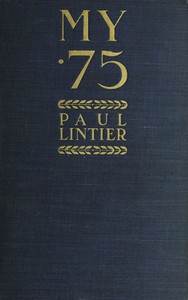
My .75: Reminiscences of a Gunner of a .75m/m Battery in 1914 — Context and Discussion
(0 User reviews)
56
Project Gutenberg
2017
Not confirmed
World War, 1914-1918 -- Personal narratives, French
Readers of public-domain and historical texts
Project Gutenberg digital edition
en
Edition facts
Words
65,856
Reading time
287 min
Text sections
7
The source record for My .75: Reminiscences of a Gunner of a .75m/m Battery in 1914 — Context and Discussion measures this digital text at 65,856 words, 4 hr 47 min estimated reading time, and 7 detected text sections.
The text analysis averages about 15.1 words per sentence, while the detected sections provide another way to judge how the source is divided.
Project Gutenberg metadata also associates the work with “World War, 1914-1918 -- Personal narratives, French,” connecting these edition facts with the source record’s subject description.
Source:
Project Gutenberg record #54816
Paul Lintier's memoir of serving a 75mm battery in 1914 offers a gunner's unflinching view of fear, duty, and adaptation under fire, with precise observations on the psychology of courage and the physical reality of modern artillery.
Editorial Edition Score
4.7/5
★★★★★
★★★★★
Calculated from edition completeness, EPUB availability, text structure and catalogue metadata. Not a user rating.
How this score is calculated
- Description quality20 pts
- Title & short description10 pts
- Source metadata20 pts
- Text length15 pts
- Chapters / structure15 pts
- EPUB file integrity20 pts
Total of 100 points, scaled to a 2.5-5.0 range. Editions with an empty description or a missing EPUB file are not scored.
Edition quality
Public-domain source text
Read the source text
The source text is kept in the dedicated reader, separate from this catalogue record and its commentary.
Paul Lintier's My .75: Reminiscences of a Gunner of a .75m/m Battery in 1914 opens not with a declaration of heroism but with a quiet, analytical account of how a soldier learns to master fear. The author, a French artilleryman who fell in 1916, writes from the immediate perspective of a participant, yet his prose is marked by a cool, almost clinical detachment. He dissects the process by which danger becomes routine: 'One becomes accustomed to danger just as one becomes accustomed to the most cruel privations.' This is not a panoramic history but a close-range study of a single battery's experience in the opening months of World War I.
The Mechanics of Courage
Lintier devotes considerable attention to the psychology of staying steady under fire, framing courage not as an innate trait but as a learned discipline. He argues that 'men are not born brave; they become brave,' and describes how the gunner's position—fixed in a battery with comrades watching—makes flight nearly impossible. 'A gunner under fire is literally unable to run away,' he writes, contrasting his situation with that of infantrymen, who can more easily slip away unnoticed. This structural constraint, he suggests, forces a kind of public accountability that becomes internalized as honor. The passage is notable for its refusal to romanticize: fear is a physical force that 'makes one perspire and tremble,' and overcoming it requires conscious effort. Lintier's analysis is grounded in specific details—the whistling of shells, the acrid smoke of melinite—that he learns to interpret, distinguishing real danger from mere accompaniment.
The Gunner's Gaze: Observation Under Fire
Throughout the excerpts, Lintier demonstrates a methodical eye for the physical effects of artillery. He recounts examining a field of Jerusalem artichokes after a shell burst, not for tactical reasons but to 'form an exact idea of the effects of a shell.' This impulse to understand the weapon's material impact—the crater, the shredded vegetation—reflects a broader pattern in the memoir: the gunner's relationship with his piece is intimate and empirical. The title itself, My .75, signals a personal bond with the 75mm field gun, a piece of machinery that is both tool and companion. Lintier's voice is that of a technician as much as a soldier, one who notes the 'flashes of melinite' and the 'noise of the explosions' as phenomena to be parsed rather than simply endured. This observational stance gives the narrative a documentary quality, even as it remains firmly rooted in subjective experience.
The Social Fabric of the Battery
The memoir also reveals the tight social dynamics within an artillery unit. Lintier refers to fellow gunners like Hutin by name, and his analysis of courage hinges on the visibility of one's actions to the group. The battery functions as a moral arena where 'dishonour would be palpable, irretrievable.' This emphasis on communal judgment shapes the narrative's tone: Lintier is acutely aware of how others perceive him, and he extrapolates from his own experience to explain the behavior of infantrymen, who face different pressures. The preface by Frances Wilson Huard, who translated and introduced the work to American readers, frames Lintier as a 'humble artilleryman lost in the masses,' yet the memoir itself insists on the individual's struggle within that mass. The battery is both a source of discipline and a crucible for self-mastery, a setting where the abstract concept of honor is tested in concrete, daily decisions.
Readers approaching My .75 should expect a narrative that prioritizes interior experience over grand strategy. Lintier's focus remains tightly on what a single gunner sees, feels, and reasons through during the first year of war. The memoir's value lies in its refusal to generalize beyond the author's own position: it is a document of one man's education in survival, written with the precision of a diarist and the clarity of a thinker who has stared directly at what he describes.
That gray afternoon, Lintier’s account of crouching beside the 75mm, his hands on the hot breech while the air screamed, stayed with me long after I set it down. Rain tapped the window. His raw fear felt like a quiet companion. Later, idly, I found myself in True Stories of the Great War, Volume 2 (of 6) Tales of Adventure--Heroic Deeds--Exploits Told by the Soldiers, Officers, Nurses, Diplomats, Eye Witnesses — Story, Setting & Ideas, seeking other voices, other moments of that same unguarded truth.
There are no reviews for this eBook.
There are no comments for this eBook.
Reader reflection
Your personal reading reflection
Build a private reading journal entry for this title.
Your progress
0
/
10
2
Was reading this book enjoyable?
3
Would you encourage someone else to read it?
4
How demanding did the text feel?
5
Could you see yourself revisiting this book?
6
Did anything about the book feel genuinely new?
7
Did it raise ideas you would like to talk about?
8
Which element worked best for you?
9
In one sentence, what did you learn?
10