1

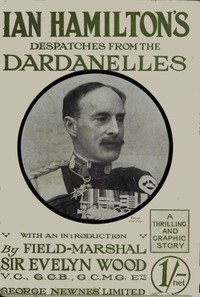
Sir Ian Hamilton's Despatches from the Dardanelles, etc. — A Reader’s Guide
(0 User reviews)
2505
Project Gutenberg
2017
Not confirmed
World War, 1914-1918 -- Campaigns -- Turkey -- Gallipoli Peninsula
Readers of public-domain and historical texts
Project Gutenberg digital edition
en
Edition facts
Words
31,639
Reading time
138 min
Text sections
4
Sir Ian Hamilton's Despatches from the Dardanelles, etc. — A Reader’s Guide can be approached with a clearer sense of reading commitment from its source measurements: 31,639 words, 2 hr 18 min estimated reading time, and 4 detected text sections.
The text analysis averages about 20.2 words per sentence, while the detected sections provide another way to judge how the source is divided.
Project Gutenberg metadata also associates the work with “World War, 1914-1918 -- Campaigns -- Turkey -- Gallipoli Peninsula,” connecting these edition facts with the source record’s subject description.
Source:
Project Gutenberg record #53959
Sir Ian Hamilton's official despatches from the Gallipoli campaign, with an introduction by Field-Marshal Sir Evelyn Wood. The text presents a commander's perspective on the Dardanelles operations, blending tactical reports with personal observations of the fighting.
Editorial Edition Score
4.6/5
★★★★★
★★★★★
Calculated from edition completeness, EPUB availability, text structure and catalogue metadata. Not a user rating.
How this score is calculated
- Description quality20 pts
- Title & short description10 pts
- Source metadata20 pts
- Text length15 pts
- Chapters / structure15 pts
- EPUB file integrity20 pts
Total of 100 points, scaled to a 2.5-5.0 range. Editions with an empty description or a missing EPUB file are not scored.
Edition quality
Read the Text
as obliged to entrench. From this time onward his small force was subjected to strong and repeated attacks, supported by field artillery, and owing to the configuration of the ground, which here drops inland from the edge of the cliff, the guns of the supporting ships could render him little assistance. Throughout the afternoon and all through the night the Turks made assault after assault upon the British line. They threw bombs into the trenches, and, favoured by darkness, actually led a pony with a machine gun on its back over the defences, and were proceeding to come into action in the middle of our position when they were bayoneted.
The British repeatedly counter-charged with the bayonet, and always drove off the enemy for the moment, but the Turks were in a vast superiority and fresh troops took the place of those who temporarily fell back. Colonel Koe (since died of wounds) had become a casualty early in the day, and the number of officers and men killed and wounded during the incessant fighting was very heavy. By 7 a.m. on the 26th only about half of the King's Own Scottish Borderers remained to man the entrenchment made for four times their number. These brave fellows were absolutely worn out with continuous fighting; it was doubtful if reinforcements could reach them in time, and orders were issued for them to be re-embarked. Thanks to H.M.S. _Goliath_, _Dublin_, _Amethyst_, and _Sapphire_, thanks also to the devotion of a small rearguard of the King's Own Scottish Borderers, which kept off the enemy from lining the cliff, the re-embarkation of the whole of the troops, together with the wounded, stores, and ammunition, was safely accomplished, and both battalions were brought round the southern end of the peninsula. Deplorable as the heavy losses had been, and unfortunate as was the tactical failure to make good so much ground at the outset, yet, taking the operation as it stood, there can be no doubt it has contributed greatly to the success of the main attack, seeing that the plucky stand made at Y beach had detained heavy columns of the enemy from arriving at the southern end of the peninsula during what it will be seen was a very touch-and-go struggle.
THE "IMPLACABLE'S" GUNS
The landing-place known as X beach consists of a strip of sand some 200 yards long by 8 yards wide at the foot of a low cliff. The troops to be landed here were the 1st Royal Fusiliers, who were to be towed ashore from H.M.S. _Implacable_ in two parties, half a battalion at a time, together with a beach working party found by the Anson Battalion, Royal Naval Division. About 6 a.m. H.M.S. _Implacable_, with a boldness much admired by the Army, stood quite close in to the beach, firing very rapidly with every gun she could bring to bear. Thus seconded, the Royal Fusiliers made good their landing with but little loss. The battalion then advanced to attack the Turkish trenches on the Hill 114, situated between V and W beaches, but were heavily counter-attacked and forced to give ground. Two more battalions of the 87th Brigade soon followed them, and by evening the troops had established themselves in an entrenched position extending from half a mile round the landing-place and as far south as Hill 114. Here they were in touch with the Lancashire Fusiliers, who had landed on W beach. Brigadier-General Marshall, commanding the 87th Brigade, had been wounded during the day's fighting, but continued in command of the brigade.
THE LANDING FROM THE "RIVER CLYDE"
The landing on V beach was planned to take place on the following lines:
As soon as the enemy's defences had been heavily bombarded by the Fleet, three companies of the Dublin Fusiliers were to be towed ashore. They were to be closely followed by the collier _River Clyde_ (Commander Unwin, R.N.), carrying between decks the balance of the Dublin Fusiliers, the Munster Fusiliers, half a battalion of the Hampshire Regiment, the West Riding Field Company, and other details.
Sir Ian Hamilton's despatches from the Dardanelles are official military reports, yet they carry a distinctive personal voice. Written during the Gallipoli campaign, these documents combine precise tactical language with moments of stark observation. The first despatch opens with a detailed account of the landings, noting that 'the firing line is everywhere close to the enemy's trenches' and describing the 'incessant' sapping and bomb attacks. Hamilton's prose is measured, even when recounting heavy losses: 'As many as 1,400 shells have fallen on Anzac within the hour.' The text is framed by an introduction from Field-Marshal Sir Evelyn Wood, who draws on his own Crimean War experiences, comparing the bravery he witnessed then to the actions at Gallipoli.
A Commander's Eye for Detail
Hamilton's despatches are notable for their specificity. He records the calibre of shells—'from 11 inches to field shrapnel'—and the exact distances between trenches. At Quinn's Post, he notes that the fire trenches are 'mere ledges on the brink of a sheer precipice falling 200 feet into the valley below.' This attention to terrain and weaponry gives the reports a concrete, almost technical quality. Yet Hamilton also includes human elements: the death of Major-General Bridges is described with restrained emotion—'his loss still stands out even amidst the hundreds of other brave officers who have gone.' The despatches thus oscillate between cold statistics and personal tribute, reflecting the dual role of a commander who must report both numbers and names.
The Weight of Numbers
Throughout the despatches, Hamilton quantifies the scale of combat. He reports that 'over 3,000 dead were lying in the open in view of our trenches' after a single Turkish assault, and that two Turkish regiments lost '600 killed and 2,000 wounded' in one engagement. These figures are presented without embellishment, but their accumulation creates a grim arithmetic. Hamilton also notes the enemy's strength: '30,000 troops, including five fresh regiments, were used against us,' with General Liman von Sanders in command. The despatches are careful to record friendly casualties too—'about 100 killed and 500 wounded' in one action—but the emphasis often falls on the enemy's losses, perhaps to demonstrate the effectiveness of the defence.
Tactical Rhythm and Repetition
The structure of Hamilton's reports follows a pattern: a date, a location, an action, and a result. This rhythm is evident in entries like 'On May 9 a night assault... was delivered on the enemy's trenches in front of Quinn's Post. The trenches were carried at the point of the bayonet... At dawn on May 10 a strong counter-attack forced our troops to evacuate.' The repetition of such sequences—assault, counter-attack, repulse—conveys the grinding nature of trench warfare. Hamilton also notes the timing of attacks: 'midnight of the 18th-19th,' 'slackening from 3 a.m. to 4 a.m.,' and 'by 11 a.m.' This temporal precision underscores the relentless cycle of combat, where hours determine survival.
Readers approaching these despatches should attend to the interplay between official form and personal inflection. Hamilton's reports are not neutral documents; they are shaped by his perspective as a commander under pressure. The introduction by Sir Evelyn Wood, with its Crimean anecdotes, sets a tone of martial valor that contrasts with the despatches' more sober accounting. To read them is to witness a campaign through the eyes of its leader, filtered through the conventions of military correspondence.
That grey afternoon, reading Sir Ian Hamilton’s despatches, I kept noticing how the fog of war blurs into the fog of memory—his careful phrases about the Dardanelles somehow felt like a man trying to describe weather he could barely see. Later, idly, I picked up The Battles in Flanders, from Ypres to Neuve Chapelle — Inside the Classic, and found that same distant voice, only colder, closer to the mud.
There are no reviews for this eBook.
There are no comments for this eBook.
Reader reflection
Your personal reading reflection
Build a private reading journal entry for this title.
Your progress
0
/
10
2
Did this book hold your interest?
3
Is this a title you would suggest to others?
4
What was the reading difficulty like?
5
How well did it match your expectations?
6
Did the story or argument move comfortably?
7
Did the book give you something worth debating?
8
What was its emotional impact?
9
Which lesson or insight stayed with you?
10