1

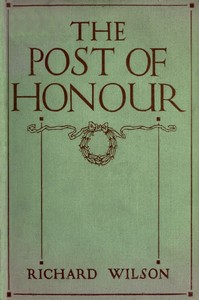
The post of honour — Inside the Classic
(0 User reviews)
637
Project Gutenberg
2015
Not confirmed
World War, 1914-1918 -- Anecdotes
Readers of public-domain and historical texts
Project Gutenberg digital edition
en
Edition facts
Words
37,362
Reading time
163 min
Text sections
41
This digital edition of The post of honour — Inside the Classic is described by source-level measurements including 37,362 words, 2 hr 43 min estimated reading time, and 41 detected text sections.
The text analysis averages about 21.5 words per sentence, while the detected sections provide another way to judge how the source is divided.
Project Gutenberg metadata also associates the work with “World War, 1914-1918 -- Anecdotes,” connecting these edition facts with the source record’s subject description.
Source:
Project Gutenberg record #48169
A 1917 collection of short narratives about British Empire soldiers in World War I, focusing on Victoria Cross actions. The excerpts show a patriotic tone, episodic structure, and specific details like Nurse Cavell's trial and Jack Cornwell's story.
Editorial Edition Score
4.8/5
★★★★★
★★★★★
Calculated from edition completeness, EPUB availability, text structure and catalogue metadata. Not a user rating.
How this score is calculated
- Description quality20 pts
- Title & short description10 pts
- Source metadata20 pts
- Text length15 pts
- Chapters / structure15 pts
- EPUB file integrity20 pts
Total of 100 points, scaled to a 2.5-5.0 range. Editions with an empty description or a missing EPUB file are not scored.
Edition quality
Public-domain source text
Read the source text
The source text is kept in the dedicated reader, separate from this catalogue record and its commentary.
The excerpts from Richard Wilson's 1917 collection reveal a work built around short, self-contained narratives of individual bravery, each typically focused on a single action or person. The table of contents lists over thirty episodes, from 'Captain Grenfell and the Charge of the Lancers' to 'Midshipman Gyles and the German Boarders,' suggesting a deliberate variety across services and theaters. The author's note states that sources include newspapers, official reports, private letters, and diaries, and that the book aims for 'the widest possible publicity, especially in the schools of the Empire.' This explicit educational purpose shapes the tone and selection of material.
Patriotic Framing and Moral Lessons
The excerpts consistently frame acts of courage within a patriotic and moral context. The author's note quotes Rupert Brooke ('If I should die, think only this of me') and a letter from a young officer who hopes his loved ones will 'get increased enjoyment from the Sussex Downs' after his death. These epigraphs set a tone of noble sacrifice. In the Nurse Cavell section, Wilson contrasts German 'military law' with 'the higher law of kindness,' explicitly praising her for breaking rules to save lives. He writes that she 'did not count the cost to herself' and that her record of helping men escape 'would still be a proud one' even if halved. This moral judgment is typical of the book's approach: deeds are presented not just as facts but as examples of character.
Narrative Structure and Source Use
The Cavell narrative illustrates Wilson's method. It begins with her arrest, then backtracks to explain her work, the German suspicion, and the betrayal by a spy who 'went to ask her to help him to leave the country.' The trial is described in detail: the language used was German, translated into French; she had a lawyer but only saw him on the day of trial; she confessed her 'fault.' Wilson speculates on her thoughts, writing that 'she probably thought of cases in English military history where women had been found guilty of military offences and had been imprisoned.' This blend of reported fact and inferred psychology is common in the excerpts. The author acknowledges that 'very meagre particulars of most of these brave deeds are at present available,' yet he presents them as straightforward stories, often without citing specific sources within the text.
Recurring Details and Thematic Threads
Several motifs recur across the excerpts. The phrase 'carried on' appears in the title 'Jack Cornwell, the Boy who "Carried On"' and echoes the stoic endurance praised throughout. The setting often involves escape or rescue: the Cavell story focuses on helping soldiers cross the frontier into Holland, with mentions of 'barbed-wire fence' and 'German guards.' The book also highlights youth—Cornwell is a boy, and midshipmen appear in multiple titles. The geographic range is broad: the contents include 'The Canadian Scottish,' 'The Lancashire Landing,' 'Anzac,' 'Submarines in the Dardanelles,' and 'The Canadians at Vimy Ridge.' This variety supports the book's claim to represent the whole British Empire. The tone is consistently reverent, with chapter titles like 'When can their Glory Fade?' and 'The Heart of a Lion' reinforcing the commemorative purpose.
Readers should note that the excerpts represent only a portion of the full text, and the complete book may contain additional episodes or framing. The catalog subject 'World War, 1914-1918 -- Anecdotes' accurately describes the content, but the patriotic and moralizing tone is more pronounced than that label suggests. The book is best approached as a contemporary document of wartime propaganda and commemoration, rather than a neutral historical record.
That rainy afternoon, I kept returning to the Victoria Cross stories, especially Jack Cornwell’s quiet bravery at Jutland. The book’s episodic glimpses left me wanting the wider sweep of mud and tactics. I found myself reaching for The Battles in Flanders, from Ypres to Neuve Chapelle — Inside the Classic, almost without deciding to. It felt less like a next step, more like turning the page.
There are no reviews for this eBook.
There are no comments for this eBook.
Reader reflection
Record your reading impressions
A brief reflection can help important ideas stay with you longer.
Your progress
0
/
10
2
Was reading this book enjoyable?
3
How likely are you to recommend this book?
4
How much effort did this book require?
5
How closely did the book connect with your experience?
6
Did the story or argument move comfortably?
7
Was the book easy to understand?
8
Did you gain anything practical from the text?
9
In one sentence, what did you learn?
10