1

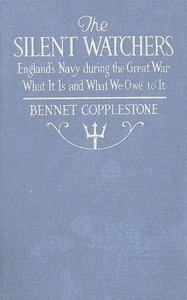
The Silent Watchers England's Navy during the Great War: What It Is, and What We Owe to It — Reading Notes
(0 User reviews)
728
Project Gutenberg
2015
Not confirmed
World War, 1914-1918 -- Naval operations; Great Britain. Royal Navy
Readers of public-domain and historical texts
Project Gutenberg digital edition
en
Edition facts
Words
98,589
Reading time
429 min
Text sections
10
For The Silent Watchers England's Navy during the Great War: What It Is, and What We Owe to It — Reading Notes, the stored edition analysis reports 98,589 words, 7 hr 9 min estimated reading time, and 10 detected text sections.
The text analysis averages about 24.1 words per sentence, while the detected sections provide another way to judge how the source is divided.
Project Gutenberg metadata also associates the work with “World War, 1914-1918 -- Naval operations,” connecting these edition facts with the source record’s subject description.
Source:
Project Gutenberg record #48497
Bennet Copplestone's 1918 account of the Royal Navy in WWI, blending firsthand reportage with strategic analysis. The prose shifts from technical exposition to vivid narrative, as in the Sydney-Emden encounter, where Euclid-like geometry sets up a dramatic convergence. The author's 'golden thread'—the human element behind machines—unifies the work.
Editorial Edition Score
4.9/5
★★★★★
★★★★★
Calculated from edition completeness, EPUB availability, text structure and catalogue metadata. Not a user rating.
How this score is calculated
- Description quality20 pts
- Title & short description10 pts
- Source metadata20 pts
- Text length15 pts
- Chapters / structure15 pts
- EPUB file integrity20 pts
Total of 100 points, scaled to a 2.5-5.0 range. Editions with an empty description or a missing EPUB file are not scored.
Edition quality
Public-domain source text
Read the source text
The source text is kept in the dedicated reader, separate from this catalogue record and its commentary.
Bennet Copplestone's The Silent Watchers opens with a striking metaphor: the Navy's ships and guns are 'secreted by the men just as a tortoise secretes its shell.' This image, drawn from the prologue, sets the tone for a work that consistently foregrounds human agency over machinery. The book, assembled from articles originally published in The Cornhill Magazine between 1916 and 1918, weaves together revised sketches and new chapters into a connected series. Copplestone explicitly names a 'golden thread' running through the whole—'The Secret of the Navy'—which he defines not as technology but as the character and competence of the service's personnel.
A Narrative Voice That Shifts Between Analyst and Storyteller
Copplestone's prose is not uniform. In expository passages, he writes with the detached clarity of a naval analyst, laying out strategic contexts and logistical details. But when recounting specific actions—such as the Sydney's pursuit of the Emden—his voice becomes almost novelistic. He describes the night of November 8, 1914, as a piece of 'scene-setting upon which the Fates were busy,' and traces the converging tracks of the British convoy and the German raider with the precision of a geometry problem: 'draw a line from Fremantle … to Colombo … the middle point … about fifty miles east of the Cocos-Keeling Islands.' This blend of technical diagram and dramatic irony gives the narrative a distinctive pulse, alternating between cool exposition and tense, almost cinematic pacing.
Recurring Structural Devices: The Parallel and the Surprise
Copplestone frequently draws historical parallels to frame modern events. In the Emden chapter, he compares the near-miss of the British convoy with Napoleon and Nelson's crossing in 1798, noting that 'whole fleets used then to do it in a way which now seems always unbelievable.' This device does more than add color; it underscores his theme that luck and human error remain decisive even in an age of wireless and steam. He also uses surprise as a structural tool: the convoy, 'wholly unconscious of the scene-setting,' sails on while the Emden unknowingly crosses its path. The reader is given a god's-eye view, creating suspense from historical fact. These recurring patterns—parallel, coincidence, and the limits of detection—give the book a cohesive rhetorical architecture.
The Human Element as the 'Golden Thread'
Throughout the excerpts, Copplestone returns to the idea that men, not machines, are the Navy's true strength. He praises the Sydney's crew as 'largely manned by men in course of training' but led by 'experienced officers “lent” by the Royal Navy.' The phrase 'lent' is carefully chosen, implying a transfer of expertise that transcends institutional boundaries. In the prologue, he states flatly that 'the Navy is a matter of machines only in so far as human beings can only achieve material ends by material means.' This conviction shapes his treatment of every engagement: he lingers on decisions, training, and morale rather than on tonnage or gun calibers. Even when describing the Emden's destruction, he notes that the Sydney was 'a clean ship not three weeks out of dock'—a detail that speaks to readiness and maintenance as products of human effort.
Readers approaching The Silent Watchers should note that it is not a continuous history but a collection of pieces written for a magazine audience during the war. Copplestone's tone is consistently patriotic but rarely jingoistic; he is more interested in competence than in glory. The book rewards those who attend to its shifts in register—from the cool geometry of fleet movements to the warm praise of individual officers. The 'golden thread' is worth following, as it ties together episodes that might otherwise seem disparate.
There’s a moment in Copplestone’s book where the Emden’s geometry turns fatal, and I keep thinking how the human thread runs through every machine, even the ones we lost. That same wistfulness followed me into The Big Fight (Gallipoli to the Somme) — Themes and Context, where the scale becomes personal again, quietly, the way old photographs do.
There are no reviews for this eBook.
There are no comments for this eBook.
Reader reflection
Your personal reading reflection
Build a private reading journal entry for this title.
Your progress
0
/
10
2
What was your overall reaction to the book?
3
Would you pass this book on to a friend?
4
How easy was the book to follow?
5
Would you like to discuss this book with someone?
6
Could you see yourself revisiting this book?
7
How distinctive were its ideas or approach?
8
Which part made the strongest impression?
9
What changed or sharpened your thinking?
10