1

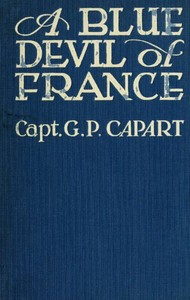
A Blue Devil of France: Epic figures and stories of the Great War, 1914-1918 — Inside the Classic
(0 User reviews)
305
Project Gutenberg
2015
Not confirmed
World War, 1914-1918 -- Personal narratives
Readers of public-domain and historical texts
Project Gutenberg digital edition
en
Edition facts
Words
40,729
Reading time
178 min
Text sections
7
The catalog record for A Blue Devil of France: Epic figures and stories of the Great War, 1914-1918 — Inside the Classic provides practical reading context through 40,729 words, 2 hr 58 min estimated reading time, and 7 detected text sections.
The text analysis averages about 16.6 words per sentence, while the detected sections provide another way to judge how the source is divided.
Project Gutenberg metadata also associates the work with “World War, 1914-1918 -- Personal narratives,” connecting these edition facts with the source record’s subject description.
Source:
Project Gutenberg record #48229
Captain Capart's diary-based memoir of the French poilu at Eparges in 1916, blending stark trench realism with moments of dark comedy and unexpected civility, as seen through specific episodes like a major offering lobster under shellfire and a corpse used for souvenirs.
Editorial Edition Score
4.7/5
★★★★★
★★★★★
Calculated from edition completeness, EPUB availability, text structure and catalogue metadata. Not a user rating.
How this score is calculated
- Description quality20 pts
- Title & short description10 pts
- Source metadata20 pts
- Text length15 pts
- Chapters / structure15 pts
- EPUB file integrity20 pts
Total of 100 points, scaled to a 2.5-5.0 range. Editions with an empty description or a missing EPUB file are not scored.
Edition quality
Public-domain source text
Read the source text
The source text is kept in the dedicated reader, separate from this catalogue record and its commentary.
Captain G. P. Capart's A Blue Devil of France is not a continuous narrative but an ensemble of diary entries from the Eparges sector in early 1916. The author, writing from a convalescent bed, insists he has recorded only what he saw or heard. The result is a fragmented, episodic record that juxtaposes the mundane and the macabre: a major nonchalantly brandishes a live lobster while shells fall; a corpse nicknamed Herman becomes a source of brass buttons and mushrooms. These vignettes, translated literally by J. C. Drouillard, preserve the original French phrases where English fails, aiming to retain the spirit of the poilu's experience.
The Diary as a Lens on Trench Life
Capart's preface frames the book as a truthful record, yet the diary form itself imposes a particular structure. Entries are dated by month and location—Eparges, Calonne Trench—but lack year headers after the first, creating a sense of suspended time. The prose shifts abruptly from a bombing duel to a luncheon invitation, as when Major X—— offers Turin, whisky, Pernod, and a live lobster. These juxtapositions are not smoothed over; the reader encounters the same tonal whiplash the soldiers lived. The translator's note adds another layer: Drouillard calls himself a literalist, yet admits to leaving French phrases untranslated where needed, signaling that some textures of the original resist transfer.
Recurring Motifs: The Corpse, the Grave, the Mud
Several entries return to the physical presence of death. In "Herman and His Canteen," a German officer's body lies fifty yards away for months, its brass buttons coveted for cigarette lighters, its boots rotting under a bed of mushrooms. The Eparges cemetery is shelled systematically, and poilus mutter, "Again they're murdering our dead." A lost soldier finds his bearings by touching a grave marker. These details are not sentimentalized; they are reported with the same flatness as the mud that can swallow a man up to his hips. The diary records what persists: a corpse that shifts in the rain, a cross that reads "Here lies an unknown soldier," and the practical uses the living make of the dead.
The Officer's Dugout as a Stage for Contrasts
Several entries center on meals and conversations in command dugouts, where the war's violence is held at a distance by ritualized hospitality. Colonel X——, an immense Corsican, dismisses a German torpedo burst by asking for talk of Verdi's music. The major who offers lobster also commands a telephone operator to "set two covers more" as if in a restaurant. These scenes are not ironic; they are presented as ordinary. The diary does not comment on the strangeness of discussing opera while the hill trembles. Instead, it lets the incongruity stand. The effect is to show how the army's hierarchy maintained a semblance of normalcy, even as the board paths outside were churned by shells and the dead lay unburied nearby.
Readers should approach A Blue Devil of France as a collection of fragments, not a unified story. The diary entries reward attention to recurring objects—the board path, the shell hole, the grave marker—and to the tonal shifts between horror and hospitality. Because the excerpts are incomplete, the full range of Capart's observations remains unknown, but the pattern of contrasts visible here offers a specific, unsentimental entry into the poilu's world.
There’s a moment in Capart’s account—lobster under shellfire, the strange civility of men—that stays with me long after closing the book. It makes me think of the other side of that coin, the quieter dread of the sea, which I found again in The German pirate — Reading Companion. Both leave a similar ache, somehow.
There are no reviews for this eBook.
There are no comments for this eBook.
Reader reflection
What did you think of this book?
Answer a few questions and save a private reflection on this device.
Your progress
0
/
10
2
Was reading this book enjoyable?
3
Would you pass this book on to a friend?
4
How much effort did this book require?
5
How personally connected did you feel to the book?
6
Did the book meet your expectations?
7
How useful did the reading feel?
8
What was the strongest part of the book?
9
What is the main idea you are taking away?
10