1

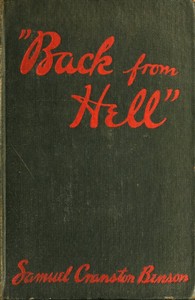
"Back from hell" — Story, Setting & Ideas
(0 User reviews)
1991
Project Gutenberg
2015
Not confirmed
World War, 1914-1918 -- Personal narratives, American
Readers of public-domain and historical texts
Project Gutenberg digital edition
en
Edition facts
Words
53,810
Reading time
234 min
Text sections
6
For "Back from hell" — Story, Setting & Ideas, the stored edition analysis reports 53,810 words, 3 hr 54 min estimated reading time, and 6 detected text sections.
The text analysis averages about 20.5 words per sentence, while the detected sections provide another way to judge how the source is divided.
Project Gutenberg metadata also associates the work with “World War, 1914-1918 -- Personal narratives, American,” connecting these edition facts with the source record’s subject description.
Source:
Project Gutenberg record #48997
Samuel Cranston Benson's 1918 memoir recounts his transformation from pacifist to ambulance driver and spy in WWI France and Belgium, with detailed observations on medical innovations, bureaucratic hurdles, and the psychological toll of war.
Editorial Edition Score
4.7/5
★★★★★
★★★★★
Calculated from edition completeness, EPUB availability, text structure and catalogue metadata. Not a user rating.
How this score is calculated
- Description quality20 pts
- Title & short description10 pts
- Source metadata20 pts
- Text length15 pts
- Chapters / structure15 pts
- EPUB file integrity20 pts
Total of 100 points, scaled to a 2.5-5.0 range. Editions with an empty description or a missing EPUB file are not scored.
Edition quality
Public-domain source text
Read the source text
The source text is kept in the dedicated reader, separate from this catalogue record and its commentary.
Samuel Cranston Benson opens his 1918 memoir by declaring himself a former pacifist, a stance that frames his entire narrative. The book’s subtitle—"Who went to the war, a pacifist, but returned a fighting American"—signals a conversion story, but Benson’s prose is less about ideological argument and more about accumulated, often grim, experience. He writes in a direct, reportorial style, favoring concrete detail over abstraction. The table of contents alone, with chapter titles like "Trench Nightmare" and "The Treacherous 'German Souvenir'," hints at a work that moves from personal history to frontline observation. Benson’s voice is that of a man who has seen things he wants to set down plainly, without literary flourish.
A Pacifist’s Vocabulary of War
Benson’s language reveals a man learning to describe the indescribable. Early chapters use the rhetoric of adventure—"red letter day," "spirit of expectancy"—but the tone shifts as he encounters wounded soldiers. He describes a British Tommy with his "entire lower jaw blown off," noting the surgeons who "built a jaw for him, taking a piece from here and another from there." The clinical precision of such passages contrasts with the earlier, almost jaunty tone. Benson’s diction becomes more technical when discussing medical apparatus: he explains Dr. Alexis Carrel’s frame with "pulleys with ropes and weights attached," a device that could "lift any portion of the body to any height or angle." This shift from amateur enthusiasm to matter-of-fact description mirrors his own transformation. He does not dwell on horror; he records procedure. The effect is that the reader, like Benson, becomes accustomed to the machinery of war.
Bureaucratic Obstacles as Narrative Engine
A substantial portion of Benson’s account concerns not combat but paperwork. In "Getting By the Consuls," he details the process of obtaining visas: first the American consul, then the French, then the English. He must have a "reason for doing everything," and he learns to supply plausible fictions. His stated destination is England "en route to Holland," a half-truth that gets him past officials. The chapter reads like a manual for navigating wartime bureaucracy, complete with tips: keep "pretty mum" about your real intentions, and find a helpful drunk soldier at Dieppe who vouches for you. This focus on administrative friction is unusual in war memoirs. Benson treats the consuls as obstacles to be outwitted, not authorities to be respected. His persistence—"I never gave up the idea of going to Belgium"—drives the narrative forward, making the quest for permission as suspenseful as any battlefield episode.
The Body in Pieces: Medical Observation
Benson’s most vivid writing emerges from his work with the wounded. He describes a soldier "all 'broken up'" placed in a bed with pulleys and weights, a system that holds limbs "in a form" for healing. The quotation marks around "broken up" suggest Benson is quoting the soldiers’ own language, a vernacular of injury. He notes that some positions are "necessary for rapid healing" and others "for comfort or for avoiding intense pain." This dual purpose—medical efficiency and humane care—runs through his observations. He also records the aftermath of reconstructive surgery: a man whose jaw was rebuilt so skillfully that "today you cannot discern that he was ever badly mutilated," except for a small scar and a lisp from a partly shot-away tongue. Benson’s attention to these details is not sentimental; it is precise. He is documenting what modern medicine could achieve in 1918, even as the war continued to produce new casualties.
The Psychology of a Former Pacifist
Benson’s subtitle promises a psychological transformation, but the memoir delivers it indirectly. He admits that seeing "German Kultur" whetted his appetite and changed his "peaceful views." Yet he does not dwell on his former beliefs. Instead, he shows change through action: he volunteers for dangerous missions, applies for leave to enter Belgium, and eventually is caught and threatened with crucifixion (as a later chapter title indicates). The narrative arc is one of increasing involvement. Benson’s motivation shifts from curiosity to a desire for evidence: "I wanted to get the evidence from the Huns themselves." This forensic impulse—gathering proof of German atrocities—replaces his earlier pacifism. The book’s final chapters, with titles like "The Heritage of Hate" and "Back From Hell," suggest that Benson’s transformation is complete, but the text itself remains focused on external events rather than internal struggle. The reader is left to infer the psychological cost from the accumulation of detail.
Benson’s memoir is best read as a document of its time, a firsthand account by a man who was neither a professional soldier nor a trained writer. His strengths are observation and persistence, not reflection. Readers interested in the logistics of ambulance work, the experience of a neutral American in wartime Europe, or the bureaucratic maze of early twentieth-century travel will find this book valuable. The title’s promise of a journey from pacifism to militancy is fulfilled less by argument than by the steady accumulation of grim facts.
This morning, I remembered my grandfather’s quiet glances at the garden gate after the war—how he never spoke of it. Benson’s memoir echoes that hush. Funny, the same stillness crept through another book, Submarine and Anti-submarine — Reading Companion, where waiting beneath waves felt like holding breath. Both left me staring at ordinary light a little longer.
There are no reviews for this eBook.
There are no comments for this eBook.
Reader reflection
Your personal reading reflection
Build a private reading journal entry for this title.
Your progress
0
/
10
2
Did this book hold your interest?
3
Is this a title you would suggest to others?
4
What was the reading difficulty like?
5
Do you expect to return to this book?
6
How original did the book feel?
7
How clearly were the main ideas presented?
8
Would this book work well in a reading group?
9
What changed or sharpened your thinking?
10