1

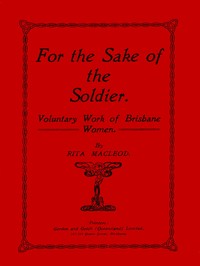
For the Sake of the Soldier: Voluntary Work of Brisbane Women — Context and Discussion
(0 User reviews)
60
Project Gutenberg
2016
Not confirmed
World War, 1914-1918 -- War work -- Australia; World War, 1914-1918 -- Medical care -- Australia
Readers of public-domain and historical texts
Project Gutenberg digital edition
en
Edition facts
Words
15,384
Reading time
67 min
Text sections
3
The source record for For the Sake of the Soldier: Voluntary Work of Brisbane Women — Context and Discussion measures this digital text at 15,384 words, 1 hr 7 min estimated reading time, and 3 detected text sections.
The text analysis averages about 21.3 words per sentence, while the detected sections provide another way to judge how the source is divided.
Project Gutenberg metadata also associates the work with “World War, 1914-1918 -- War work -- Australia,” connecting these edition facts with the source record’s subject description.
Source:
Project Gutenberg record #52827
Rita Macleod's 1917 compilation documents Brisbane women's voluntary work during WWI, including Red Cross efforts, spinning guilds, soldiers' comforts, and a recruiting ready-reckoner, with poems and advertisements interspersed.
Editorial Edition Score
4.5/5
★★★★★
★★★★★
Calculated from edition completeness, EPUB availability, text structure and catalogue metadata. Not a user rating.
How this score is calculated
- Description quality20 pts
- Title & short description10 pts
- Source metadata20 pts
- Text length15 pts
- Chapters / structure15 pts
- EPUB file integrity20 pts
Total of 100 points, scaled to a 2.5-5.0 range. Editions with an empty description or a missing EPUB file are not scored.
Edition quality
Public-domain source text
Read the source text
The source text is kept in the dedicated reader, separate from this catalogue record and its commentary.
Rita Macleod's For the Sake of the Soldier is a compilation of reports, poems, advertisements, and official notices that documents the voluntary work of Brisbane women during the First World War. Rather than a continuous narrative, the book moves between descriptions of specific organizations—such as the Red Cross Workshop at Kangaroo Point Hospital and the Anzac Club—and broader appeals for recruitment and home-front production. The text's structure mirrors the fragmented, urgent nature of wartime volunteering, where efforts shifted as needs changed.
Shifting Venues and Evolving Efforts
The book repeatedly notes how women's work adapted to changing circumstances. The Anzac Club, for instance, was opened to provide a lounge and attractions for soldiers, but was closed when few recruits remained in camp by the end of 1916. The women then redirected their energy into other patriotic channels. Similarly, a small theatre at Kangaroo Point Hospital was moved and converted into a workshop for convalescent soldiers, where they learned wood-carving, basket-making, and toy-making. The text emphasizes that these were not static operations but responsive to immediate conditions.
Recruiting Appeals Embedded in the Text
Interspersed with descriptions of women's work are direct recruiting materials, such as the full-page Recruiting Ready-Reckoner for Married Men. This table calculates fortnightly pay, patriotic fund allowances, and pensions for soldiers with wives and children, concluding that single men were not enlisting sufficiently. The inclusion of such official notices within a book about women's voluntary work suggests that the volume itself served a dual purpose: documenting contributions while encouraging further enlistment and home-front production.
The Role of Commerce and Advertising
Advertisements for local products, such as Wertheim pianos made in Australia, appear alongside the editorial content. A quote from Lloyd George declares that Australia can best help the Imperial Government by making goods locally that she now imports. This commercial messaging reinforces the book's broader theme of national duty, linking women's voluntary work to economic self-sufficiency. The advertisements are not merely decorative but part of the text's argument for practical patriotism.
Poems as Emotional Anchors
Three poems—Remember the Men in the Trenches, Verdun, and The Return—are reprinted from the Brisbane Daily Mail. These pieces provide an emotional counterpoint to the factual reports and tables. The preface, written by Colonel A. J. Thynne, frames women's work as a source of spiritual regeneration, while the poems evoke sacrifice and memory. The juxtaposition of administrative data with verse creates a layered portrait of the home-front experience.
Readers should approach this book as a period document that blends reportage, propaganda, and commerce. The shifting scenes—from hospital workshops to recruiting tables to spinning guilds—reveal how quickly wartime priorities changed. Pay attention to the interplay between official notices and personal appeals; the book's structure itself mirrors the improvisational nature of voluntary work. The poems and advertisements are not incidental but integral to understanding the text's purpose.
Leafing through Rita Macleod's careful record of Brisbane's knitting circles and Red Cross parcels, I felt that quiet ache of ordinary hands reaching across an ocean. It reminded me of History of the U.S.S. Leviathan, cruiser and transport forces, United States Atlantic fleet Compiled from the ship's log and data gathered by the history committee — Story, Setting & Ideas—another vessel of small daily duties carrying something far larger than itself.
There are no reviews for this eBook.
There are no comments for this eBook.
Reader reflection
How will you remember this book?
Save your reaction, strongest insight, and memorable passage.
Your progress
0
/
10
2
How much did you enjoy the reading experience?
3
How likely are you to recommend this book?
4
How easy was the book to follow?
5
What was its emotional impact?
6
How well did it match your expectations?
7
Would this book work well in a reading group?
8
How useful were the ideas in this book?
9
What did this book teach you most?
10