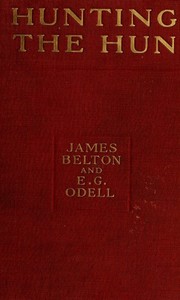
Hunting the Hun — Key Ideas to Explore
Edition facts
Before opening Hunting the Hun — Key Ideas to Explore, the edition data offers a quick orientation: 45,501 words, 3 hr 18 min estimated reading time, and 5 detected text sections.
The text analysis averages about 19.1 words per sentence, while the detected sections provide another way to judge how the source is divided.
Project Gutenberg metadata also associates the work with “World War, 1914-1918 -- Personal narratives, Canadian,” connecting these edition facts with the source record’s subject description.
Calculated from edition completeness, EPUB availability, text structure and catalogue metadata. Not a user rating.
How this score is calculated
- Description quality20 pts
- Title & short description10 pts
- Source metadata20 pts
- Text length15 pts
- Chapters / structure15 pts
- EPUB file integrity20 pts
Total of 100 points, scaled to a 2.5-5.0 range. Editions with an empty description or a missing EPUB file are not scored.
Read the Text
Germans had held it, resisting all Allied assaults. Its strategical importance was fully recognized by both the Allies and the Germans. Every artificial means had been taken to increase its natural strength, the best scientific devices of fortifications had been made use of by the Germans, and for two years it had defied all attacks.
The French vainly attacked it all through the month of December, 1914, and January, 1915. General Foch in May, 1915, delivered several attacks known as the Battle of Souchez. He gained a little ground on the lower slopes, but failed to weaken to any extent the Main Ridge. In September, 1915, while the British were making an attack around and near Loos, the French under General Foch once more attacked the Ridge. Again they failed. As long as the Germans retained Vimy Ridge, their line was secure in this quarter, so its retention allowed them to contemplate with a certain degree of equanimity withdrawals of troops from the line. On either side of the Ridge, it was flanked with Lens on the north, and Arras on the south--both cities under distant artillery fire.
The Canadian corps was working in conjunction with the Imperial troops, and the attack by the British troops, including the Canadians, extended from Givenchy-en-Gohelle to Henin-sur-Cojaul, an approximate distance of fifteen miles. The actual assault upon Vimy Ridge which was four to five miles long was entrusted to the Canadians. The forces engaged in this advance were to be commanded by Lieutenant-General Sir Edmund Allenbury and Lieutenant-General H.S. Horne. The Canadians in the First Army Corps were under the command of Major-General Byng. He is now in command of the Third British Army with the rank of Lieutenant-General.
On the morn of the 8th of April, reveille was sounded at 4:15 A.M. as everything had to be packed up. All the surplus kits were loaded on transport wagons. Every officer and man was busy looking after his personal effects and cleaning up the billets, for everything must be left in as good shape and order as when we moved in. The boys were in high spirits and glad of the opportunity to demonstrate again the quality of the New World troops. At about 9:00 A.M. the bugle sounded and the battalion fell in. Each platoon was carefully inspected. Our acting commanding officer, Major R----, spoke a few words to the whole battalion, telling us that we would uphold all traditions of the Canadian Army, and that he was sure our battalion would prove to be one of the best in France. He felt certain we would gain all our objectives. He then wished us the "best of luck" and, as it was his turn to remain out of the line, he handed the command over to the acting second in command of the battalion, Major M----.
It was a bright day and the roads had commenced to dry up. For a short distance, our battalion marched along making very slow progress, as the highway was being used by motor transports, most of them carrying ammunition for the "Big Push." Behind a few of these there were some big guns, ever coming forward. The road was alive with excitement--the very atmosphere reeked with it. Every one felt the crisis was at hand. As we moved slowly along the road in detachments of platoons in columns of fours, or two deep, our progress was in consequence extremely slow. Our guides had been sent out to find out the best cross-country road to reach our brigade assembling point. Each platoon had its own guide. We were led by them off the main road across country to the eastern slope of Mount St. Eloi which we reached at noon of the same day.
We halted and took off our equipment to await for dusk. Other platoons were continually arriving. The men had their dinner, and then made themselves as comfortable as possible, some went to sleep and others wrote letters, many for the last time.
By four in the afternoon battalions of our brigade and of other brigades had arrived and were thickly scattered along the slope of Mount St. Eloi. Some bands were playing. A short distance away from us at the foot of Mount St. Eloi a large Y.M.C.A. marquee was being well patronised by our boys. After the various brigade bands would stop playing, I could hear faintly the soft tones of the Y.M.C.A. organ mingled with the voices of the boys singing a hymn.
We had our supper at 6 P.M. and again inspected our platoons most carefully. The gas helmets had to be examined thoroughly to see that they were in perfect condition, that the goggles were not cracked or broken and that the gas fumes could not penetrate through any part of the mask. All the officers' watches were carefully synchronised from brigade time. The small box respirator was put on in the alert position. Every man had to show that he had his iron rations and extra rations to last for two days.
After inspection, it was fast approaching dusk. At 7:45 P.M. we formed up and moved off in detachments of platoons at distances of 100 yards.
We marched up the slope of Mount St. Eloi. A little over half way, we came to a bush road. This we followed until we reached the main road. This road led us through part of the badly shelled little town of Mount St. Eloi. As we reached the top of the summit, on the right of the road could be seen the ruins of the church and monastery of Mount St. Eloi. The monastery had been founded by St. Eloi in the year six hundred and forty and reconstructed in the eighteenth century. Previous to the present war, only the facing walls of the church were standing, but the Germans demolished these walls by shell fire as well as the surrounding buildings, formerly occupied by the clergy and civilians. Mount St. Eloi Church, a very prominent object on the landscape, we had used for an observation post.
It was now 8:30 P.M. and quite dark. We started to descend the slope. As I looked ahead of me, I could see the German white flares, also their green and red rockets going up, and could see the bursting of the shrapnel and its flash, and hear the thunder of both ours and the enemy's artillery.
It was an awe-inspiring spectacle. To the right of the road the ammunition column men on mules were hauling to the various artillery dumps large and small shells, fodder for hungry guns that were to give us victory the next day. As we passed these men they wished us the "best of luck," shouting some friendly remarks such as "We are working like h--- for you boys; see that you give Fritz h--- to-morrow!"
We left the main road and started across open fields until we reached at right angles the Arras-Bethune road, directly opposite was the entrance of the Aux Reitz communication trench. A few hundred yards to our left, along the Arras-Bethune road stood once the little village of La Targette, and on the opposite side, Neuville St. Vaast. Now nothing remained but masses of fallen masonry caused by the continuous bombardments both by the Allies when these towns were occupied by the Germans, and then by the Huns when they were driven back, and the Allies occupied them.
The Aux Reitz communication trench was what we called an ingoing communication trench. The leading platoon had started up the communication trench--my platoon came next. As I was crossing the road at the head of my platoon, now in single file, I formed a mental picture of what I saw before me. It was about 10 P.M. and pitch dark. Our shells were bursting in the German trenches and wire entanglements. On our right forward flank, the Germans were signalling by means of green rockets. They were an exceedingly pretty and spectacular display of fireworks, as these green rockets would go up and, after attaining a certain height, they would burst and a tail of green stars would appear.
The Germans very often use their golden spray rocket for the S.O.S. signal, but they are liable to change from time to time, as is also our habit.
Here and there I could see fires where the German ammunition dumps had been blown up by our shell fire. Then I would suddenly hear the quick hissing sound of German shells upon our right and left flanks along the Arras-Bethune road. The Huns were shelling our back area.
Our battalion scout officer, Lieutenant B----, who had preceded us, was directing each platoon from the top of the communication trench, past the various intersections of the C.T.[1] Lieut. B---- was very much exposed and in a more dangerous position than any of us who were in the trench, but he did not seem to mind it. I could hear above me the swish, swish, swish of the German shells and the rat-tat-tat of their machine guns. As the machine gun bullets struck the top of the trench above us, small clods of earth would fall in our midst.
As previously mentioned, the Aux Reitz communication trench had a regular maze of trenches branching off from it. At the intersection were signboards on which were painted the names of each trench and where they led to. Quite a number of the trenches were without these signboards. They had probably been knocked off the side of the trench in some manner. Nevertheless, our scout officer guided us correctly in the intense darkness.
Our C.T. was about seven feet deep in some places and five feet wide, but this varied. It was the usual zig-zag formation. Under our feet in some places were trench mats.[2]
We had proceeded up the communication trench for some 300 yards when word was passed along to me from the rear to double in front, as the entrance of the communication trench was being shelled by the Huns and that there were some casualties due to the congestion. As the whole brigade was coming up in single file and each man had to run across the exposed Arras-Bethune road to get into the communication trench, they were anxious to obtain the protection from shell fire that the trench would afford. I passed the word along to the platoon commander of No. 1 platoon, which had the desired effect. We started at a steady double march, bending under small culverts, through little rivulets of water, slipping and sliding over the muddy trench mats when we found them under our feet. Ofttimes we would suddenly find ourselves up to our hips in muddy water.
A considerable number of telephone wires crossed our C.T. Some sagged and were in line with our faces. In the darkness they were hard to see, and if one was unfortunate enough to get caught by the wire under his chin he would have good cause to remember it. Word was being continually passed along as obstacles were encountered, such as, "Wire overhead," "Wire underfoot," "Step down," "Step up," etc. This information was appreciated by those in the rear. After doubling for about 500 yards, word was passed along to me that the "line was broken." This meant that we had left behind us some of the boys who could not run as fast as those in front. This usually happens to the section of Lewis gunners who have their gun equipment to carry, which is much heavier than what the men have to carry in the other sections. We therefore had to halt for a few minutes until they caught up to us. At last we reached the end of our trench. To the right and left, we could see the boys on sentry duty, holding the front line trench. On the fire step men were sitting or lying down trying to get a few minutes' sleep. These were the men who had to hold the front line trenches at all costs. We were what is commonly known as the "storming troops."
By the time we had reached the front line trenches, approximately 300 yards from the German front line, their white flares were going up in profusion, and while these flares were up, it was almost as light as day. We passed down the lines the usual caution, "Be sure when the flare light breaks to keep your body perfectly rigid and your face down as you go over No Man's Land to the jumping-off trench."
Someone passed the word from the rear that the jar of rum which is allotted to each platoon and which is usually in charge of the platoon commander had been ditched (thrown away). I looked around for my batman to whom I had entrusted it, and I was informed he had gone ahead over No Man's Land with Lieutenant B---- in order to select my position in the jumping-off trench. When last seen he had the jar of rum with him. The rum is usually given out at "stand to" both in the morning and evening, one hour before dawn and one hour before dusk. After being in the wet and cold, it both braces and stimulates the men.
While we were crouching and doubling over the ground from shell hole to shell hole, one after the other German white flares would go up and burst. We were seen by the Huns, who, probably thinking it might be a raiding party, turned their machine guns upon us. Those who happened to be outside of a shell hole fell flat, and awaited for orders. All this time our shells were dropping upon the German wire entanglements and front line trenches, which were then about 250 yards away from where we were out in No Man's Land.
The German machine guns were searching out the whole of this territory. For fully one hour we were glued to the ground.
As the "Zero Hour" was 5.30 A.M. we had lots of time to reach the jumping-off trench, yet, I could overhear remarks in a low tone of voice about the rum. It was still worrying the men. They were quite used to the machine gun bullets, and their only thought was how they might be cheated by fate of a small tot of rum before going "over the top."
I was then in a shell hole that was very shallow. As I looked over the lip of it, I saw someone making his way in short rushes towards me. The man I saw was Lieutenant B----. He was trying to locate me amidst all the shell holes. I went over to meet him. He told me that everything was all right and that the battalion had only four casualties who were taken out of the line. He then gave me exact directions to my place in the jumping-off trench.
There was a lull in the firing at this time, so I passed the word behind to the boys to advance and follow me closely.
Just then, the Germans opened up with machine-gun fire, and word was passed up for the stretcher bearer. That meant a man wounded and at this time it was very awkward. I could not spare my stretcher bearer, as we were going to advance, and again I could not allow a wounded man to die for want of attention. Neither could I endanger the lives of the men in my platoon more than was necessary for that of one man. However, I pointed out to the stretcher bearer who had crawled from a shell hole near by, his location on the ground and gave him an idea where he would find our platoon in the jumping-off trench. I told him if the man could walk to give him first aid if necessary, but if he could not walk, to see that word would be passed back to the firing line in the rear and have them send out stretcher bearers.
We crawled for a distance, and as there were no German white flares going up during this interval, we doubled up in a half crouching position until we reached and tumbled into our jumping-off trench. As I looked at my luminous watch, I noticed it was exactly midnight. We were packed like sardines in this little trench not more than 2-1/2 feet wide by four feet. But that mattered not--we were nearing our goal.
I was reminded by the boys that they had not seen the rum carrier, my batman Lamb. I was also anxious to see him, so I passed the word along to my right and left flank that if anyone did see him, they were to tell him where I was located. A few minutes later, as a German white flare was sent up, I saw a figure crouching along the trench. It was Lamb, and under his arm he had the jar of rum. I heaved a sigh of relief, and Lamb at that particular moment was a very popular man. I could hear the boys passing the glad word down the line, "Good old Lamb has got the rum! Lamb's got the rum!"
I made room for Lamb to get beside me in the trench. The Huns then began shelling our front line trenches in the rear of us with "Minenwerfers," "rum-jars," and "fish-tails." The latter are short range trench shells that have a high trajectory and make considerable noise when they explode. I could feel the hot air as they went over my head.
Our guns were shelling the German trenches, so that we were between both fires without any overhead protection. The Germans, never dreaming for a moment that we were so close to them, kept on shelling to the rear of us. They imagined we were still in the front line trenches. We carefully posted sentries and warned them to listen for any noise, such as hammering on the faucets of gas drums, as the wind was favourable for the Germans to attempt a gas wave attack.
I began to think how many of us would come through this show, for I knew we had a tough proposition before us. I then remembered that my stretcher bearer had not returned, so I told my platoon sergeant to find out where he was. A little later, he appeared above the parados and got in beside us in the trench with his stretcher.
Too much praise cannot be given to the stretcher bearers. They are unarmed and many of them are killed. The moment a man is wounded, a stretcher bearer rushes to his assistance; no matter how heavy the bombardment may be, he is in the thick of the fight attending to the wounded and dying. All men in the ranks know the old familiar cry, "Stretcher bearer, stretcher bearer, on the double." Then we know it is blighty for someone; it may be a mere scratch, or it may mean death.
I had often gone over No Man's Land at night, and looked over it through my periscope in the daytime, but this was going to be my first time "over the top" in daylight. I did not feel afraid, yet I was naturally anxious as to what I should feel like, and also how my platoon would act under the ordeal. No man but one who has gone "over" can describe or try to make anyone realise the feeling. One wishes to get it over quickly; the time seems to drag until that moment, and then it seems to fly.
Suddenly, I was aroused from my reverie by a voice that sounded between us and our own firing line. I listened, and heard the same voice shout out these startling words, "Where in h--- is the end of this damned ditch?" The voice was clear and distinct and betrayed no sign of nervousness or fear. The Huns were strafing our front lines, we all knew he was not a soldier, therefore, he must be a civilian, and we wondered why he was out here. Then again he would have called a trench a trench, and not a ditch. I heard one of the boys say, "Well, he must have some nerve, whoever he is!" and then I heard another say, "I'm going to take a peep at the man." Another said, "He may be a German spy." I could see it was up to me to do something, so I told my platoon sergeant to take charge and gave instruction to the men to keep their heads down below the parapet.
From the opening pages, Hunting the Hun establishes a voice that is less memoir than field report. The foreword by Louis Tracy notes the “terseness of a despatch,” and the narrative bears this out: scenes shift from practice grounds marked with white tape to the Aux Reitz communication trench, then to the “jumping-off” trench where men wait for a missing jar of rum. The authors, Captain James Belton and Lieutenant E. G. Odell, favor concrete detail over sentiment. A raiding party is described not by its courage but by its equipment—rifles, bayonets, bombs, knobkerries, wire cutters—and by the precise reconnaissance that located a gap in the enemy wire.
White Tapes and Practice Grounds
The book’s most striking structural device is the repeated use of taped outlines to rehearse attacks. Before the assault on Vimy Ridge, the battalion practices on ground where “white tapes on the practice ground … showed the conformation of the German trenches.” This pattern recurs in the later raid narrative: “for three days we practiced for this raid by going over the tapes.” The tapes are a recurring image—a ghost geography laid over French soil, turning farmland into a diagram of enemy defenses. The authors treat these rehearsals as essential, not dramatic. They note the method of signalling to contact aeroplanes during an advance, a technical detail that underscores the coordination required. The effect is to make the reader see the battlefield as a set of problems to be solved, not a landscape to be endured.
The Censor’s Pencil and the Lonely Officer
Amid the preparations for raids and the capture of Vimy Ridge, the narrative pauses for episodes from trench life that reveal the social fabric of the battalion. One chapter recounts a young officer who placed an advertisement in the “Agony Column” to find a female correspondent. After days of mockery, three mail bags arrive, then a transport car “completely loaded down with his correspondence.” The anecdote is told without judgment, but it exposes the loneliness behind the bravado. The authors also describe censoring letters: a boy writing to his mother under an assumed name, the “xxxxxxx” denoting kisses, and the single “x” marked “For the Censor.” These details are not sentimentalized; they are presented as part of the routine, alongside the more dramatic work of raiding.
The Raid: From Reconnaissance to Knobkerries
The raid narrative is the most extended set piece in the excerpts. It begins with orders from brigade headquarters to destroy a German machine-gun emplacement. The authors walk through the preparation: aerial photographs, map locations, three days of practice on taped ground. The raiding party of ten men is equipped with rifles, bayonets, bombs, and knobkerries—a mix of modern and improvised weapons. The battalion scout officer had crawled to the enemy wire the night before and found the opening. The raid itself is set for 1 A.M. The prose is procedural: “I gave the sergeant the necessary instructions … the men were to ha” (the text cuts off). Even incomplete, the passage shows how the book treats combat as a series of logistical steps, not a frenzy. The raid is a job to be done, and the authors want the reader to understand how it was done.
Movement Between Trenches and Time
The book’s structure mirrors the movement of troops: from training grounds to communication trenches to front line to No Man’s Land. The foreword captures this rhythm: “you plod with it in Indian file along the Aux Reitz communication trench; you sprawl with the officers and men in the ‘jumping-off’ trench; you wonder whether the missing jar of rum will turn up in time, and, finally, you go ‘over the top.’” This is not a continuous narrative but a series of discrete scenes, each anchored to a specific place and moment. The authors shift between the collective experience of the battalion and individual episodes like the lonely officer’s mail. The effect is a mosaic of trench life, where the mundane and the deadly sit side by side. The reader is never allowed to settle into a single tone or pace.
Hunting the Hun is best approached as a document of procedure rather than a dramatic story. The authors’ interest lies in how things were done—how a raid was planned, how mail was censored, how a battalion prepared for Vimy Ridge. Readers who expect a continuous narrative of heroism may be disoriented by the shifts in scale and subject. But those who attend to the recurring images of white tapes, the careful enumeration of equipment, and the dry humor of the Agony Column will find a record of the war that values precision over sentiment. The book rewards a patient, observant reading.
There’s something tender beneath the terse lines of that Canadian officer—the way he notes censored mail, the careful white tape on practice grounds. It makes me think of the quiet, unglamorous stitching those Brisbane women did, miles away, for soldiers they’d never meet. A different kind of trench, perhaps, but the same steady heartbeat of care. For the Sake of the Soldier: Voluntary Work of Brisbane Women — Context and Discussion sits beside it like a folded letter kept for years.
Your personal reading reflection
Build a private reading journal entry for this title.
Dylan White
4 weeks ago