1

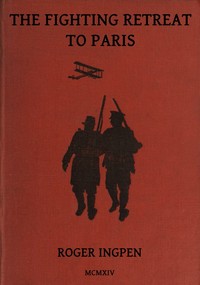
The Fighting Retreat To Paris — Inside the Classic
(0 User reviews)
71
Project Gutenberg
2016
Not confirmed
World War, 1914-1918 -- Campaigns -- Western Front
Readers of public-domain and historical texts
Project Gutenberg digital edition
en
Edition facts
Words
42,958
Reading time
187 min
Text sections
10
Before opening The Fighting Retreat To Paris — Inside the Classic, the edition data offers a quick orientation: 42,958 words, 3 hr 7 min estimated reading time, and 10 detected text sections.
The text analysis averages about 22.2 words per sentence, while the detected sections provide another way to judge how the source is divided.
Project Gutenberg metadata also associates the work with “World War, 1914-1918 -- Campaigns -- Western Front,” connecting these edition facts with the source record’s subject description.
Source:
Project Gutenberg record #53736
Roger Ingpen's 1914 compilation of official despatches, soldier accounts, and press reports chronicles the British Expeditionary Force's retreat from Mons to the Marne. The narrative blends high-command strategy with raw, colloquial testimony from the ranks, revealing the gap between orders and experience.
Editorial Edition Score
4.8/5
★★★★★
★★★★★
Calculated from edition completeness, EPUB availability, text structure and catalogue metadata. Not a user rating.
How this score is calculated
- Description quality20 pts
- Title & short description10 pts
- Source metadata20 pts
- Text length15 pts
- Chapters / structure15 pts
- EPUB file integrity20 pts
Total of 100 points, scaled to a 2.5-5.0 range. Editions with an empty description or a missing EPUB file are not scored.
Edition quality
Public-domain source text
Read the source text
The source text is kept in the dedicated reader, separate from this catalogue record and its commentary.
Roger Ingpen’s The Fighting Retreat to Paris (1914) is a wartime compilation that juxtaposes official despatches from Sir John French and Lord Kitchener with first-person accounts from soldiers, chaplains, and railway officials. The book’s structure—alternating between command-level summaries and vernacular testimony—creates a layered portrait of the British Expeditionary Force’s withdrawal from Mons. Ingpen’s editorial hand is light, allowing the contrast between the measured language of despatches and the raw, colloquial voices of the ranks to speak for itself.
Voices from the Ranks
The most striking feature of Ingpen’s compilation is the inclusion of unpolished soldier narratives. A Gordon Highlander describes how “our boys were as lively as crickets, but under fire as cool as you could wish,” a phrase that captures both the jaunty tone and the pressure of combat. Another account notes that at close quarters the Germans “fell in their scores, and we jumped over them to get at the others.” These passages are not literary set-pieces; they retain the rhythms of spoken testimony, with short, breathless sentences and colloquialisms such as “surprise packet.” Ingpen does not smooth out the roughness, preserving the immediacy of men reporting what they saw.
The Machinery of Command
Interleaved with the soldiers’ stories are official despatches that speak a different language. Sir John French’s account of the battle at Le Cateau refers to “the most critical day of all” and quantifies the opposing forces: “300,000 German troops … opposed to two British Army Corps and a Division.” The despatches are precise about unit movements and casualty ratios, but they avoid the sensory details that fill the personal accounts. Ingpen’s juxtaposition highlights a gap: the generals describe a battle of numbers and positions, while the men describe a chaos of streets, forests, and heaped bodies. The book does not resolve this tension; it presents both registers side by side.
Setting as Tactical Fact
The excerpts repeatedly anchor action in specific geography: the forest near Le Cateau, the streets of Cambrai, the road to Compiègne. One soldier notes that the Germans “swarmed out of the forest and entered the small town from different directions,” making the landscape a tactical actor. The retreat is measured in place names—Mons, Charleroi, Le Cateau, Compiègne—each marking a phase of pressure. Ingpen’s text treats these locations not as picturesque backdrops but as functional coordinates in a fighting withdrawal. The reader follows the army’s path through a series of named points, each with its own character of engagement.
The Weight of Numbers
Ingpen’s book repeatedly foregrounds the disparity in troop strength. Mr. Asquith’s announcement in the House of Commons states that “the odds were three to one, and were probably much heavier.” Lord Kitchener’s address and Sir John French’s despatches reinforce this theme. The numerical imbalance becomes a structural refrain, framing the retreat not as a failure but as a managed survival against superior force. Yet the soldier accounts rarely mention numbers; they focus on immediate actions—clearing a street, holding a crossroads. The book thus offers two scales of perception: the strategic arithmetic of command and the tactical intimacy of the man on the ground.
Readers approaching The Fighting Retreat to Paris should attend to the friction between its documentary layers. The official despatches provide a framework of dates and corps movements, but the heart of the book lies in the unadorned voices of the soldiers. Ingpen’s compilation is best read as a mosaic of perspectives, each incomplete, together suggesting the complexity of a retreat that was both a tactical necessity and a human ordeal.
The rain kept tapping my window as I finished Roger Ingpen's account of the Mons retreat, struck by how the gunners' voices lingered after the generals' prose faded. That afternoon, I found myself reaching for a slimmer, more personal volume—My .75: Reminiscences of a Gunner of a .75m/m Battery in 1914 — Context and Discussion. It felt like sitting down with one of those same men, still smelling cordite and damp earth.
There are no reviews for this eBook.
There are no comments for this eBook.
Reader reflection
How did this book work for you?
Your answers remain private and are stored only in this browser.
Your progress
0
/
10
2
How much did you enjoy the reading experience?
3
Would you pass this book on to a friend?
4
Did the language feel accessible?
5
How strongly did the book affect you emotionally?
6
Which element worked best for you?
7
How valuable was this book for your own interests?
8
How closely did the book connect with your experience?
9
Which lesson or insight stayed with you?
10