1

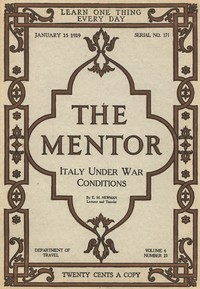
The Mentor: Italy Under War Conditions, Vol. 6, Num. 23, Ser. No. 171, January 15, 1919 — A Reader’s Guide
(0 User reviews)
1507
Project Gutenberg
2014
1919
World War, 1914-1918 -- Italy
Readers of public-domain and historical texts
Project Gutenberg digital edition
en
Edition facts
Words
12,164
Reading time
53 min
Text sections
2
This digital edition of The Mentor: Italy Under War Conditions, Vol. 6, Num. 23, Ser. No. 171, January 15, 1919 — A Reader’s Guide is described by source-level measurements including 12,164 words, 53 min estimated reading time, and 2 detected text sections.
The text analysis averages about 19.9 words per sentence, while the detected sections provide another way to judge how the source is divided.
Project Gutenberg metadata also associates the work with “World War, 1914-1918 -- Italy,” connecting these edition facts with the source record’s subject description.
Source:
Project Gutenberg record #44983
E. M. Newman's 1919 report on Italy's wartime economy, civilian morale, and cultural preservation, based on firsthand observation. Highlights co-operative societies, government price controls, and the protection of artworks like Titian's 'Assumption' and da Vinci's 'Last Supper'.
Editorial Edition Score
4.5/5
★★★★★
★★★★★
Calculated from edition completeness, EPUB availability, text structure and catalogue metadata. Not a user rating.
How this score is calculated
- Description quality20 pts
- Title & short description10 pts
- Source metadata20 pts
- Text length15 pts
- Chapters / structure15 pts
- EPUB file integrity20 pts
Total of 100 points, scaled to a 2.5-5.0 range. Editions with an empty description or a missing EPUB file are not scored.
Edition quality
Read the Text
You had to choose 'twixt liberty and guilt; There is no half-way house for human kind If human kind is still to breathe God's air. And so you placed your lips upon the hilt Of Freedom's sword, devoted soul with mind To this great task which frees sad Europe from despair.
Hence we who loved and love you, Italy,... Send winged words of greeting. You are free; Sun-smitten the cloud that hid the soaring dome Of Liberty, your Palace and your Home. We who are free greet you from sea to sea.
Mazzini, Garibaldi, great Cavour Watch now and greet you from their timeless place, Whence they behold the growth of your great race Which so they knit that long it should endure. Spectators of eternity, whose pure, Untarnished brows recall their ancient grace, Behold them once again, and in them trace The soul of freedom, splendid, patient, sure!
J. E. G. DE MONTMORENCY.
In _The Contemporary Review_.
THE MENTOR ASSOCIATION
ESTABLISHED FOR THE DEVELOPMENT OF A POPULAR INTEREST IN ART, LITERATURE, MUSIC, SCIENCE, HISTORY, NATURE, AND TRAVEL
THE MENTOR IS PUBLISHED TWICE A MONTH
BY THE MENTOR ASSOCIATION, INC., AT 114-116 EAST 16TH STREET, NEW YORK, N. Y. SUBSCRIPTION, FOUR DOLLARS A YEAR. FOREIGN POSTAGE 75 CENTS EXTRA. CANADIAN POSTAGE 50 CENTS EXTRA. SINGLE COPIES TWENTY CENTS. PRESIDENT, THOMAS H. BECK; VICE-PRESIDENT, WALTER P. TEN EYCK; SECRETARY, W. D. MOFFAT; TREASURER, J. S. CAMPBELL; ASSISTANT TREASURER AND ASSISTANT SECRETARY, H. A. CROWE.
JANUARY 15, 1919 VOLUME 6 NUMBER 23
Entered as second-class matter, March 10, 1913, at the postoffice at New York, N. Y., under the act of March 3, 1879. Copyright, 1919, by The Mentor Association, Inc.
_ITALY UNDER WAR CONDITIONS_
PREPARED SPECIALLY FOR THE MENTOR BY E. M. NEWMAN ILLUSTRATION FOR THE MENTOR, VOL. 6, No. 23, SERIAL No. 171 COPYRIGHT, 1919, BY THE MENTOR ASSOCIATION, INC.
_The Business of War_
None of the Allied Nations has had more or greater problems confronting it than Italy has. Manpower has not been lacking, but the want of raw materials for the making of munitions has been a serious handicap, and one that has been most difficult to overcome. Italy has been absolutely dependent upon her allies for steel and coal. After her declaration of war against Germany, she was left helpless. Badly as France and England needed these raw materials, they had to come to the assistance of their ally. For a long time the quantities received were insufficient, and a sustained offensive against Austria was impossible, for want of ammunition.
This condition was greatly improved when the United States entered the war, and Italy received from us vast quantities of steel, and sufficient coal came from England to supply her needs.
It must be borne in mind that when war was declared (August 1, 1914) practically all the industrial and commercial organizations in Italy were controlled by Germany. The largest banks and financial houses were German-owned. One of the most prolific sources of income, the electric and other plants operated by water-power, were in German hands.
Germany had a firm grip on the resources of the country. Her agents carried on a propaganda which required the utmost courage of the Italians to overcome, and let it be said to the credit of the Italian people, they risked financial ruin when they decided to enter the war on the side of the Allies.
The first result of their entry into the World War was to demoralize their securities and almost to destroy the value of their money. The _lira_, a coin which, before the war, was worth about 19 cents, decreased in buying power to about 11 cents. Bonds dropped alarmingly.
With the United States as an ally, loans have been made to Italy, her credit has been re-established, the _lira_ has gradually increased in value, and with steel and coal in sufficient quantities for all purposes, prosperity is returning.
It was the shrewd Bismarck who arranged with Signor Crispi, twice Premier, to come to the assistance of Italy. A loan was made, and the best Italian securities were obtained for a song. Ever since, the German grip has tightened. As a result of the war Italy will be restored to commercial freedom and she will have a new and much needed opportunity to expand.
The Ansaldo Company, a new and gigantic corporation, is now one of the largest munition plants in the world. Italy has tremendous resources in her water-power which is now being developed. Like her allies, she will be able to manufacture many of the things she needs.
Her airplanes are among the best that are made. Her engines are wonders of mechanical perfection. Her motor cars are unexcelled. Italy, prepared as she never was, is ready for the future.
_The Food Problem and How It Is Met_
E. M. Newman's account of Italy under war conditions, published in January 1919, focuses on the practical adjustments of a nation at war rather than battlefield heroics. The text opens with a poem by J. E. G. De Montmorency that frames Italy's choice as one between 'liberty and guilt,' setting a moral tone that the prose does not sustain. Newman instead documents concrete measures: government price controls known as 'calmiere,' co-operative societies selling at cost, and the closure of theaters at midnight. The report is structured as a series of topical sections—business, amusements, travel—each grounded in specific regulations and observed behaviors.
Economic Controls and Co-operative Networks
Newman identifies two mechanisms that kept civilian life functional. The first is the calmiere, a system of government regulation that fixed maximum prices for certain products. The second is the widespread network of co-operative societies, which sold to members at cost. He notes that nearly every trade or profession had its own co-operative store, with entrance fees as low as five lire—about one dollar. Retailers had to compete with these societies, which curbed profiteering. This dual structure, part state mandate and part voluntary association, is presented as a distinctive Italian response to wartime scarcity.
Civilian Austerity and Resilience
Newman observes that society did not consider it good form to wear evening dress or jewels. Officers avoided dress uniforms at any function. Yet he insists that Italy was 'not gloomy nor depressed'; the Italians remained 'vivacious' and 'sunny.' Travel was permitted but uncomfortable: coal shortages reduced trains, and passengers stood for six or seven hours in first-class compartments, accepting the discomfort with 'far less grumbling than one would expect.' The tone here is observational, not celebratory—Newman records a pattern of voluntary restraint and good-natured endurance.
Venice: Damage and Preservation
The section on Venice is the most vivid. Three-fourths of the population fled, leaving about fifty thousand. Hotels closed; tourists vanished. Industries were ruined, commerce depleted. Churches and hospitals were repeatedly bombed. Yet Newman also details protective measures: sandbags piled around St. Mark's Square, the famous horses taken down, Byzantine mosaics removed, and the entire façade of St. Mark's hidden. He mentions that Titian's 'Assumption' was transported across country to a secure place, and da Vinci's 'Last Supper' was protected by padding. The text balances loss—'frescoes have been obliterated that can never be replaced'—with the assertion that much damage 'will soon be repaired.'
Newman's report is best read as a document of its moment—published just two months after the Armistice, it looks back on wartime conditions without yet knowing the postwar outcome. The poem at the start and the prose that follows sit in an unresolved tension: the verse invokes Mazzini, Garibaldi, and Cavour as eternal witnesses, while the text describes a nation improvising with price controls and co-operative stores. Readers interested in the everyday texture of World War I home fronts will find this a useful primary source, especially for its attention to economic organization and cultural protection.
Reading about Newman’s Italy, I kept thinking how some wars leave marks on stone, others on people. That quiet devotion to saving Titian’s work stayed with me. It reminded me of The Silent Watchers England's Navy during the Great War: What It Is, and What We Owe to It — Reading Notes, where the same patient guarding happens, just out at sea. Both books feel like holding a lantern for someone else’s memory.
There are no reviews for this eBook.
There are no comments for this eBook.
Reader reflection
Take a moment to reflect on this book
Create a short personal record of your experience with this book.
Your progress
0
/
10
2
Was reading this book enjoyable?
3
Would you encourage someone else to read it?
4
How much effort did this book require?
5
How clear did the writing feel?
6
Which aspect of the book did you value most?
7
Did any part of the book feel personally relevant?
8
Could you apply anything you learned?
9
Which lesson or insight stayed with you?
10