1

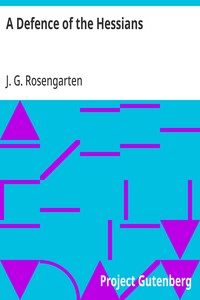
A Defence of the Hessians — Background and Themes
(0 User reviews)
1684
Project Gutenberg
2010
Not confirmed
United States -- History -- Revolution, 1775-1783 -- Participation, German
Readers of public-domain and historical texts
Project Gutenberg digital edition
en
Edition facts
Words
12,843
Reading time
56 min
Text sections
2
Before opening A Defence of the Hessians — Background and Themes, the edition data offers a quick orientation: 12,843 words, 56 min estimated reading time, and 2 detected text sections.
The text analysis averages about 27.0 words per sentence, while the detected sections provide another way to judge how the source is divided.
Project Gutenberg metadata also associates the work with “United States -- History -- Revolution, 1775-1783 -- Participation, German,” connecting these edition facts with the source record’s subject description.
Source:
Project Gutenberg record #33235
A 1899 article defending Hessian soldiers and princes against Revolutionary War-era accusations, arguing they were well-paid allies of England, not mercenaries sold into service. Based on a German pamphlet, it uses pay records and treaties to counter claims of exploitation.
Editorial Edition Score
4.5/5
★★★★★
★★★★★
Calculated from edition completeness, EPUB availability, text structure and catalogue metadata. Not a user rating.
How this score is calculated
- Description quality20 pts
- Title & short description10 pts
- Source metadata20 pts
- Text length15 pts
- Chapters / structure15 pts
- EPUB file integrity20 pts
Total of 100 points, scaled to a 2.5-5.0 range. Editions with an empty description or a missing EPUB file are not scored.
Edition quality
Public-domain source text
Read the source text
The source text is kept in the dedicated reader, separate from this catalogue record and its commentary.
This editorial note examines how Joseph G. Rosengarten’s 1899 article, reprinted from The Pennsylvania Magazine of History and Biography, frames its defense of Hessian soldiers. The catalog subjects list the work under “United States – History – Revolution, 1775-1783 – Participation, German,” but the excerpts reveal a narrower focus: a summary and rebuttal of a German pamphlet from 1879. Rosengarten does not narrate battles or American perspectives; instead, he dissects financial treaties and pay scales to argue that Hessians were well-compensated allies, not victims of princely greed.
The defense hinges on detailed accounting—thalers, shillings, and savings reports—rather than moral appeals. This approach raises questions about the relationship between the catalog’s broad subject heading and the text’s actual content, which is a specialized historiographical intervention.
A Defense Built on Ledgers, Not Anecdotes
Rosengarten’s primary evidence is numerical. He cites treaties and pay tables to show that Hessian soldiers received full English pay, plus allowances for clothing, food, and booty. For example, he notes that Hessian sergeants in Gibraltar started at £1 14s., while English sergeants got £1 9s. He also provides savings figures: four colonels accumulated 24,000 thalers, and General von Mirbach sent home 6,000 thalers in sixteen months. These details are meant to counter the “perjured soldier” claims that pay was reduced.
The author’s reliance on such data suggests that the pamphlet he summarizes was itself a financial rebuttal. The catalog subject “Participation, German” implies a military history, but the excerpts focus on economics and contractual obligations. Readers expecting battle narratives will instead find a ledger-based argument about fairness and alliance.
The German Pamphlet as Source and Target
Rosengarten explicitly frames his article as a summary of a 1879 pamphlet titled “Frederick the Second and Modern History,” which he calls “a second and enlarged edition” that “must have found readers.” He does not name the pamphlet’s author, nor does he provide its full argument. Instead, he selects evidence that supports his own defense, particularly regarding pay and the Elector’s integrity.
This reliance on a single, obscure source limits the scope of the defense. The catalog does not list the pamphlet as a subject, yet it is the backbone of the article. Rosengarten’s claim that the pamphlet offers “a new view of Seume’s statements” hints at a broader historiographical debate, but the excerpts do not develop it. The reader is left to wonder how representative this pamphlet was of German scholarship.
Missing Context: The American Revolutionary War
Despite the catalog subject linking the work to the American Revolution, the excerpts contain almost no American content. There are no mentions of battles, generals, or colonial grievances. The only reference to America is geographical: the Hessians served “under the British flag” there. Instead, the text dwells on European alliances, the Seven Years’ War, and the financial relationship between England and Hesse.
This disconnect suggests that the catalog subject is misleadingly broad. The article is not about Hessian participation in the war itself, but about the moral and financial terms of their service. Readers interested in the Revolutionary War will find little here beyond a footnote on pay scales. The work is better understood as a contribution to German historiography than to American military history.
Rosengarten’s article is a narrow, evidence-driven rebuttal that challenges popular narratives about Hessian mercenaries. Its value lies in the detailed financial records it preserves, not in any comprehensive account of the Revolution. Readers should approach it as a primary source for late-19th-century German-American historical debate, rather than as a general history of Hessian soldiers. The catalog subject may overstate its scope, but the work itself offers a precise, if limited, corrective.
Reading the old Hessian defence, I kept thinking about how easily we reduce soldiers to caricatures—paid cogs, hired hearts. The records in that pamphlet made them people again, like voices long buried under slogans. It reminded me of "Crumps", The Plain Story of a Canadian Who Went — Reading Companion, where the same quiet, ordinary weight of marching exists, far from any flag-waving. Just men, walking.
There are no reviews for this eBook.
There are no comments for this eBook.
Reader reflection
Your personal reading reflection
Build a private reading journal entry for this title.
Your progress
0
/
10
2
What was your overall reaction to the book?
3
Would you recommend this book to another reader?
4
Did the language feel accessible?
5
Did it raise ideas you would like to talk about?
6
Would you read this book again?
7
How would you rate its originality?
8
How did the pace of the book feel?
9
What did this book teach you most?
10