1

An Englishman's View of the Battle between the Alabama and the Kearsarge An Account of the Naval Engagement in the British Channel, on Sunday June 19th, 1864 — Story, Setting & Ideas
(0 User reviews)
1002
Project Gutenberg
2011
Not confirmed
United States -- History -- Civil War, 1861-1865 -- Naval operations; Alabama (Screw sloop); Kearsarge (Sloop)
Readers of public-domain and historical texts
Project Gutenberg digital edition
en
Edition facts
Words
13,232
Reading time
58 min
Text sections
2
An Englishman's View of the Battle between the Alabama and the Kearsarge An Account of the Naval Engagement in the British Channel, on Sunday June 19th, 1864 — Story, Setting & Ideas can be approached with a clearer sense of reading commitment from its source measurements: 13,232 words, 58 min estimated reading time, and 2 detected text sections.
The text analysis averages about 20.0 words per sentence, while the detected sections provide another way to judge how the source is divided.
Project Gutenberg metadata also associates the work with “United States -- History -- Civil War, 1861-1865 -- Naval operations,” connecting these edition facts with the source record’s subject description.
Source:
Project Gutenberg record #36988
Frederick Milnes Edge's 1864 pamphlet examines the naval battle between the USS Kearsarge and CSS Alabama off Cherbourg, using firsthand interviews and crew rosters to challenge contemporary misrepresentations about the engagement.
Editorial Edition Score
4.5/5
★★★★★
★★★★★
Calculated from edition completeness, EPUB availability, text structure and catalogue metadata. Not a user rating.
How this score is calculated
- Description quality20 pts
- Title & short description10 pts
- Source metadata20 pts
- Text length15 pts
- Chapters / structure15 pts
- EPUB file integrity20 pts
Total of 100 points, scaled to a 2.5-5.0 range. Editions with an empty description or a missing EPUB file are not scored.
Edition quality
Public-domain source text
Read the source text
The source text is kept in the dedicated reader, separate from this catalogue record and its commentary.
Frederick Milnes Edge opens his account by declaring that the battle between the Kearsarge and the Alabama was the first decisive engagement between steam-propelled ships and the first test of modern naval artillery. He immediately positions his pamphlet as a corrective to what he calls a mass of misrepresentations, listing specific false claims about the Kearsarge's size, speed, and chain-plating. Edge's diction is pointed and forensic: he uses phrases like 'diametrically opposed to the truth' and 'excused or palliated' to frame his investigation as a debunking effort. The author's voice is that of an English gentleman of intelligence, as the prefatory note describes him, and he dedicates the work's proceeds to the United States Sanitary Commission, signaling a political and humanitarian stance.
A Pamphlet of Corrections
Edge structures his pamphlet as a point-by-point refutation. He enumerates four principal reasons given for the Kearsarge's victory—superior size, speed, armament, and chain-plating—and then systematically addresses each. The authorial choice to list these claims in numbered form gives the text a legalistic, evidence-driven tone. Edge does not merely assert; he promises to provide data from firsthand observation in Cherbourg and interviews with officers and crew of the Kearsarge, as well as wounded and prisoners from the Alabama. This methodical approach suggests that Edge saw his work as a factual record rather than a narrative. The pamphlet's brevity—just over 13,000 words—forces him to be concise, and he uses that compression to sharpen his corrective arguments.
The Voice of an English Observer
Edge's position as an Englishman writing for an American audience shapes his rhetorical choices. He adopts a tone of detached expertise, referring to himself in the third person in the prefatory note as 'an English gentleman of intelligence.' His language is formal and parliamentary, as when he avoids 'an unparliamentary expression' to describe false statements. Yet he also shows a clear partisan alignment: the dedication calls the battle a 'most glorious victory gained in the cause of justice and humanity.' This blend of clinical correction and moral endorsement creates a distinctive authorial voice—one that claims objectivity while openly supporting the Union cause. The excerpts do not reveal whether Edge maintains this balance throughout, but the opening pages establish it firmly.
Crew Lists as Evidence
A striking feature of the excerpts is the inclusion of a full crew roster for the Kearsarge, listing 163 officers and men with their ranks, names, and native places. Edge likely uses this list to counter claims about the Kearsarge's superior size by showing its actual complement. The roster's detail—including landsmen, coal-heavers, and marines—gives a granular view of the ship's composition. Edge's decision to print this list verbatim reflects a documentary impulse; he treats the crew as data points rather than characters. The list also reveals the crew's diversity: men from the United States, Western Islands, France, Holland, Spain, and England. This factual presentation reinforces Edge's authority as an investigator who has gathered primary sources.
Setting the Scene in Cherbourg
Edge visited Cherbourg specifically to gather information, and his account is grounded in that location. The title places the battle in the British Channel on Sunday, June 19, 1864, and the text likely describes the town and its vantage points. The excerpts do not include those descriptions, but Edge's method—'from information personally obtained in the town of Cherbourg'—suggests a reporter's attention to setting. He contrasts the first news, which came 'enveloped in a mass of statements,' with his own on-the-ground findings. This emphasis on physical presence and eyewitness testimony is a deliberate authorial choice to bolster credibility. The setting also carries political weight: Cherbourg was a French port, and the battle occurred in international waters, adding a diplomatic layer to the naval engagement.
Edge's pamphlet is best read as a contemporary attempt to set the record straight, not as a comprehensive history. Readers should attend to his rhetorical strategies—the numbered refutations, the documentary inserts, the self-presentation as an impartial English observer—as much as to the facts he presents. The excerpts offer a window into how Civil War naval engagements were reported and contested in real time, and Edge's work rewards attention to its structure and voice.
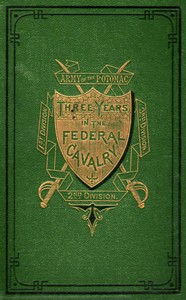
That June afternoon, reading Edge’s pamphlet under a grey sky, I kept thinking about the witnesses—ordinary men trying to make sense of sudden violence. Their confusion lingered, and it led me, almost by accident, to a cavalryman’s quieter account of the same war’s muddy roads. Together, they felt less like history, more like weather. I found Three Years in the Federal Cavalry — Context and Discussion waiting on the shelf, rain-streaked and patient.
There are no reviews for this eBook.
There are no comments for this eBook.
Reader reflection
What did you think of this book?
Answer a few questions and save a private reflection on this device.
Your progress
0
/
10
2
Did this book hold your interest?
3
Would you encourage someone else to read it?
4
How much effort did this book require?
5
How would you describe its reading pace?
6
Did you relate to its people, ideas, or situations?
7
Which part made the strongest impression?
8
How useful were the ideas in this book?
9
In one sentence, what did you learn?
10