Adventures and Reminiscences of a Volunteer; Or, A Drummer Boy from Maine — Reading Companion
Edition facts
The source record for Adventures and Reminiscences of a Volunteer; Or, A Drummer Boy from Maine — Reading Companion measures this digital text at 23,947 words, 1 hr 45 min estimated reading time, and 3 detected text sections.
The text analysis averages about 20.8 words per sentence, while the detected sections provide another way to judge how the source is divided.
Project Gutenberg metadata also associates the work with “United States -- History -- Civil War, 1861-1865 -- Personal narratives,” connecting these edition facts with the source record’s subject description.
Calculated from edition completeness, EPUB availability, text structure and catalogue metadata. Not a user rating.
How this score is calculated
- Description quality20 pts
- Title & short description10 pts
- Source metadata20 pts
- Text length15 pts
- Chapters / structure15 pts
- EPUB file integrity20 pts
Total of 100 points, scaled to a 2.5-5.0 range. Editions with an empty description or a missing EPUB file are not scored.
Read the Text
That was my first experience, and I always after tried to avoid guard-houses. The next morning I was given a broom and put to sweeping around camp with about twenty tough-looking customers. The broom did not look well with my uniform, and as soon as an officer noticed me, I was summoned before the colonel in command. He asked, what I was? I told him I didn't know yet--would not know 'till I reached my regiment. He had a hearty laugh at my appearance; said I ought to be sent to some fair instead of the front. However, he detailed me as his orderly. I held this position some time, until one day there was going to be a squad of recruits, and returned furloughed men sent on a steam-barge to the front at City Point, where Butler was bottled up. I asked to be one of them. The colonel told me I was foolish, and better stay with him, but I insisted; and he allowed me to go. The barge was a kind of an open double-deck boat without cabin or shelter, and they crowded us on to her as thick as we could stand; we were like sardines. I secured a position against the smoke-stack, and before we reached Chesapeake bay I was glad of it, for it became bitterly cold, and I curled down around this smoke-stack, went to sleep, and when I awoke in the morning I was crisp, dirty, and nearly roasted alive. We crossed the bay in the afternoon. Oh, wasn't it rough! This old river barge would roll and pitch out of sight at times, and we were all wet from head to foot. Then I began to wish myself home on the farm again; but I was in for it, and could not back out. I had one thought that buoyed me up, the thought of meeting my brother.
That evening we passed by Fortress Monroe, up the James river. There was not much transpired to relieve the monotony or appease our hunger or thirst; in fact, it began to look dubious as to reaching City Point. The monotony, however, was somewhat relieved in the morning. About daylight a commotion was caused by the sound of distant cannonading. Every one crowded to the front of the boat; everybody was asking questions of everybody. Each one had some idea to offer as to the cause. Some ventured to say it was a gunboat up the river practising. One old chap, who had evidently been to the front, facetiously claimed that it was the corks out of Butler's bottles. The river was very crooked at this point, and you could not see very far; but presently we rounded a bend in the river, which revealed to us where the cannonading came from, but for what, we could not make out. About a mile ahead of us lay a United States gunboat, and every few minutes a puff of smoke, and then a loud bang--erang--erang--erang--with its long vibrations on that still morning, awoke a sense of fear in everyone aboard that boat. No one could account for the situation. Even the captain of the barge stood with pallid cheek, seemingly in doubt what to do as he rang the bell to slow down; but on--on we kept moving--nearer and nearer this most formidable war-ship, and as we did so the shots became more frequent. Then we noticed a man on the bank waving a flag back and forth, up and down in a wild, excited sort of a way. I asked what that meant. An old soldier said the man was signaling the boat to let them know they had hit the target.
Suddenly we were brought to an understanding of what it all meant, for we could now hear the musketry very plain, and could even see the rebels on the banks of the river. At this point a "gig" from the gunboat pulled alongside and gave orders to the captain "to land those troops at once," telling him at the same time that this was Fort Powhatan landing; that Fitzhugh Lee with his cavalry had swooped down upon the garrison, which was only composed of two hundred negro troops, and that they must be re-enforced. The captain protested, as the troops on board were all unarmed, being returned furloughed men and recruits; but it was no use, the order was imperative, and the captain headed his barge toward the shore. There was no wharf. That had been burnt, so he was obliged to run as far as he could onto the sand, then land us overboard. I tell you as that boat neared toward the shore, my face felt as if it were marbleized; sharp twinges ran up and down my whole body, and I'll bet that I was the picture of a coward. I was not the only one. I looked them all over, every one looked just as I felt. One man who stood near me, I know, was more frightened than I, for he was so frightened he smelt badly. But I didn't blame any of those poor men; it was not the pleasantest thing in the world to be placed before the enemy as we were. However, we all landed.
The firing above us on the bank became more intense. An officer who was on the boat with us, returning from a leave of absence, assumed command. He ordered us to fall into line, and marched us into a little ravine, halted, and told us the position and necessity of the occasion. He said the fort was a very important position, and must be held at all hazards; that there were only two hundred colored troops there, and they could not hold it. Now, he proposed, as we had no arms, to go in with a rush and a yell, and make those rebels think that re-enforcements had arrived. All this time the musketry firing was increasing. The whizz of bullets through the air and about our heads were becoming too frequent. I was in the front rank, center of the line, and I tell you I think I had a little of that frightened smell about me at this time. Whether it was that or my looks or what, the officer probably took pity on me and told me to skirmish in the rear. I hardly knew where the rear was, but I thought it would be safer under the bank of the river, and there I hastened, and none too soon, for the rebels had made a break through the lines and poured several volleys into our poor, unarmed re-enforcements. The rebs became more cautious, and that was what was wanted, as the only hope we had was to hold them at bay until re-enforcements could arrive.
Well, I skirmished in the rear, and I found it hotter than the front, for the rebs would crawl to the bank at either end of the breastworks and kept a cross-fire up and down the river. Under and against the banking, there was a sort of old barn; this was filled with hay. The bullets were flying around so thickly that I squeezed myself behind this barn, and after I was well in, the bullets just rained against that old building; but I felt pretty secure till I looked up overhead--I saw that while I was in safety from bullets, a worse danger threatened me. The overhanging bank was liable to cave in and bury me alive.
The uncertainty of my position became more and more apparent. Each moment the increased storm of bullets on the barn prevented me from even looking out, and the constant rattling down of dirt and pebbles from above, told me plainly what a position I was in. I tell you I wished then I had never been mustered in. The uncertainty of my position was soon developed. I came to myself and found I was buried to my neck; my head and face were cut and bleeding, and a soldier was trying to wipe the sand from my eyes and ears. I found I had not been shot, but the banking had caved in and buried me. Gen. "Baldy" Smith, who was in command, happened to see me behind the barn just as the bank caved in. It was he who put the soldiers at work to rescue me. As soon as I was out, and the dust out of my eyes, the general rode down to the beach, leading an extra horse; he called to me. Ordered me to mount. I did so. He made me his orderly.
A new danger. I was to carry dispatches across the field, but I did not now have the fear I did at first. I did not mind the sound of the bullets. I became accustomed to it, and I rode back and forth all day long without a scratch. I believe I was so small that I rode between those bullets, and from that time forth I had no fear. I felt as though I were bullet-proof. I felt as if it were ordained that I should go through the war unscathed and unscarred. It did seem so, for I would go through places where it rained bullets, and come out without a scratch. This was my experience all through, and was commented on by comrades, who said I had a charmed life. Well, the day wore away the rebs making feints first at one point, then another. Finally they concentrated their forces against one point, and would have carried it, too, but just then a steamboat loaded with troops rounded the bend of the river. Well, the shouts that went up from the handful of brave soldiers at the sight of that boat I never can forget. The boys on the boat caught the sound. They took in the situation, and answered back the shout with three long, hearty cheers. It created consternation in the rebel lines. They knew the jig was up, but they drew up in line, like dare-devils that they were, and with a cool deliberation, poured volley after volley into the side of the steamer until her nose touched the shore. Well, to see those soldiers leave that steamer was a sight never to be forgotten. They jumped overboard from every part of her. It did not seem five minutes from the time she touched shore until the banks were swarming with our boys in blue. The rebels had taken to flight--our boys followed some distance, and then returned, relieving us and allowing us to embark again for City Point. After the rebels had retreated, I went outside the breastworks, and the sight that met my eyes on every side would curdle the blood of stouter hearts than mine. It appeared that Lee, with his cavalry, had surprised the pickets, and being negroes, every one they captured they would hang up to a tree after they were mutilated. I saw several with fingers cut off in order to obtain a ring quickly, and many other sickening sights which tended to make me a hardened soldier. I was having lots of experience, even before I had really reached my regiment, and I tell you, the heroic ardor of my boyish dream was beginning to ooze out of me quite fast. I began to think I was not cut for a soldier.
Well, my first battle was over, my first experience before an enemy. The first sound of musketry had died away, and we were again steaming towards City Point to join our regiments. We arrived there the next night about ten o'clock. There didn't seem to be any one in command of us or any one to direct us. It was very dark on shore, but in the distance you could see a glaring light above the horizon, as if there was a long building on fire. But from the occasional sound of guns from that quarter, I made up my mind it was the advance line of our army. It was Butler's command, and our regiment, the Eighth Maine, must be there. The Eighth Maine, Company H, was the regiment and company to which my brother belonged, and in which I was enlisted. I started out across the fields in the direction of the light--on, on I tramped, into ditches, through mires, over fences. The farther I went the faster I went. I was so impatient I could not hold myself to a walk; it was a dog-trot all the time. I was heedless of every obstacle, till I began to near the front. I realized the danger by the whizzing of shell, and the zip, zip of bullets. I found myself among lots of soldiers, and how ragged and dirty the poor fellows looked. I asked the first man I came to where the Eighth Maine was? He looked at me in perfect astonishment. "This is the Eighth, what's left of it." I asked him if he knew where my brother was--Charley Ulmer? "Oh, yes," he said, and pointing to a little group of men, who were round a wee bit of a fire; "there he is, don't you know him?"
I hesitated, for really I could hardly tell one from the other. He saw my bewilderment, and took me by the arm and led me over to the fire. They all started and stared at me, and to save my life I could not tell which was my brother; but one more ragged than the rest uttered a suppressed cry, rushed forward, and throwing his arm about my neck, sobbed and cried like a child. "My God! my brother! Oh George, George, why did you come here?" His grief seemed to touch them all, for they all began to wipe their eyes with their ragged coat-sleeves. This began to tell on me, and for the next ten minutes it was a kind of a blubbering camp. After awhile they reconciled themselves, and began to ply me with questions faster than I could answer. My brother sat down with me and lectured me very soundly for coming, as there was no need of it. He gave a graphic description of the hardships they had endured, and I can never obliterate the picture he presented that night. His clothes were ragged and patched, begrimed with smoke, grease and dirt; his hat an old soft one, with part of the rim gone and the crown perforated with bullet holes; his beard scraggly and dirty; his big toes peeping out of a pair of old boots with the heels all run down, in fact, he was a sight--a strong contrast to my tailor-made suit. I will never forget the expression on my brother's face when about half an hour after my arrival he looked up to me with his eyes half full of tears glistening on that dirty face, and with a kind of cynical smile, asked, after looking me over and over: "What are you, anyhow?"
I told him I didn't know.
"Well, after you have been here awhile, those pretty clothes won't look as they do now, and you will probably find out what you are after you have dodged a few shells."
Our conversation was brought to a climax by orders to break camp and fall in. We learned we were going to embark somewhere on a boat; everything was hustle-bustle now; little sheltered tents were struck, tin cups, canteens, knapsacks were made ready, and in about fifteen minutes that begrimed, dirty, hungry family of Uncle Sam's was on the march to the river. We were marched on board an old ferry-boat, and crowded so thickly that we could scarcely stand. My brother seemed now to feel that he had the responsibility of my comfort, even my life, on his hands--and being a favorite he elbowed me a place at the end of the boat, where we could sit down by letting our feet hang over the end of the boat. In that position we remained. We didn't have room to stand up and turn around. I was awful sleepy, but dared not go to sleep for fear I would fall overboard. Finally my brother fixed me so I could lay my head back, and he held on to me while I slept. The next morning we landed at a place called West Point, on the York river; why we landed there we didn't know. Of course soldiers never did know anything of the whys and wherefores; they only obeyed orders, stood up or laid down and got killed--they had no choice in the matter. Well, we landed, and I tell you, we were stiff and hungry. While they were unloading the horses, which was done by lowering them into the water and letting them swim ashore, which took some time, they allowed us a chance to skirmish for food. About half a mile from the river were a dozen houses--nice-looking places. Towards these we started; they were all closed up; they all looked deserted; there was not a sign of life, except the cackle of hens or chickens in the hen-house. Chickens were good enough for us, and I was one of the first to get to the pen; secured two handfuls of chicks, and was just emerging with them when a big woman confronted me; she stood and looked me straight in the eye, and with both hands held on to a mastiff, that to me looked as big as an ox.
"How dare you?" said she.
"What are you doing with my chickens, you good-for-nothing Yankee thief?"
I tried to apologize, but it was no use. Even my pretty uniform had no more effect than my eloquence. I simply put Mr. and Mrs. Chicks down and backed out of the yard. She was good enough to hold on to the dog, for which I was very grateful. I think I had more respect for the dog than the lady. However, I had to resort to pork and hard tack for my breakfast. About noon that day we began our march. Where we were going, everybody guessed, but none knew. I didn't care. I was now a kind of a half-settled soldier, but from the first, I was a kind of privileged character. No one gave me orders. No one seemed to claim me. I had never been assigned to any company. I never had to answer roll-call. I could go and come as I pleased. Once in awhile a guard would halt me, but not often. They didn't know what I was, and they didn't care. All the afternoon we marched. Our route was along the railroad, the rails of which had the appearance of being recently torn up by the rebels. About four o'clock I was becoming very tired. We came to a clearing, and some distance in the field was a darky plowing with a mule. I made a break for him, and the rest of that march I rode. No one objected, but the boys shouted as I made my appearance on the mule; a mile or two further along we sighted a farm-house. I drew reins on my mule and made for the house; I made the boys glad on my return, for I secured a demijohn of applejack, a big bundle of tobacco, and a box of eggs. That successful raid gave me courage, and I began to think that was what I was destined for, and I liked it first-rate, for it was a pleasure to me to see those poor, hungry boys have any delicacy, or even enough of ordinary food.
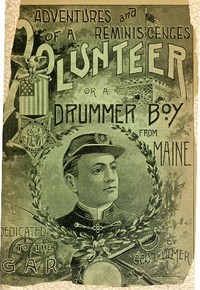
George T. Ulmer opens his 1892 memoir with a disclaimer: he does not intend to write a history of the rebellion, nor does he claim heroic deeds, since "most of the heroes of the war were killed." Instead, he promises a "truthful account of an unimportant career" in "homely, rugged, commonplace language." The excerpts bear this out. Ulmer describes himself as a barefoot New York newsboy who shouted "Fort Sumter Bombarded!" to sell papers before his family moved to a hilly Maine farm. He enlisted young and became the "midget orator of the Army of the Potomac," arguing strategy around campfires. The catalog subject—"United States -- History -- Civil War, 1861-1865 -- Personal narratives"—fits, but the excerpts reveal a voice less concerned with grand tactics than with the absurdity and terror of a boy in uniform.
A Self-Aware Narrator, Not a Hero
Ulmer's preface sets a deliberate tone: he expects no glory and jokes that writing the book might get him killed for audacity. This self-deprecation continues in the excerpts. When a shell explodes near his company, he runs "on the dead run for the rear," then fears he has stumbled into Confederate lines. He finds two "big Johnnies" behind a hen-house who ask for food. The scene is comic and vulnerable—Ulmer is "most scared to death"—and he does not edit out his panic. The catalog label "personal narrative" is accurate, but the excerpts show a memoir that leans into embarrassment and luck, not battlefield prowess.
Campfire Debates and Opinions on Command
Ulmer portrays himself as a talkative soldier who "kept posted on facts and the topography of the country." He criticizes generals who were selected "not for their qualifications in military tactics alone" but for pluck and honesty. He singles out Custer's brigade as wasting time on minor operations. In one campfire scene, Colonel McArthur asks what he would do if given supreme command. Ulmer replies he would take Richmond quickly with a dream team of generals—Grant, Sherman, Sheridan, Custer, and others—prompting cheers. The excerpt reveals a young man with strong, if naive, strategic opinions, and a regiment that indulged his debates. This is not a standard personal narrative of suffering; it is a record of a soldier who argued politics and tactics.
The Drummer Boy's Voice and Audience
Ulmer dedicates the book to the Grand Army of the Republic and addresses "some of his comrades" who might recall similar incidents. The excerpts show him as the "midget" of the regiment, called upon for oratory. His language is colloquial: he "needed money" selling papers, he "forgave himself" for false shouts, and he "made up his mind" he was inside rebel lines. The catalog subject "biography-memoir" fits, but the excerpts emphasize a specific readership—fellow veterans who would recognize the mix of fear, humor, and opinion. Ulmer does not claim to represent all soldiers; he offers one "unimportant career" as a way to introduce himself as a comrade.
Readers should approach this memoir as a deliberately unpolished account. Ulmer warns that dates may be approximate and that he is not writing a history. The excerpts reward attention to his voice—self-mocking, opinionated, and occasionally terrified. His criticisms of generals and his campfire debates are as central as the combat scenes. The book is best read as a personal artifact of how one young soldier remembered the war, not as a comprehensive narrative.
That rainy afternoon, the drummer boy’s blunt words about sleeping through cannon fire made me think of the wide-eyed children hearing those same sounds for the first time across the ocean. The personal gave way to the distant. I found myself drifting afterwards through The Childrens' Story of the War, Volume 1 (of 10) From the Beginning of the War to the Landing of the British Army in France — Context and Discussion, wondering how any of them kept their innocence.
William Roberts
1 month agoEvelyn Wilson
3 weeks agoHenry Green
1 month agoCarter Mitchell
2 weeks agoWhat did you think of this book?
Answer a few questions and save a private reflection on this device.
William Torres
2 weeks ago