1

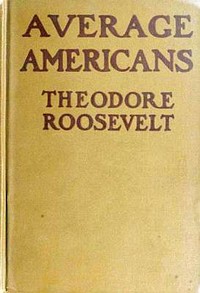
Average Americans — Context and Discussion
(0 User reviews)
128
Project Gutenberg
2011
Not confirmed
World War, 1914-1918 -- Personal narratives, American
Readers of public-domain and historical texts
Project Gutenberg digital edition
en
Edition facts
Words
50,456
Reading time
220 min
Text sections
8
This digital edition of Average Americans — Context and Discussion is described by source-level measurements including 50,456 words, 3 hr 40 min estimated reading time, and 8 detected text sections.
The text analysis averages about 18.7 words per sentence, while the detected sections provide another way to judge how the source is divided.
Project Gutenberg metadata also associates the work with “World War, 1914-1918 -- Personal narratives, American,” connecting these edition facts with the source record’s subject description.
Source:
Project Gutenberg record #36292
Theodore Roosevelt's firsthand account of World War I service, blending personal letters from his father with detailed combat narratives, revealing the tension between bureaucratic frustration and frontline duty.
Editorial Edition Score
4.7/5
★★★★★
★★★★★
Calculated from edition completeness, EPUB availability, text structure and catalogue metadata. Not a user rating.
How this score is calculated
- Description quality20 pts
- Title & short description10 pts
- Source metadata20 pts
- Text length15 pts
- Chapters / structure15 pts
- EPUB file integrity20 pts
Total of 100 points, scaled to a 2.5-5.0 range. Editions with an empty description or a missing EPUB file are not scored.
Edition quality
Public-domain source text
Read the source text
The source text is kept in the dedicated reader, separate from this catalogue record and its commentary.
Theodore Roosevelt's Average Americans opens with a striking structural choice: the author includes his father's letters as a preface, framing the entire narrative as a continuation of paternal counsel. The elder Roosevelt's words—'New Year's greetings to you!'—set a tone of moral urgency, while the son's own prose quickly shifts to the gritty specifics of trench warfare. This juxtaposition of intimate family correspondence with tactical descriptions of raids and shelling creates a layered voice that is both personal and official.
A Dual Voice: Father and Son
The book's preface is not a conventional introduction but a selection of letters from Theodore Roosevelt Sr. to his children, dated 1917–1918. These passages speak of 'the great crisis that sifted out men's souls' and criticize military bureaucracy—'appointments are made primarily on grounds of seniority.' The younger Roosevelt then takes over, but the paternal voice lingers. In the main text, the author often echoes his father's blend of idealism and impatience, as when he notes that 'words count for but little when the drumming guns have been waked.' This intergenerational dialogue gives the memoir a dual perspective: the elder's strategic frustration from home, the younger's tactical immediacy at the front.
The Language of Combat
Roosevelt's descriptions of military action are precise and unadorned. He recounts a raid where 'the raiding party worked up into position, passing by through the mist like black shadows.' The prose favors concrete details over grand rhetoric: 'trenches were shallow and scanty, and dugouts were almost lacking.' Dialogue is sparse but telling—'Come out of there,' the men call down dugouts, and if the Huns do not comply, 'a couple of incendiary grenades were thrown down.' The author notes losses with a matter-of-fact tone: 'Unfortunately the one man killed was Lieutenant Freml, the raid leader, who fell in a hand-to-hand combat.' This restraint underscores the routine nature of violence.
Character Sketches Amid the Action
Roosevelt pauses to profile individual soldiers, offering glimpses of personality. Lieutenant Freml, an 'old Regular Army sergeant,' had fought in the Philippines and planned to 'return and establish a chicken farm.' His men 'were devoted to him and would follow him anywhere.' Another officer, Lieutenant Dabney, is simply 'a very good fellow from Louisville, Ky.' These brief portraits humanize the ranks without sentimentality. The author also notes the men's reactions: after a successful raid, they returned 'in high excitement and fine spirits,' and the first question from each returning party was 'S...' (cut off in the excerpt). Such details convey morale without editorializing.
Tension Between Policy and Practice
Throughout the excerpts, Roosevelt criticizes the military establishment indirectly. The preface includes his father's complaint that 'Generals Wood and Crowder have been denied the chance to render service' and that seniority rules hamper effectiveness. In the field, the author observes that 'too long a stay in our army—with its peculiar limitations—produces a rigidity of mind.' Yet he does not dwell on these grievances; instead, he focuses on the work at hand. The narrative thus embodies a central tension: the desire for reform versus the necessity of action. This undercurrent gives the memoir a critical edge without undermining its patriotic tone.
Readers should approach Average Americans as a document shaped by its dual authorship and its moment. The letters from Theodore Roosevelt Sr. provide a political and moral framework, while the younger Roosevelt's combat narrative offers a ground-level view. Pay attention to the shifts in register—from fatherly advice to tactical report—and to the way the author balances criticism of the system with respect for the men who serve. The incomplete excerpts leave some questions unanswered, but the voice remains consistent: direct, observant, and grounded in specific experience.
Reading Roosevelt’s letters made me recall the hushed way my grandfather spoke of his own father’s Great War diary—that same gap between paperwork and mud. Then I thought of The Childrens' Story of the War, Volume 1 (of 10) From the Beginning of the War to the Landing of the British Army in France — Context and Discussion, which once gave me that identical ache: history told too simply, yet somehow closer to the truth.
There are no reviews for this eBook.
There are no comments for this eBook.
Reader reflection
How will you remember this book?
Save your reaction, strongest insight, and memorable passage.
Your progress
0
/
10
2
How much did you enjoy the reading experience?
3
Is this a title you would suggest to others?
4
What was the reading difficulty like?
5
Was the book moving at the right speed?
6
Did the book meet your expectations?
7
What did you appreciate most?
8
Did it raise ideas you would like to talk about?
9
What changed or sharpened your thinking?
10