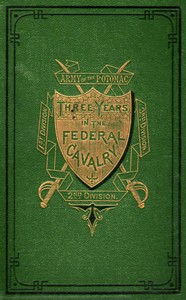
Three Years in the Federal Cavalry — Context and Discussion
Edition facts
For Three Years in the Federal Cavalry — Context and Discussion, the stored edition analysis reports 84,666 words, 6 hr 9 min estimated reading time, and 12 detected text sections.
The text analysis averages about 21.0 words per sentence, while the detected sections provide another way to judge how the source is divided.
Project Gutenberg metadata also associates the work with “United States -- History -- Civil War, 1861-1865 -- Personal narratives,” connecting these edition facts with the source record’s subject description.
Calculated from edition completeness, EPUB availability, text structure and catalogue metadata. Not a user rating.
How this score is calculated
- Description quality20 pts
- Title & short description10 pts
- Source metadata20 pts
- Text length15 pts
- Chapters / structure15 pts
- EPUB file integrity20 pts
Total of 100 points, scaled to a 2.5-5.0 range. Editions with an empty description or a missing EPUB file are not scored.
Read the Text
THE WAR FOR THE UNION.--CONTEST BEGUN.
1861.--Enthusiasm of the North.--Washington Threatened.--Bull Run, and Its Lessons.--General Scott and the Cavalry.--Enlistment under Captain Buel.--The Harris Light Cavalry.--Leaving Troy, New York.--Captain A. N. Duffie.--Drilling and Fencing at Scarsdale, New York.--Bound for the Seat of War.--Philadelphia. --Baltimore.--Washington.--Camp Oregon. 19
CAMP-LIFE AND ITS INFLUENCES.
1861.--Our unmilitary Appearance.--First Equipage.--My Black Mare.--Good and Evil Influences.--News-Boys.--Mail-Bag.-- Letter-Writing.--The Bugle Corps.--Camp-Guard.--Guerillas under Turner Ashby.--Mounted Drill.--Laughable Experiences with Horses.--Southern Egotism.--Northern Fancies. 27
PREPARATIONS FOR ACTIVE SERVICE.
1861.--First Advance.--"Contrabands," their Hopes and Treatment. --Union Ranks Filling Up.--Promotion.--Foraging and its Obstacles.--Scouting and its Aim.--Senator Harris visits the Command.--Ball's Bluff.--Recruiting Service.--Interesting Incidents.--Camp Palmer.--"Contrabands" at Work.--Drilling near Arlington Heights.--Colonel George D. Bayard.--Fight at Drainesville. 39
THE ADVANCE TO THE RAPPAHANNOCK.
1862.--"All quiet along the Potomac."--Preparations.--Army of the Potomac Moves!--Capture of the "Quaker Guns" at Centreville. --Return to Defences.--Guerillas.--Their Attacks and Stratagems. --The Bovine Foe.--Picketing: how it is done.--Sufferings.-- McClellan to the Peninsula.--Virginia Weather and the People. --General Augur's Advance to the Rappahannock.--Lieutenant Decker's Bravery and Death.--Night Charge on Falmouth Heights. --Fredericksburg Surrenders.--How Citizens regard us.--Guarding a Train to Thoroughfare Gap.--Fight and Captures at Flipper's Orchard.--Shenandoah Valley.--The Fifth New York Cavalry, First Ira Harris' Guard.--Death of Turner Ashby.--Strange Cavalry Tactics.--Personal Bravery of Captain Hammond.--End of the Peninsular Campaign. 49
POPE'S CAMPAIGN IN NORTHERN VIRGINIA.
1862.--Kilpatrick at Beaver Dam.--Captain John S. Mosby.--Return of the Raiders.--Complimentary Orders.--The Harris Light at Anderson's Turnout.--Rebel Account of the Scare.--General John P. Hatch, his Misfortunes and Justification.-- Reconnoissances.--Battle of Cedar Mountain.--Hospital at Culpepper.--General Stuart in Close Quarters.--His Adjutant- General Captured.--Death of Captain Charles Walters.--Pope driven back and waiting for Reinforcements.--Kilpatrick's Fight at Brandy Station.--Waterloo Bridge.--Bristoe Station. --Manassas Junction.--Battle of Groveton.--Second Bull Run. --Chantilly and Death of Kearny.--General Pope resigns. 72
REBEL INVASION OF MARYLAND.
1862.--Result of Pope's Campaign.--Rest and Recruit at Hall's Hill.--"My Maryland;" Its Invasion.--Offensive Policy of the Rebellion.--Pennsylvania and the Whole Country Aroused. --Battle of South Mountain.--Harper's Ferry.--Colonel Miles. --His Treachery and Death.--Bloody Battle of Antietam.-- Drilling Recruits.--The Harris Light again at the Front.--At Chantilly.-- Sudley Church.--Leesburg.--McClellan again Relieved from Command. 95
McCLELLAN SUCCEEDED BY BURNSIDE.
1862.--Burnside's First Campaign.--Army of the Potomac in Three Divisions.--Advance from Warrenton to Falmouth.--General Stahel's Raid to the Shenandoah.--Laying Pontoons across the Rappahannock under Fire.--Battle of Fredericksburg.-- Daring Feats and General Heroism.--Death of General Bayard. --The Hospitals.--Sanitary and Christian Commissions.--Camp "Bayard."--Camp-Fires.--Winter Quarters.--Friendly Relations of Pickets.--Trading.--Pay-Day.--"Stuck in the Mud." 105
ORGANIZATION OF A CAVALRY CORPS.
1863.--General Hooker assumes Command of the Army of the Potomac.--Demoralization.--Reorganization.--A Cavalry Corps. --General George D. Stoneman in Command.--Death of Sergeant May.--Forests of the Old Dominion.--The Cavalryman and his Faithful Horse.--Scenes in Winter Quarters.--Kilpatrick.-- His Character.--Qualifications of the True Soldier.--A New Horse.--A Mulish Mule.--Kilpatrick's Colored Servants in Trouble.--Terrific Hail-Storm.--Major E. F. Cooke Honored. --Colonel Clarence Buel. 124
REBEL CHIEFS AND THEIR RAIDS.
1863.--Rebel Raids by Stuart, Imboden, and Fitz-Hugh Lee.--John S. Mosby, Guerilla Chief.--His Character.--His Command.-- Daring and Plunder.--Aided by Citizens.--Condition of the Country Favorable for their Depredations.--Our Picket Lines too Light.--Attacks on Pickets at Herndon Station, Cub Run, and Frying-Pan Church.--Miss Laura Ratcliffe, Mosby's Informant.--Mosby at Fairfax Court House.--Capture of General Stoughton.--Fight at Chantilly.--Mosby lauded by His Chiefs. --Mosby beaten at Warrenton Junction.--Severely whipped at Greenwich, where he loses a Howitzer captured from Colonel Baker at Ball's Bluff. 143
CHANCELLORSVILLE AND STONEMAN'S RAID.
1863.--Review of the Army by the President.--Deserters Punished. --Sports and Pastimes.--Stoneman's First Move.--Storm.-- Reconnoissance to Warrenton.--Another Move.--Other Storms. --Catching "Rabbits."--Stoneman's Great Raid on Lee's Communications.--On the Virginia Central Railroad.-- Kilpatrick at Louisa Court House.--He Marches upon Richmond.--Bold Advance near the City.--Important Captures. --Retreat over Meadow Bridge.--Destructions.--Bushwhackers. --Happy Rencounter.--Safe Arrival at Gloucester Point.-- Public Prints.--Battle of Chancellorsville.--Heroism and Defeat.--Stonewall Jackson Falls.--Hooker Injured.--Retreat. --Orders. 161
FROM YORKTOWN TO FALMOUTH.
1863.--Curiosity Satisfied.--Pastimes on the York River. --Religious Services; their Influence.--Raid to Mathias Court House.--Sickness and Recovery.--From Gloucester Point to Falmouth.--Exciting Details.--Correspondence of Mr. Young.--The Press.--With the Army of the Potomac again.--Cavalry Fight at Brandy Station.--Bold Charge of the First Maine Cavalry.--The Chivalry fairly Beaten.-- Death of Colonel B. F. Davis, Eighth New York Cavalry.-- Interesting Letter of a Rebel Chaplain.--Casualties.-- What was Gained by the Reconnoissance.--Pleasonton and Kilpatrick Promoted.--Rebels Raiding in Maryland. 203
SECOND INVASION OF MARYLAND.--GETTYSBURG.
1863.--Invasion of the Northern States.--Kilpatrick at Aldie. --The Bloody Battle.--Daring Deeds.--Colonel Cesnola, Fourth New York Cavalry.--Incidents.--Victory.--Advance to Ashby's Gap.--Pleasonton's Official Report.--Rebel Movements on Free Soil.--Difficulties in the North.--The Cavalry Corps Crosses the Potomac at Edward's Ferry.-- General Meade succeeds Hooker.--Orders.--Changes in the Cavalry.--Movements.--Kilpatrick's Fight with Stuart at Hanover Junction.--Solemn and Laughable Scenes.--Buford's Division Opens the Fight at Gettysburg.--Death of General Reynolds.--First Day's Repulse.--Second Day.--Rebel Advantages.--Third Day.--Last Grand Effort.--Death of General Farnsworth.--The Republic just Saved. 225
RETREAT OF THE REBELS FROM GETTYSBURG.
1863.--National Rejoicing.--The Enemy Retreating.--Feebly Pursued.--Reconnoissances.--Kilpatrick Gives the Enemy a Fourth of July Entertainment at Monterey Pass.--Storm and Terror.--Immense Train Destroyed, and Hosts of Prisoners Taken.--Pitiable Condition of Stuart's Cavalry.--Battle of Hagerstown.--Captains Penfield and Dahlgren Wounded.-- Wonderful Exploits of a Union Scout.--Kilpatrick and Buford at Williamsport.--Cavalry Fight at Boonsboro'.--Stuart Defeated.--Hagerstown Retaken.--Orders to Advance, One Day Too Late.--Kilpatrick Chases the Flying Foe.--Fight at Falling Waters, Last Act in the Drama.--Great Bravery of Union Troops.--Last Vestige of the Invaders Wiped Out.-- Bivouac and Rest. 267
KILPATRICK'S GUNBOAT EXPEDITION.
1863.--Escape of Lee into Virginia.--Reasons.--Cavalry Advance into the Valley _via_ Harper's Ferry.--Riot in New York and other Northern Cities.--Again Across the Potomac on "Sacred Soil."--Blackberries and Discipline.--Mails.--Battle of Manassas Gap.--Mosby Again, and His Bands.--Kilpatrick's Gunboat Expedition on the Rappahannock.--Cavalry Captures Navy.--Complimented by Superiors.--General Advance of the Army.--Third Cavalry Battle at Brandy Station.--Stuart's Cavalry Worsted at Culpepper Court House.--Sharp Artillery Practice at Raccoon Ford, on the Rapidan.--Special Duties and Special Dangers.--Good Living Along the Hazel and Robertson Rivers.--Important Reconnoissance and Raid. --Hard Fighting and Narrow Escape.--Needed Rest Received.--The Paymaster.--Rebel Plan of Attack Foiled by a Citizen Informer. --Suspicious Activity on Our Front. 298
CAPTURE OF THE AUTHOR.
1863.--Fight at James City.--Music of Retreat.--Fourth Cavalry Fight at Brandy Station.--Critical Situation.--Kilpatrick Undaunted.--Davies and Custer.--The Grand Charge.--The Escape.--The Scene.--Subsequent Charges and Counter-charges. --The Cavalry Routed.--The Rappahannock Recrossed in Safety. --Infantry Reconnoissance to Brandy Station.--Comical Affair at Bealeton Station.--Thrilling Adventure of Stuart.--His Escape.--Battle of Bristoe.--Casualties.--Retreat Continued. --Destruction of Railroad by the Rebels.--Kilpatrick at Buckland Mills.--Unpleasant Surroundings.--Sagacity and Daring.--The Author's Capture.--Fall, Insensibility, Change of Scene.--The End.--Introduced to Prison Life. 327
List of Illustrations.
1. Portrait of the Author, Frontispiece.
2. Our Cavalry Leaders, 17
3. Cavalry Column on the March, 37
4. Night Attack on Falmouth Heights, 61
5. Burial of Captain Walters at Midnight, during Pope's Retreat, 87
6. Federal and Rebel Pickets Meeting on the Rappahannock, 119
7. Cavalry Scouting Party Halting for the Night, 173
8. Cavalry Fight at Brandy Station, 215
9. The Cavalry Bivouac, 277
10. Cavalry Battle at Buckland Mills, Va., and Capture of the Author, 323
THREE YEARS IN THE FEDERAL CAVALRY.
THE WAR FOR THE UNION.--CONTEST BEGUN.
1861.--Enthusiasm of the North.--Washington Threatened.--Bull Run, and Its Lessons.--General Scott and the Cavalry.--Enlistment under Captain Buel.--Harris Light Cavalry.--Leaving Troy, New York.-- Captain A. N. Duffie.--Drilling and Fencing at Scarsdale, New York. --Bound for the Seat of War.--Philadelphia.--Baltimore.-- Washington.--Camp Oregon.
The eleventh of April, 1861, revealed the real intention of the Southern people in their dastardly assault upon Fort Sumter. The thunder of Rebel cannon shook the air not only around Charleston, but sent its thrilling vibrations to the remotest sections of the country, and was the precursor of a storm whose wrath no one anticipated. This shock of arms was like a fire-alarm in our great cities, and the North arose in its might with a grand unanimity which the South did not expect. The spirit and principle of Rebellion were so uncaused and unprovoked, that scarcely could any one be found at home or abroad to justify them.
President Lincoln thereupon issued a call for seventy-five thousand men to uphold and vindicate the authority of the Government, and to prove, if possible, that secession was not only a heresy in doctrine, but an impracticability in the American Republic. The response to this call was much more general than the most sanguine had any reason to look for. The enthusiasm of the people was quite unbounded. Individuals encouraged individuals; families aroused families; communities vied with communities, and States strove with States. Who could be the first and do the most, was the noble contention which everywhere prevailed. All political party lines seemed to be obliterated. Under this renovating and inspiring spirit the work of raising the nucleus of the grandest army that ever swept a continent went bravely on. Regiments were rapidly organized and as rapidly as possible sent forward to the seat of Government; and so vast was the number that presented themselves for their country's defence, that the original call was soon more than filled, and the authorities found themselves unable to accept many organizations which were eager to press into the fray.
Meanwhile the great leaders of the Rebellion were marshalling the hordes of treason, and assembling them on the plains of Manassas, with the undoubted intention of moving upon the national capital. This point determined the principal theatre of the opening contest, and around it on every side, and particularly southward, was to be the aceldama of America,--the dreadful "field of blood."
The first great impulse of the authorities was in the direction of self-defence (and what could be more natural and proper?), and Washington was fortified and garrisoned. This done, it was believed that the accumulating forces of the Union, which had become thoroughly equipped and somewhat disciplined, ought to advance into the revolted territory, scatter the defiant hosts of the enemy, and put a speedy end to the slaveholders' Rebellion. But the hesitation and indecision which prevailed in our military circles were becoming oppressive and unendurable, and hence the cry of "On to Richmond!" was heard from the Border States to the St. Lawrence, precipitating the first general engagement of the war. Our defeat at Bull Run was a totally unexpected disaster, which, for a time, it was feared, would chill the enthusiasm and greatly weaken the energy of the North. But though the South was much strengthened and emboldened by their victory, our defeat had its own curative elements: it taught us that the enemy was determined and powerful, and that to overcome him the ranks of the Union army must be filled with something besides three months' men, or men on any very limited term of enlistment. Other lessons were also gained: our men had formed some acquaintance with the citizens and the country; they had learned the importance of a more thorough discipline and organization; and those who had gone forth as to a picnic or a holiday, sat down "to count the cost" of "enduring hardness as good soldiers." The nation discovered that this struggle for life was desperate and even dubious, and it was thoroughly aroused.
Under the military regime of General Winfield Scott, the cavalry-arm of the service had been almost entirely overlooked. His previous campaigns in Mexico, which consisted mainly of the investments of walled cities, and of assaults on fortresses, had not been favorable to extensive cavalry operations, and he was not disposed at so advanced an age in life materially to change his tactics of war. What few regiments of cavalry we had in the regular army were mostly broken up into small detachments for the purpose of ranging our Western frontiers, while a few squads were patrolling between the outposts of our new army, carrying messages from camp to camp, and pompously escorting the commanding generals in their grand reviews and parades.
But the Black Horse Cavalry of Virginia, at Bull Run, unmatched by any similar force on our side, had demonstrated the efficiency and importance of this branch of the service, and our authorities began to change their views. The sentiment of the people at large seemed to turn in the same channel, and a peculiar enthusiasm in this direction was perceptible everywhere. It was as though the spirit of the old knight-errantry had suddenly fallen upon us.
I was in Troy, New York, when the sad intelligence of the reverse to our arms at Bull Run, was received. This was followed quickly by another call for volunteers, and I decided without hesitation to enter the army. In accordance with my resolve I enlisted as a private soldier at Troy, on the sixth day of August, 1861, in a company raised by Captain Clarence Buel, for the cavalry service. To encounter the chivalrous Black Horse Cavalry, of Bull Run fame, it was proposed to raise a force in the North, and as Senator Ira Harris, of New York, was giving this organization his patronage and influence, a brigade was formed, whose banners should bear his name.
Originally the regiment to which my company was assigned was intended for the regular army, and was for some time known as the Seventh United States Cavalry; but the Government having decided to have but six regiments of regular cavalry, and as New York had contributed the majority of the men to the organization, we were denominated the Second Regiment of New York Cavalry, "Harris Light." This regiment was organized by J. Mansfield Davies, of New York, as colonel, assisted by Judson Kilpatrick, of New Jersey, as lieutenant-colonel. The men were mostly from the States of New York, New Jersey, Connecticut, Vermont, Pennsylvania, and Indiana.
_August 13._--To-day Captain Buel's company of Trojans was summoned together for the purpose of leaving for the South. Under a severe, drenching rain we were drawn up in line fronting the residence of General John E. Wool, when the old veteran delivered a most heroic address, which led us quite to forget the pelting rain, and prepared us for our departure. The boys then found a very pleasant shelter on board the Vanderbilt, bound for New York City. The day following all the New York State men rendezvoused at 648 Broadway, and were mustered into the service of the United States by Lieutenant-colonel D. B. Sackett, of the regular army. At four o'clock P. M. we were ordered aboard a train of cars, and told that our destination was Camp Howe, near Scarsdale, twenty-four miles north of the city, between the Harlem and East rivers. We reached the place just in time to pitch our tents for the night--an operation which was not only new and strange, but performed in any thing but a workman-like manner. We had every thing to learn, and this was our first lesson in soldiering.
Captain A. N. Duffie, of Co. A, a Frenchman and graduate of the military school of St. Cyr, France, is in command of the camp, and is to be the superintendent of our discipline and drill. He is undoubtedly well qualified for this position.
_August 16._--This morning we commenced the inevitable drill on foot, as we are still without horses. We find this exercise very severe, and yet, in view of its great importance, we accept it with a good degree of relish. Our drill-master is thorough and rigidly strict, after the fashion of the French schools. We cannot avoid learning under his tuition. In the afternoon we were set to policing camp. This comprises the cleaning of one of the roughest farms in the country of stone. And as a remuneration to the owners for the use of this most unsightly of God's forsaken ground, we are compelled to build stone fences--a very unpleasant introduction to military life, and an occupation which by no means accords with our ideas of a soldier's duties. But our hands toil with a protest in our hearts, and with a certain resolve that this kind of fencing must not long continue.
After a week spent in drill and the stone-wall enterprise, we were all surprised one morning with an order to fall into line to receive a Napoleonic harangue from Captain Duffie. So many and even loud had been our protests, and so glaringly manifest our rebellious spirit on the subject of fortifying a farm in the State of New York, that the captain undoubtedly feared that he might not be very zealously supported by us in his future movements, and so, like Napoleon, on assuming command of the army of Italy, he sought to test the devotion of his men. After amusing us awhile in his broken English, and arousing us by his touching appeals to our patriotism and honor, at length he shouted, "Now as many of you as are ready to follow me to the cannon's month, take one step to the front." This _dernier resort_ to pride was perfectly successful, and the whole line took the desired step. We were then ordered to be ready to leave camp at eleven o'clock that morning, which was on the twentieth of August, assured that Washington, D. C., was our destination.
Our ranks were quickly broken, and all due preparation made for our departure. After marching to Scarsdale we took cars and were soon landed in the metropolis, through the principal streets of which our command passed to the Jersey City ferry. Without much delay we reached Philadelphia in the evening, where we were bountifully supplied with rations by her proverbially generous and patriotic people. True to the instinct of "Brotherly Love," the citizens are making arrangements such as would indicate that millions of Union soldiers might be fed at their tables. Here we spent the night. The next morning at 6.30 we were on our way southward. A brief halt was made in Baltimore, whose streets still seem to be speaking of the blood of the brave Massachusetts men. And as we march along, we can but recall the poet's prophesy:
"And the Eagle, never dying, still is trying, still is trying, With its wings upon the map to hide a city with its gore; But the name is there forever, and it shall be hidden never, While the awful brand of murder points the Avenger to its shore; While the blood of peaceful brothers God's dread vengeance doth implore, Thou art doomed, O Baltimore!"
At 4 o'clock P. M. we beheld the dome of the nation's capitol, and, after landing, we were marched to the eastern part of the city, and pitched tents near Camp Oregon--named thus in honor of Colonel Edward D. Baker, who represented that Territory in the Senate of the United States, previous to his acceptance of a military commission, and who is now in command of the famous California regiment which occupies this camp.
CAMP-LIFE AND ITS INFLUENCES.
1861.--Our unmilitary Appearance.--First Equipage.--My Black Mare.--Good and Evil Influences.--News-Boys.--Mail-Bag.--Letter-Writing.--The Bugle Corps.--Camp Guard.--Guerillas under Turner Ashby.--Mounted Drill.--Laughable Experiences with Horses.--Southern Egotism.-- Northern Fancies.
Drill! drill! and camp-police are the order of the day. Indeed we have nothing else to do, and to do nothing at all is the hardest kind of work. We expect soon to have some accoutrements to enable us to drill something besides our feet. Our preparations for war have commenced at the extremities; for thus far nothing but our heads and feet have been instructed. However, as we become better acquainted with this part of our duty we enjoy it better than at first, and we think we are making no very mean progress.
Willard Glazier's Three Years in the Federal Cavalry opens not with a grand proclamation but with a practical note: the author kept a daily journal during the campaigns of the Army of the Potomac, and from that diary this account is compiled. The preface acknowledges that many engagements, though vivid to participants, may seem too brief on the page—a frank admission that shapes the reader's expectations. What follows is a narrative that alternates between the swift, episodic rhythm of raids and the slower, more reflective pace of camp life, creating a distinctive cadence that mirrors the cavalryman's experience.
Diary-Driven Narrative and Its Effects
Glazier explicitly states that his story is compiled from a journal kept during the campaigns. This origin is evident in the text's structure: entries are often dated (e.g., "May 6."), and the prose moves in short, declarative bursts that record events as they happen. The diary format lends immediacy to descriptions of captures and skirmishes, but it also means that the narrative can feel episodic, jumping from one action to the next without extensive reflection. For instance, the capture of a Rebel wagon train is noted matter-of-factly: "After appropriating a generous supply for the day, the remnant was reduced to ashes." The reader is left to infer the emotional weight from the spare language. This technique creates a sense of authenticity but also leaves gaps where a more reflective memoir might linger.
Pace Shifts Between Action and Lull
The narrative's pace is far from uniform. During raid sequences, the prose accelerates: columns press onward through rain, ferry crossings are "tedious," and bushwhackers fire from thickets. Glazier uses short, stacked clauses to convey urgency: "Cold, hungry, and fatigued, we still pressed onward, suffering not a little." In contrast, camp-life sections slow to a more deliberate tempo, describing unmilitary appearances, the bugle corps, and the mail-bag. This alternation between rapid movement and static waiting is a structural feature of cavalry service itself, and Glazier's text reproduces it faithfully. The reader experiences the same jarring transition from the quiet of a bivouac to the chaos of a surprise encounter, as when a body of cavalry appears at dusk and shots are exchanged before the mistake is discovered.
Voice: Soldierly Directness and Patriotic Framing
Glazier's narrative voice is that of a soldier who sees his duty clearly. He describes the capture of supplies with a practical tone—"just the prize we coveted"—and notes the destruction of property without moral hand-wringing. Yet this directness is periodically overlaid with patriotic sentiment, as when he compares his comrades' feelings to those of Napoleon's legions: "The eyes of all Europe are upon you." The juxtaposition is striking: the same paragraph that invokes Napoleon also mentions the possibility of ending up in "Libby" or "Belle Isle." This blend of high-flown rhetoric and grim reality gives the voice a dual character—part official chronicle, part private soldier's account. The reader must navigate between these registers, recognizing that the author is both participant and memorialist.
Readers will find that the book's value lies less in strategic analysis than in its accumulation of small, concrete details: the one-horse ferry, the captured ham and eggs, the horses killed to prevent capture. Glazier's diary-based method preserves these moments with a fidelity that a more polished memoir might lose. Approaching the text as a document of lived experience—with all its abrupt transitions and uneven pacing—allows its particular texture to emerge.
I kept thinking about Glazier’s quiet moments between raids—how a soldier’s mind holds both the thunder and the stillness. That same ache carries through The Empty Sleeve or, The Life and Hardships of Henry H. Meacham, in the Union Army — Edition Insights, where hardship settles into memory like a long evening. It stayed with me gently, the way old war stories sometimes do.
There are no reviews for this eBook.
Record your reading impressions
A brief reflection can help important ideas stay with you longer.