1

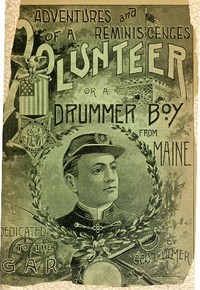
Adventures and Reminiscences of a Volunteer; Or, A Drummer Boy from Maine — Reading Companion
(0 User reviews)
2435
Project Gutenberg
2010
Not confirmed
United States -- History -- Civil War, 1861-1865 -- Personal narratives
Readers of public-domain and historical texts
Project Gutenberg digital edition
en
Edition facts
Words
23,947
Reading time
105 min
Text sections
3
The source record for Adventures and Reminiscences of a Volunteer; Or, A Drummer Boy from Maine — Reading Companion measures this digital text at 23,947 words, 1 hr 45 min estimated reading time, and 3 detected text sections.
The text analysis averages about 20.8 words per sentence, while the detected sections provide another way to judge how the source is divided.
Project Gutenberg metadata also associates the work with “United States -- History -- Civil War, 1861-1865 -- Personal narratives,” connecting these edition facts with the source record’s subject description.
Source:
Project Gutenberg record #32246
A Civil War memoir by a Maine drummer boy who enlisted young, recounting camp debates, near-capture, and his blunt opinions on generals. The preface disclaims heroism and literary polish, offering a plain-spoken soldier's perspective.
Editorial Edition Score
4.6/5
★★★★★
★★★★★
Calculated from edition completeness, EPUB availability, text structure and catalogue metadata. Not a user rating.
How this score is calculated
- Description quality20 pts
- Title & short description10 pts
- Source metadata20 pts
- Text length15 pts
- Chapters / structure15 pts
- EPUB file integrity20 pts
Total of 100 points, scaled to a 2.5-5.0 range. Editions with an empty description or a missing EPUB file are not scored.
Edition quality
Read the Text
That was my first experience, and I always after tried to avoid guard-houses. The next morning I was given a broom and put to sweeping around camp with about twenty tough-looking customers. The broom did not look well with my uniform, and as soon as an officer noticed me, I was summoned before the colonel in command. He asked, what I was? I told him I didn't know yet--would not know 'till I reached my regiment. He had a hearty laugh at my appearance; said I ought to be sent to some fair instead of the front. However, he detailed me as his orderly. I held this position some time, until one day there was going to be a squad of recruits, and returned furloughed men sent on a steam-barge to the front at City Point, where Butler was bottled up. I asked to be one of them. The colonel told me I was foolish, and better stay with him, but I insisted; and he allowed me to go. The barge was a kind of an open double-deck boat without cabin or shelter, and they crowded us on to her as thick as we could stand; we were like sardines. I secured a position against the smoke-stack, and before we reached Chesapeake bay I was glad of it, for it became bitterly cold, and I curled down around this smoke-stack, went to sleep, and when I awoke in the morning I was crisp, dirty, and nearly roasted alive. We crossed the bay in the afternoon. Oh, wasn't it rough! This old river barge would roll and pitch out of sight at times, and we were all wet from head to foot. Then I began to wish myself home on the farm again; but I was in for it, and could not back out. I had one thought that buoyed me up, the thought of meeting my brother.
That evening we passed by Fortress Monroe, up the James river. There was not much transpired to relieve the monotony or appease our hunger or thirst; in fact, it began to look dubious as to reaching City Point. The monotony, however, was somewhat relieved in the morning. About daylight a commotion was caused by the sound of distant cannonading. Every one crowded to the front of the boat; everybody was asking questions of everybody. Each one had some idea to offer as to the cause. Some ventured to say it was a gunboat up the river practising. One old chap, who had evidently been to the front, facetiously claimed that it was the corks out of Butler's bottles. The river was very crooked at this point, and you could not see very far; but presently we rounded a bend in the river, which revealed to us where the cannonading came from, but for what, we could not make out. About a mile ahead of us lay a United States gunboat, and every few minutes a puff of smoke, and then a loud bang--erang--erang--erang--with its long vibrations on that still morning, awoke a sense of fear in everyone aboard that boat. No one could account for the situation. Even the captain of the barge stood with pallid cheek, seemingly in doubt what to do as he rang the bell to slow down; but on--on we kept moving--nearer and nearer this most formidable war-ship, and as we did so the shots became more frequent. Then we noticed a man on the bank waving a flag back and forth, up and down in a wild, excited sort of a way. I asked what that meant. An old soldier said the man was signaling the boat to let them know they had hit the target.
George T. Ulmer opens his 1892 memoir with a disclaimer: he does not intend to write a history of the rebellion, nor does he claim heroic deeds, since "most of the heroes of the war were killed." Instead, he promises a "truthful account of an unimportant career" in "homely, rugged, commonplace language." The excerpts bear this out. Ulmer describes himself as a barefoot New York newsboy who shouted "Fort Sumter Bombarded!" to sell papers before his family moved to a hilly Maine farm. He enlisted young and became the "midget orator of the Army of the Potomac," arguing strategy around campfires. The catalog subject—"United States -- History -- Civil War, 1861-1865 -- Personal narratives"—fits, but the excerpts reveal a voice less concerned with grand tactics than with the absurdity and terror of a boy in uniform.
A Self-Aware Narrator, Not a Hero
Ulmer's preface sets a deliberate tone: he expects no glory and jokes that writing the book might get him killed for audacity. This self-deprecation continues in the excerpts. When a shell explodes near his company, he runs "on the dead run for the rear," then fears he has stumbled into Confederate lines. He finds two "big Johnnies" behind a hen-house who ask for food. The scene is comic and vulnerable—Ulmer is "most scared to death"—and he does not edit out his panic. The catalog label "personal narrative" is accurate, but the excerpts show a memoir that leans into embarrassment and luck, not battlefield prowess.
Campfire Debates and Opinions on Command
Ulmer portrays himself as a talkative soldier who "kept posted on facts and the topography of the country." He criticizes generals who were selected "not for their qualifications in military tactics alone" but for pluck and honesty. He singles out Custer's brigade as wasting time on minor operations. In one campfire scene, Colonel McArthur asks what he would do if given supreme command. Ulmer replies he would take Richmond quickly with a dream team of generals—Grant, Sherman, Sheridan, Custer, and others—prompting cheers. The excerpt reveals a young man with strong, if naive, strategic opinions, and a regiment that indulged his debates. This is not a standard personal narrative of suffering; it is a record of a soldier who argued politics and tactics.
The Drummer Boy's Voice and Audience
Ulmer dedicates the book to the Grand Army of the Republic and addresses "some of his comrades" who might recall similar incidents. The excerpts show him as the "midget" of the regiment, called upon for oratory. His language is colloquial: he "needed money" selling papers, he "forgave himself" for false shouts, and he "made up his mind" he was inside rebel lines. The catalog subject "biography-memoir" fits, but the excerpts emphasize a specific readership—fellow veterans who would recognize the mix of fear, humor, and opinion. Ulmer does not claim to represent all soldiers; he offers one "unimportant career" as a way to introduce himself as a comrade.
Readers should approach this memoir as a deliberately unpolished account. Ulmer warns that dates may be approximate and that he is not writing a history. The excerpts reward attention to his voice—self-mocking, opinionated, and occasionally terrified. His criticisms of generals and his campfire debates are as central as the combat scenes. The book is best read as a personal artifact of how one young soldier remembered the war, not as a comprehensive narrative.
That rainy afternoon, the drummer boy’s blunt words about sleeping through cannon fire made me think of the wide-eyed children hearing those same sounds for the first time across the ocean. The personal gave way to the distant. I found myself drifting afterwards through The Childrens' Story of the War, Volume 1 (of 10) From the Beginning of the War to the Landing of the British Army in France — Context and Discussion, wondering how any of them kept their innocence.
There are no reviews for this eBook.
There are no comments for this eBook.
Reader reflection
What did you think of this book?
Answer a few questions and save a private reflection on this device.
Your progress
0
/
10
2
Did this book hold your interest?
3
Would you encourage someone else to read it?
4
How demanding did the text feel?
5
What was its emotional impact?
6
How useful were the ideas in this book?
7
How personally connected did you feel to the book?
8
Did the story or argument move comfortably?
9
What is the main idea you are taking away?
10