1

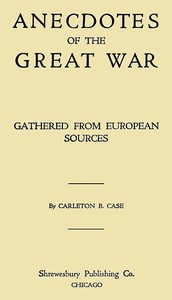
Anecdotes of the great war, gathered from European sources — Story, Setting & Ideas
(0 User reviews)
2256
Project Gutenberg
2015
Not confirmed
World War, 1914-1918 -- Humor, caricatures, etc.
Readers of public-domain and historical texts
Project Gutenberg digital edition
en
Edition facts
Words
38,382
Reading time
167 min
Text sections
5
For Anecdotes of the great war, gathered from European sources — Story, Setting & Ideas, the stored edition analysis reports 38,382 words, 2 hr 47 min estimated reading time, and 5 detected text sections.
The text analysis averages about 16.3 words per sentence, while the detected sections provide another way to judge how the source is divided.
Project Gutenberg metadata also associates the work with “World War, 1914-1918 -- Humor, caricatures, etc.,” connecting these edition facts with the source record’s subject description.
Source:
Project Gutenberg record #48393
A 1916 collection of humorous anecdotes from European newspapers during World War I, compiled by Carleton B. Case. The book captures the lighter side of trench life, home-front absurdities, and linguistic misunderstandings, with a focus on British, French, German, and Belgian perspectives. It avoids bitter propaganda and instead offers a mild palliative through mirth.
Editorial Edition Score
4.6/5
★★★★★
★★★★★
Calculated from edition completeness, EPUB availability, text structure and catalogue metadata. Not a user rating.
How this score is calculated
- Description quality20 pts
- Title & short description10 pts
- Source metadata20 pts
- Text length15 pts
- Chapters / structure15 pts
- EPUB file integrity20 pts
Total of 100 points, scaled to a 2.5-5.0 range. Editions with an empty description or a missing EPUB file are not scored.
Edition quality
Public-domain source text
Read the source text
The source text is kept in the dedicated reader, separate from this catalogue record and its commentary.
Carleton B. Case's 1916 compilation, Anecdotes of the Great War, gathers humorous newspaper items from European sources, presenting a deliberate counterpoint to the conflict's grimness. The foreword states that the war could not be "all slaughter and struggle" without relief, and the anecdotes serve as a "mild paliative." Case explicitly avoids the "bitterness and hatred" of contemporary German and British press, aiming instead for a tone that lets soldiers and civilians alike smile. The collection's structure—short, punchy vignettes—mirrors the oral tradition of trench storytelling, where a quick joke could ease tension. Notably, the compiler acknowledges gaps: Russian, Japanese, and other sources are absent due to limited access, not intent.
Diction and Dialect as Comic Devices
The anecdotes rely heavily on dialect and mispronunciation for humor. In "Has a Monopoly," a club member is mocked for being "the only fellow who knows how to pronounce the names" of war figures, suggesting that linguistic ineptitude is a social failing. More pointedly, "Not a Caruso" features an old lady whose son has enlisted; she pities the Germans because they will have to hear him sing "'It's a long way to Tipperary' on 'is lips." The dropped h's and colloquial phrasing ("P'r'aps you 'aven't 'eard of their cruelties?") mark her as working-class, and the punchline—"p'r'aps you 'aven't 'eard George sing!"—turns her pride into a weapon. The compiler preserves these speech patterns, letting the characters' own words generate the comedy rather than editorial commentary.
The Absurdity of Officialdom
Several anecdotes skewer bureaucratic rigidity. In "Blankety-Blank," a Mrs. Waring asks what language Belgians use, and her husband replies, "I know what language I'd use if I were a Belgian!"—a joke that relies on the unspoken profanity. More elaborate is the narrator in a later excerpt who, frustrated by a crowded train, addresses a German official with absurdly ornate language: "Thou transcendental Triton, is it thus that the confidential visitors... are rewarded?" The official's response—"Are you Suffer-gette?"—mishears "suffragette" and reduces the tirade to a category. The narrator is then placed in a horse-box, treated as a madwoman. The humor derives from the clash between inflated rhetoric and literal-minded authority, a theme that recurs in "Unintentional Limitation," where a vicar's patriotic fervor leads him to substitute "for three years or the duration of the war" for the marriage vow.
Trench Life and the Trivial as Survival
In "Permanently Postponed," Private Flynn complains not of being shot but of waiting "ten minutes for a smoke from Murtagh's pipe" that is shot out of his mouth. The anecdote elevates a minor inconvenience over mortal danger, suggesting that daily irritants matter more than bullets. Similarly, "Nothing New to Him" features a captain boasting about hunting breakfast in the jungle, only for a young soldier to retort, "Yes, sir, and also of Ananias and Baron Munchausen." The soldier's deadpan reference to famous liars punctures the captain's authority. These pieces, likely drawn from soldiers' own accounts, show how humor defuses hierarchy and fear. The compiler's note that such anecdotes are "trivial" yet necessary for sanity underscores their psychological function.
The Home Front and Gender Roles
Women appear primarily as wives, mothers, or observers, often the butt of jokes about ignorance. In "English Humor," Bill teases Nell by reporting that the Prince of Wales "had a fall" and was unconscious—only to reveal he "fell asleep in his bed." Nell's concern is played for laughs, but the joke also critiques the public's appetite for royal gossip. More complex is the narrator in the train anecdote, a woman who adopts a pompous, pseudo-intellectual voice ("I will endure no more obliquity") and is dismissed as a "Suffer-gette." The humor here cuts both ways: the narrator's pretension is absurd, but the official's misogyny is also exposed. Case includes these voices without overt moralizing, letting the reader gauge the social tensions beneath the laughter.
Readers should approach this collection as a historical artifact of wartime morale, not a comprehensive history. The anecdotes are brief and often rely on stereotypes or puns that may feel dated. Pay attention to who is speaking—soldiers, civilians, officials—and what their word choices reveal about class, nationality, and gender. The compiler's deliberate omission of bitter propaganda makes this a unique record of how Europeans chose to laugh during the Great War, even as the fighting continued.
I found myself smiling over the absurdities in Anecdotes of the Great War—the way laughter bridged trenches. Yet later, a quieter thought settled in, recalling The Campaign in Russian Poland — Themes and Context. Different war, same ache beneath the jest. Humor was a shield; suffering, the weight behind it, remembered softly between pages.
There are no reviews for this eBook.
There are no comments for this eBook.
Reader reflection
Take a moment to reflect on this book
Create a short personal record of your experience with this book.
Your progress
0
/
10
2
How much did you enjoy the reading experience?
3
Would you pass this book on to a friend?
4
How demanding did the text feel?
5
How much did the book move you?
6
What did you appreciate most?
7
Would you read this book again?
8
Would you start a conversation about this book?
9
Which lesson or insight stayed with you?
10