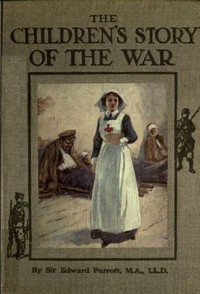
The Children's Story of the War Volume 4 (of 10) The Story of the Year 1915 — Background and Themes

(0 User reviews)   57
In Category - Modern Nations
Parrott, Edward, 1863-1921 Project Gutenberg 2011 Not confirmed
World War, 1914-1918 -- Juvenile literature Readers of public-domain and historical texts
Project Gutenberg digital edition en

Edition facts

Words 129,341
Reading time 563 min
Text sections 17

This digital edition of The Children's Story of the War Volume 4 (of 10) The Story of the Year 1915 — Background and Themes is described by source-level measurements including 129,341 words, 9 hr 23 min estimated reading time, and 17 detected text sections.

The text analysis averages about 20.5 words per sentence, while the detected sections provide another way to judge how the source is divided.

Project Gutenberg metadata also associates the work with “World War, 1914-1918 -- Juvenile literature,” connecting these edition facts with the source record’s subject description.

Examines Sir Edward Parrott's 1916 children's history of 1915's Great War, focusing on authorial choices in diction, dialogue, and description. Observations trace how Parrott balances factual narration with heroic vignettes, uses direct address to young readers, and employs vivid sensory details to render trench warfare and naval battles accessible without graphic horror.
Share
Editorial Edition Score 4.9/5

Calculated from edition completeness, EPUB availability, text structure and catalogue metadata. Not a user rating.

How this score is calculated
  • Description quality20 pts
  • Title & short description10 pts
  • Source metadata20 pts
  • Text length15 pts
  • Chapters / structure15 pts
  • EPUB file integrity20 pts

Total of 100 points, scaled to a 2.5-5.0 range. Editions with an empty description or a missing EPUB file are not scored.

Edition quality

Read the Text

SETTING THE HOUSE IN ORDER.

In this volume I am going to tell you the story of the war as it unfolded itself during the year 1915. It was a year of life-and-death struggle, during which two other nations were swept by the seething whirlpool into the waters of strife, and eight out of ten persons in the continent of Europe were living under war conditions. It was a year during which the three greatest empires of the world, and seven other Powers, fought fierce and bitter combats on five different battle fronts in Europe alone. It was a year in which some millions of men fell on the stricken field, and yet the issue of the vast and terrible struggle remained undecided.

It was a year in which the Allies, who were quite unready when war was forced upon them, strained every nerve to set their military houses in order; to enlist and train for the field their reserves of manhood; and to furnish themselves with those weapons and munitions in which they were deficient. It was a year in which millions of hard-earned money were spent every day, and the combatants piled up mountains of debt for future generations to pay off.

It was a year during which the Allies had good cause to thank God for the long years of peaceful industry which had given Britain great riches, and for the splendid navy which maintained for her the freedom of the seas. Britain's vast reserves of wealth enabled her to raise plentiful money for carrying on the war, and thanks to her navy her merchant ships were able to carry the products of her mines, mills, and factories to other lands. Great Britain alone of all the combatants was thus able to produce wealth in time of war, and to assist her sorely-hampered friends with timely loans.

During 1915 the British nation for the first time began to organize itself for warfare on a vast scale. It found itself forced to raise an army thirty times as great as it had ever marshalled before, and to equip millions of men with every weapon known to the science of war. Moreover, it had to do this while the small forces which it had already placed in the field were struggling to maintain themselves against terrible odds. It was a work that called for every ounce of energy and determination that the Empire possessed, and it could never have been done at all had not the British people, as a whole, given willing support to their leaders.

The year was not many months old when it became evident that we could not hope to hold the enemy in check and drive him from his strongly fortified trenches unless we had an almost unlimited supply of big guns and high explosive shells. Early in the struggle the French had set their gun and ammunition factories working at high pressure, and they had taken good care that they should be fully manned with skilled workmen. Britain, on the other hand, had far too small a number of factories for manufacturing the vast supplies of war material which she needed, and many of her skilled workmen had been allowed to enlist and proceed to the front.

Committees were formed to organize all the workshops in the country capable of making weapons and ammunition, and vast supplies of machine tools, guns, and shells were ordered from the United States and Canada. While this was being done, a strong feeling gained ground that the government of the country should no longer be in the hands of a particular political party, but should be composed of the best men of all parties in the State. In May a National Government was set up, and a minister was appointed to devote himself wholly and entirely to the business of speeding up the production of munitions by every possible means in his power. Mr. Lloyd-George filled this post, and forthwith flung himself with great zeal and energy into the work. His first duty was to convince the nation of the great and crying need for more munitions. He pleaded with workmen to realize the danger, and to ally themselves with brothers in the trenches by working early and late and at the very top of their energy. Great posters appeared all over the country, showing a soldier and a workman clasping hands. Behind the one was a battery of big guns, and behind the other the smoking chimneys of a munition factory. Above was the legend, "We're both needed to serve the guns," and beneath the cry, "Fill up the ranks! Pile up the munitions!"

Unhappily, even in this time of great national danger, there were labour troubles. Masters and men quarrelled about rates of wages and hours of work, while their sons and brothers were dying at the front for lack of shells with which to keep down the fierce bombardment of the enemy. Not until laws were passed preventing masters from making undue profits out of the nation's needs, and punishing workmen who kept bad time, was the strife allayed. The Trade Unions were persuaded to relax their rules, and gradually most of the difficulties were removed. Slowly but steadily the supply of arms and ammunition increased, until in the latter part of the year the shortage was overtaken, and it was possible to meet the enemy on more than equal terms. A well-known public man who visited the trenches in November was able to say, "For every shell which the Germans throw to-day, we are throwing five." "Mr. Lloyd-George's compliments," said a British gunner to the shell, as he closed the breech of his gun, "and there's plenty more where that came from."

Britain had not only to supply the needs of her own army and navy, but to help her Allies as well. Before the year was half over, the Russian supply of rifles and shells almost gave out. Russia, as you know, is far more an agricultural than an industrial country. She has no great number of machine shops that can be turned into munition factories, nor has she anything like the number of skilled workmen required to furnish her with the enormous supplies of war material which she needs. In May, when the Germans brought against her a tremendous force of artillery and machine guns, her shortage was so great that she could not resist, and was obliged to make a long retreat from Poland and Galicia. Many of her recruits had no rifles at all, and at one time the artillery of her Second Army could only reply to the incessant fire of the enemy with two shells a day!

The Russians strove manfully to increase their supply of munitions, and Great Britain and Japan gave them much help. By November they had increased their supplies to such an extent that they were able not only to resist the enemy, but to attack him. Some idea of the spirit shown by the Russian munition workers may be obtained from the following message which was found written on an ammunition box: "Do not spare the shells; there are plenty more coming, comrades. We are working hard to keep you supplied. Cheer up!"

Poor little Serbia had all along to struggle against a great lack of war supplies. Her factories were never able to give her more than a tithe of her needs. You will remember that, but for the ammunition which the Allies sent to her in December 1914, she could not have driven the Austrians from her country. In December 1915, when the Serbian army was driven into Albania,[1] it became entirely dependent for food and supplies upon Britain, France, and Italy.

Great Britain had not only to produce weapons and other munitions for herself and her friends, but she had to enlist and train more and more men to fill up her ranks and to repair the wastage of war. While every other nation engaged in the struggle could force men to serve in the army, she alone used no compulsion, but left each man to decide for himself whether he would take up arms or remain in civil life. Great efforts were made to persuade sound men of military age to join the army. Every blank wall was covered with posters calling upon men to serve their king and country, and recruiting meetings were as the sands of the sea for number. But though the response was wonderful, it was felt that some better method of securing men was needed. Many people thought that all suitable men should be compelled to serve, but the Government was reluctant to change the system which had served the country's needs so well in former times.

At the end of June a law was passed which enabled the Government to discover exactly what resources of men and women the country contained. All persons, male and female, between the ages of fifteen and sixty-five were required to fill up a form stating their names and ages, the number of those who were dependent on them, whether or no they were married, and what was the nature of their occupation. Early in October Lord Derby, who had shown great energy in raising recruits in Lancashire, was appointed Director of Recruiting for the whole country, and speedily he put forward a new plan for bringing in men. The registration forms were sorted out; those men who were engaged in Government work were "starred"--that is, they were not to be considered as available for the army--and the names of all other men between the ages of nineteen and forty-one were placed on cards, which were handed over to joint committees of the political parties, in order that a great national canvass might be conducted.

The canvassers used all their powers of persuasion to get men of military age and sound health to enlist in one or other of forty-six "groups," which were arranged according to the ages of the men, and whether they were married or unmarried. Men were permitted to enlist in their respective groups, and remain in civil life until their own particular group was called up. Courts were set up, before which enlisted men could appear and ask to be "starred" or transferred to some later class. Only those persons without whose services the business of the country could not be properly carried on could claim to be "starred." While the canvass was in progress the Government gave notice that unmarried men would be called up before married men, and that if the unmarried men did not come forward in sufficient numbers, they would be compelled to do so. The canvass was successful--it resulted in the enrolment of very many recruits; but whether compulsion could be staved off by this system remained to be seen. Late in November it was said that Britain would have four million men in arms by the following March.

Money, as you know, is "the sinews of war." Without money, and a great deal of it, armies and navies cannot be arrayed, or kept in the field. The British Empire, according to the statement of the Prime Minister, has a yearly income of £4,000,000,000. This sum is vast, but so was the cost of the war. In March we were spending five millions of money a day. If you work out a little sum, you will see that one year of war at this rate uses up not far short of half the total money earned in a year by the whole British Empire. Of course, in war time the Empire cannot produce as much wealth as it can in times of peace. Large numbers of men are taken away from their work, and, instead of being producers, they have to be kept and fed by the nation. Thousands of factories are engaged in making war material for the Government, and they do not, therefore, add to the national wealth at all. Our overseas trade falls off greatly, because we need many of our merchant ships for transport and supply, because we cannot produce such large quantities of goods for export, and because we cannot trade with enemy countries at all.

In time of peace the goods which we get from other countries are paid for by the goods which we send to them, by the money which we receive from foreigners for carrying goods to all parts of the world, and by the interest which comes to us from money which we have invested abroad. Usually these three items not only pay for our imports, but give us a large profit as well. In time of war, however, we are in quite a different position.

At all times we must import much material from abroad. We are always obliged to import the greater part of our food and the raw materials for our factories. During the present war we have also been obliged to import large quantities of machinery and munitions from the United States. Our imports of goods always exceed our exports of goods in value, but in time of war the imports soar up to a great height, while the exports sink. For example, the excess of imports over exports during the first nine months of 1914 was 99 millions, while for the same period of 1915 it was 256 millions.

Thus you see that, while the war lasts, our exports, the profits on our shipping trade, and the interest which we receive from foreign investments are not sufficient to pay for our imports. In order to make up the balance, we must either draw on our national savings or run into debt. If we draw on our savings, we shall have so much the less money left for the expenses of the war. If we run largely into debt, we shall find ourselves heavily burdened when the day of peace arrives.

By the end of May the Government was seriously considering the all-important question of money, and before long was urging on the people the necessity of being as thrifty as possible, and of saving every penny that they possibly could. Speakers went to and fro pointing out that householders must avoid waste and stint themselves of foreign goods if the nation was to have sufficient money with which to carry on a long war. Those who saved money, and gave up the use of such things as had to be imported from abroad, were doing a patriotic service, and were casting the "silver bullets" with which the war was to be won. In many thousands of homes these wise words were taken to heart; but, on the other hand, many people who were earning high wages showed but little desire to save. Something was also done to lessen the enormous sums wasted on strong drink in this country every year, by restricting the hours during which public-houses might be kept open, and by confining the sale of spirits to certain fixed times. The King set a splendid example, which was largely followed, by banishing strong drink from his table altogether.

Probably you think that all this talk about exports and imports, and the necessity for saving, is very dull, and you are eager to hear of stirring deeds by land and sea. We shall come to them in good time; but I must claim a little more of your patience before I begin the story of the year's fighting. Always remember that when the money which a nation possesses, or can borrow, gives out, it must cease to fight, and must make peace with its foes. That nation wins which has money to continue the struggle when the resources of its opponents are exhausted.

How do we obtain money with which to carry on the war? There is only one place where it can come from, and that is from the pockets of the British people. In time of peace the money for carrying on the government is raised by various kinds of taxes. People with incomes above a certain sum per year have to pay to the Government so much money for every pound which they earn or receive from investments. Those who have a lesser income do not pay what is called income tax, but you must not suppose that they go scot free. Spirits, beer, tea, coffee, tobacco, sugar, cocoa, dried fruits, and other things have to pay a duty--that is, a certain sum is added to their price, and this sum goes to the Government.

In time of war, when the expenses of the Government are much greater than they are in time of peace, the old taxes are raised and new taxes are imposed. In September 1915, for example, the taxes were raised some 40 per cent. Money is also raised from the savings of the people. They are asked to lend money to the State at a certain rate of interest, with the promise that the sum which they lend shall be paid back again in full at the end of a certain period. Of course, this interest has also to be provided by the taxpayers. Three hundred and fifty million pounds were borrowed in November 1914, but by June 1915 it was found necessary to borrow more money, and a loan of nearly six hundred millions--"far and away beyond any amount ever subscribed in the world's history"--was placed at the disposal of the Government. One feature of this loan was the attempt to get persons of small means to participate in it. Vouchers for 5s., 10s., and £1 were issued, and working men, and even school children, were encouraged to buy them. Unfortunately only about five millions were raised in this way, and later in the year other arrangements were made, in the hope of bringing in more money from the savings of the working classes. In September the people of the United States lent the British and French Governments one hundred millions, and this money was used to pay for some of the munitions and other things which we were buying from America.

War brought about many changes in our national life. We became a soberer people, and we refrained largely from those sports which are so dear to us in time of peace. Expensive entertainments were frowned upon, holidays were shortened or given up altogether, and many men beyond the military age spent their annual weeks of leisure in munition or farm work. Special constables were enrolled to take the place of the police who had joined the colours, and volunteer corps sprang up everywhere.

From the moment the war began, British women played a noble part. Not only did thousands of them qualify as nurses, and offer their services in the hospitals at home and abroad, but many of them became munition workers, ticket collectors, tram conductors, motor-car drivers, farm servants, and letter carriers. In every town and village there were work parties busily engaged in making socks, mufflers, mittens, etc., for the men in the trenches or for the wounded in the hospitals. The neglected art of knitting wonderfully revived, and women were seen plying the needles everywhere, in trams and trains, or at lectures and concerts. When the Germans first used poison gas against our troops, and the War Office asked for half a million respirators, wagon-loads of them arrived the next day. Girls' schools, women's societies, groups of friends and families buckled to, and in a remarkably short time the War Office was able to announce that no more respirators were needed.

Thousands of charitable societies made appeals for almost every war purpose imaginable. There were flag days in every town, and singers, actors, and lecturers gave their services in every good cause. The British Red Cross Society received the most generous support, while the many Belgian refugees in Britain were carefully tended, and, wherever possible, provided with work. Money was freely given by the public in every part of the Empire to set up hospitals and send nurses, doctors, and ambulances to France, Belgium, Russia, and Serbia; and even wounded horses were not neglected. One notable gift announced towards the end of November was the sum of £10,000 sent by the Canadian Government to assist in the upkeep of the Anglo-Russian hospital. In Great Britain many country houses were offered as hospitals and convalescent homes, and on the great sporting estates game was shot for the sick and wounded. Children gathered apples for the men of the Fleet, worked in the fields for short-handed farmers, and collected eggs and sphagnum moss[2] for the hospitals. There was no lack of ready and willing helpers for every good cause.

Sir Edward Parrott's The Children's Story of the War Volume 4 (1916) covers the year 1915 through a lens that is both instructional and inspirational. Written for a juvenile audience during the conflict itself, the book adopts a direct, conversational tone—"I am going to tell you the story"—that positions the author as a trusted guide. Parrott frequently interjects explanatory asides, such as calling the old Ypres salient "such a silly thing," a phrase that reveals his effort to simplify complex military geography for young minds. The narrative blends factual chronology with dramatic set-pieces, often quoting soldiers' reported speech or highlighting acts of individual bravery, like Captain Ralston's stand with three men.

Direct Address and the Authorial Voice

Parrott consistently uses the second-person pronoun "you" to engage his reader directly. The opening sentence of Chapter I sets this pattern: "In this volume I am going to tell you the story of the war as it unfolded itself during the year 1915." This technique creates an intimate, tutorial relationship between author and audience. He also employs rhetorical questions and commands—"You can form some idea of the skill with which this retirement was conducted"—to guide the reader's interpretation. The authorial voice is confident and occasionally moralizing, as when he praises the Royal Army Medical Corps as having "covered itself with glory." Such phrasing reinforces the book's dual purpose: to inform and to inculcate patriotic values.

Vivid Sensory Description of Trench Warfare

Parrott renders the physical reality of the trenches through concrete, sensory details. In the account of the Ypres salient, he describes men "stumbling over sand-bags, tripping over heaps of blown-in earth, and falling over their dead comrades." The accumulation of tactile and visual images—sand-bags, earth heaps, dead bodies—creates a palpable sense of chaos and exhaustion. He also notes the heat of rifles: "their rifles were too hot to hold." Such details ground the narrative in bodily experience, making the abstract concept of battle tangible for a young reader. At the same time, Parrott avoids graphic descriptions of wounds or death, maintaining a tone suitable for children while still conveying the grimness of war.

Heroic Anecdotes and Reported Speech

The book is structured around discrete, dramatic anecdotes that highlight individual courage. Parrott frequently incorporates reported speech or interior perspective, as when he writes that Captain Ralston and his men "bluffed" the Germans by firing from different points. The phrase "bluffed" is notably colloquial, suggesting Parrott's effort to make military tactics relatable. He also includes direct quotations from soldiers, such as the remark that the old salient "was such a silly thing." These snippets of dialogue lend authenticity and immediacy. The anecdote of Private Lynn winning the Victoria Cross by keeping his gun in action "while enveloped in the deadly gas" exemplifies how Parrott uses specific, named individuals to embody larger themes of sacrifice and duty.

Navigating the Boundaries of Fact and Narrative

Parrott walks a careful line between historical accuracy and narrative shaping. He acknowledges the incompleteness of his account—"I could fill many pages with stories of men who did miracles of heroism"—while still selecting episodes that serve his didactic purpose. The book's structure, with chapters on specific battles (Neuve Chapelle, Festubert, Loos) interspersed with thematic sections like "Stories from the Battlefield," reveals a deliberate alternation between overview and anecdote. Parrott also uses poetic epigraphs, such as William Collins's "How sleep the brave," to frame the narrative with a tone of solemn remembrance. This blend of factual reporting and literary framing suggests that the book aims not only to record events but to shape how young readers remember the war.

Parrott's volume offers a window into how the Great War was presented to contemporary children: as a series of heroic vignettes embedded in a clear chronological framework. Readers should attend to the author's choices in diction—the colloquial asides, the direct address, the sensory details—that distinguish this work from adult histories. The book's episodic nature means it can be read in sections, each self-contained story illuminating a different facet of 1915's campaigns. By focusing on individual acts of courage, Parrott transforms the vast machinery of war into a human-scale narrative, one designed to instruct and inspire its young audience.

There’s a strange tenderness in Parrott’s careful words, shielding young eyes from the worst while still honoring the grit. It makes me think of the quieter, firsthand voices gathered in What the "Boys" Did Over There By "Themselves" — Story, Setting & Ideas, where the war feels less like history and more like a letter home. Both leave a lingering ache for those who couldn’t know what waited ahead.

There are no reviews for this eBook.

0
0 out of 5 (0 User reviews )

Add a Review

Your Rating *
  • ...
    Catherine Hoffman - 3 weeks ago
    "The Children's Story of the War, Volume 4" is a fantastic educational resource for young readers. It presents the complex events of 1915 in an engaging, accessible manner, with vivid descriptions and maps that bring history to life. The author strikes a perfect balance between informative and entertaining, making it an excellent way to introduce children to the realities of WWI. Highly recommended for parents and educators.

  • ...
    Keith Petty - 3 weeks ago
    "The Children's Story of the War, Volume 4" is a flawed educational tool. The author romanticizes war, omitting the horrors and suffering, which gives a misleading impression to young minds. The narrative is also very dry, lacking the storytelling flair that would engage children. It feels more like a dated textbook than an inspiring history book. There are better options for teaching kids about WWI.

  • ...
    Joy Paul Williams - 1 week ago
    "The Children's Story of the War, Volume 4" is a well-intentioned book that covers the major events of 1915 in a simplified manner suitable for younger readers. The illustrations and maps are helpful. However, the language sometimes borders on patronizing, and the pace is uneven, with some battles oversimplified. It's a decent starting point, but kids may require additional resources for a full understanding.


Reader reflection

How did this book work for you?

Your answers remain private and are stored only in this browser.

Your progress 0 / 10
1

Where are you in your reading?

2

How did the book work for you overall?

3

Is this a title you would suggest to others?

4

Did the language feel accessible?

Related eBooks