1

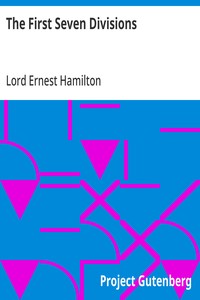
The First Seven Divisions Being a Detailed Account of the Fighting from Mons to Ypres — Reading Companion
(0 User reviews)
695
Project Gutenberg
2012
Not confirmed
World War, 1914-1918 -- Campaigns -- Western Front
Readers of public-domain and historical texts
Project Gutenberg digital edition
en
Edition facts
Words
66,457
Reading time
289 min
Text sections
7
The source record for The First Seven Divisions Being a Detailed Account of the Fighting from Mons to Ypres — Reading Companion measures this digital text at 66,457 words, 4 hr 49 min estimated reading time, and 7 detected text sections.
The text analysis averages about 21.9 words per sentence, while the detected sections provide another way to judge how the source is divided.
Project Gutenberg metadata also associates the work with “World War, 1914-1918 -- Campaigns -- Western Front,” connecting these edition facts with the source record’s subject description.
Source:
Project Gutenberg record #39158
Lord Ernest Hamilton's account of the British Expeditionary Force from Mons to Ypres, focusing on the first seven divisions. Based on officer interviews, the narrative traces specific unit movements and tactical decisions, emphasizing the formation of the Ypres salient and the challenges of concentration against German forces.
Editorial Edition Score
4.7/5
★★★★★
★★★★★
Calculated from edition completeness, EPUB availability, text structure and catalogue metadata. Not a user rating.
How this score is calculated
- Description quality20 pts
- Title & short description10 pts
- Source metadata20 pts
- Text length15 pts
- Chapters / structure15 pts
- EPUB file integrity20 pts
Total of 100 points, scaled to a 2.5-5.0 range. Editions with an empty description or a missing EPUB file are not scored.
Edition quality
Public-domain source text
Read the source text
The source text is kept in the dedicated reader, separate from this catalogue record and its commentary.
Lord Ernest Hamilton, a former captain in the 11th Hussars, wrote this account of the British Expeditionary Force's opening campaigns by drawing on interviews with officers who served in the first seven divisions. The narrative traces the fighting from Mons to Ypres, with a particular focus on the 1st and 2nd Army Corps. Hamilton states plainly that his aim is accuracy, not to magnify achievements or minimise failures. He acknowledges that every battalion was forced to abandon trenches at some point, often due to concentrated shell-fire rather than any deficiency in the troops. This frankness sets the tone for a work that is less a celebratory chronicle than a detailed operational record.
Scope and Limitations
Hamilton explicitly limits his coverage. The 4th Division arrived in time for Le Cateau but missed the earliest days; the 6th Division joined only at the Aisne. These two formed the 3rd Army Corps, whose doings Hamilton touches only lightly, because they fell outside his field of vision. The 7th Division, by contrast, is treated in detail because its operations became entangled with the 1st Army Corps east of Ypres. The 3rd Army Corps, Hamilton notes, acted independently and had no part in the Ypres and La Bassée fighting that forms the core of this book. This honest delineation of scope gives the reader a clear sense of what the narrative covers and what it omits.
The Birth of the Ypres Salient
Hamilton devotes a chapter to the emergence of the Ypres salient, describing how the 7th Division and 3rd Cavalry Division reached Ypres on 14 October. The original plan was to seize the bridge over the Lys at Menin, but this proved impracticable because the British force—only the 7th Division and two cavalry brigades—was outnumbered five or six to one by the Germans. Hamilton explains that the salient resulted from a race to concentrate: the Germans had an easier task and shorter distances. The narrative here is precise about unit positions: the 22nd Brigade at Zonnebeke, the 20th at Kruiseik, and the gap south of Zandvoorde where Allenby's cavalry had not yet made contact. The account is built around specific tactical problems and the decisions that shaped the front.
Retaking Lost Ground
Hamilton illustrates the fluid nature of early trench fighting with an episode at Le Gheir. When the enemy seized the village, exposing the cavalry flank at St. Yves, General Hunter-Weston ordered its recapture. The King's Own Regiment and Lancashire Fusiliers, under Colonel Butler, retook the trenches, took 200 prisoners, and freed 40 captured British soldiers. Hamilton uses this to show that lost positions could be regained by units that were not necessarily superior to those that had been driven out. He insists that shell-fire, not poor soldiering, often caused a battalion to abandon its trenches. This nuanced view of combat effectiveness runs through the book, distinguishing it from simpler narratives of heroism or failure.
Hamilton's work is best approached as a staff officer's report rather than a popular history. Readers will find the most value in the detailed accounts of unit movements and the candid discussions of why plans failed. The maps included with the original edition are essential for following the routes of the seven divisions during the retreat from Mons. The book assumes familiarity with the order of battle and does not pause to explain basic military terms, so a reference on the British Army's structure in 1914 may be helpful.
Reading Lord Hamilton’s account, I kept thinking of the Ypres salient as a held breath. Then my mind wandered to a quieter, later echo of that same tension, in Nothing of Importance A record of eight months at the front with a Welsh battalion, October, 1915, to June, 1916 — Story, Setting & Ideas, where the waiting itself feels like the war’s true weight. Different days, same long shadow.
There are no reviews for this eBook.
There are no comments for this eBook.
Reader reflection
Take a moment to reflect on this book
Create a short personal record of your experience with this book.
Your progress
0
/
10
2
Did this book hold your interest?
3
Is this a title you would suggest to others?
4
How much effort did this book require?
5
Could you apply anything you learned?
6
Did you relate to its people, ideas, or situations?
7
Was the book moving at the right speed?
8
Did the book offer a fresh perspective?
9
In one sentence, what did you learn?
10