1

The History of the Confederate War, Its Causes and Its Conduct, Volume 1 (of 2) A Narrative and Critical History — Context and Discussion
(0 User reviews)
107
Project Gutenberg
2014
Not confirmed
United States -- History -- Civil War, 1861-1865
Readers of public-domain and historical texts
Project Gutenberg digital edition
en
Edition facts
Words
113,066
Reading time
492 min
Text sections
10
Before opening The History of the Confederate War, Its Causes and Its Conduct, Volume 1 (of 2) A Narrative and Critical History — Context and Discussion, the edition data offers a quick orientation: 113,066 words, 8 hr 12 min estimated reading time, and 10 detected text sections.
The text analysis averages about 28.7 words per sentence, while the detected sections provide another way to judge how the source is divided.
Project Gutenberg metadata also associates the work with “United States -- History -- Civil War, 1861-1865,” connecting these edition facts with the source record’s subject description.
Source:
Project Gutenberg record #45609
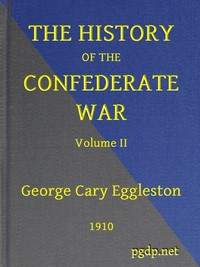
George Cary Eggleston's 1910 narrative and critical history of the Confederate War examines its causes and conduct, emphasizing the war's scale, the strategic use of geography, and the interplay of political and military decisions, as seen in detailed accounts of Manassas and other early campaigns.
Editorial Edition Score
4.8/5
★★★★★
★★★★★
Calculated from edition completeness, EPUB availability, text structure and catalogue metadata. Not a user rating.
How this score is calculated
- Description quality20 pts
- Title & short description10 pts
- Source metadata20 pts
- Text length15 pts
- Chapters / structure15 pts
- EPUB file integrity20 pts
Total of 100 points, scaled to a 2.5-5.0 range. Editions with an empty description or a missing EPUB file are not scored.
Edition quality
Public-domain source text
Read the source text
The source text is kept in the dedicated reader, separate from this catalogue record and its commentary.
George Cary Eggleston opens his 1910 history by asserting the Confederate War's magnitude: he notes that over three million men fought, a number exceeding the combined standing armies of Europe, and that the battlefield spanned an area larger than western Europe. This claim sets the tone for a work that blends sweeping statistical claims with close tactical analysis. Eggleston, a former Confederate soldier, writes as both participant and critic, aiming to provide what he calls an 'intelligible outline' of military events while avoiding the 'hopeless confusion' of excessive detail. His narrative voice is direct, often judgmental, and keenly attentive to the interplay of geography and strategy.
Scale and Strategy: The War as a Continental Conflict
Eggleston repeatedly emphasizes the war's unprecedented scale, comparing the number of combatants to European armies and the theater's size to western Europe. This framing serves a dual purpose: it establishes the conflict's global significance and justifies his focus on grand strategy over tactical minutiae. In his account of the First Battle of Manassas, he highlights how the Confederate defensive line was shaped by 'the artificial geography of railroad construction' at the Manassas junction, while the natural 'physical geography of Bull Run' provided a defensive position. He describes McDowell's plan to 'deceive the Confederates as to his point of decisive attack' and 'envelop their left wing,' illustrating a war of maneuver where terrain and logistics dictated outcomes. Eggleston's emphasis on scale and geography suggests that the war's conduct was as much about space and supply as about courage.
Narrative Choices: The 'Intelligible Outline' Approach
Eggleston explicitly states his intent to avoid 'military detail' that confuses civilian readers, instead offering an 'intelligible outline' of battles. This methodological choice shapes his prose: he summarizes movements without naming specific divisions or regiments, focusing on commanders' intentions and the ebb and flow of combat. For instance, at Manassas he notes that 'three times the tide of battle ebbed and flowed across the disputed field,' a phrase that prioritizes dramatic rhythm over precise unit locations. He also interjects critical assessments, such as calling Beauregard's determination a 'dominant trait of his character.' This blend of narrative and critique reflects Eggleston's dual role as historian and former Confederate, offering a perspective that is both engaged and analytical. Readers should note that his 'outline' approach sacrifices granularity for readability, and his judgments are those of a participant looking back.
The Causes of War: A Partisan Framework
The volume's first part, 'The Causes of the War,' includes chapters on the annexation of Texas, the Compromise of 1850, Uncle Tom's Cabin, and the Dred Scott decision, indicating a focus on political and cultural flashpoints. Eggleston's table of contents reveals a narrative arc from the 'Growth of the National Idea' to the 'Birth of War,' suggesting he sees the conflict as rooted in long-term ideological divergence. However, the excerpts provided do not include the text of these chapters, so his specific arguments remain unclear. Based on his military analysis, one can infer that he views the war as a clash of national ideas rather than a mere rebellion—he titles his first chapter 'A Public, Not a Civil War.' This framing implies a defense of Confederate legitimacy, but without the full text, readers must treat this as a hypothesis. The catalog metadata lists the work as a 'Narrative and Critical History,' and Eggleston's critical voice is evident in his strategic assessments.
Eggleston's history rewards readers who attend to his strategic judgments and narrative choices. His emphasis on scale, geography, and the 'intelligible outline' method offers a distinctive lens on the war's early years, though his partisan background colors his interpretations. For a fuller understanding, compare his accounts with Union sources and modern scholarship. The second volume continues the narrative through later campaigns.
Eggleston’s careful, unhurried telling made me feel the weight of those early campaigns, how a single decision echoed through miles of contested ground. There’s a similar quiet gravity in reading War Days in Brittany — Edition Insights—the sense that ordinary places held vast histories, barely remembered now. I found myself sitting with that thought long after closing the page.
There are no reviews for this eBook.
There are no comments for this eBook.
Reader reflection
Take a moment to reflect on this book
Create a short personal record of your experience with this book.
Your progress
0
/
10
2
How much did you enjoy the reading experience?
3
Would you encourage someone else to read it?
4
Did the language feel accessible?
5
How would you describe its reading pace?
6
What was its emotional impact?
7
What was the strongest part of the book?
8
Did the book offer a fresh perspective?
9
What is the main idea you are taking away?
10