1

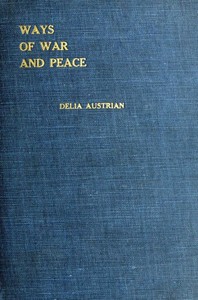
Ways of War and Peace — Reading Companion
(0 User reviews)
108
Project Gutenberg
2014
Not confirmed
World War, 1914-1918 -- Personal narratives; Peace
Readers of public-domain and historical texts
Project Gutenberg digital edition
en
Edition facts
Words
48,741
Reading time
212 min
Text sections
5
The source record for Ways of War and Peace — Reading Companion measures this digital text at 48,741 words, 3 hr 32 min estimated reading time, and 5 detected text sections.
The text analysis averages about 22.1 words per sentence, while the detected sections provide another way to judge how the source is divided.
Project Gutenberg metadata also associates the work with “World War, 1914-1918 -- Personal narratives,” connecting these edition facts with the source record’s subject description.
Source:
Project Gutenberg record #45828
Delia Austrian's 1914 eyewitness account contrasts the paradoxes of war and peace through personal encounters, including a peace activist's thwarted efforts, and examines women's roles during mobilization, using direct observation and a conversational, opinionated voice.
Editorial Edition Score
4.7/5
★★★★★
★★★★★
Calculated from edition completeness, EPUB availability, text structure and catalogue metadata. Not a user rating.
How this score is calculated
- Description quality20 pts
- Title & short description10 pts
- Source metadata20 pts
- Text length15 pts
- Chapters / structure15 pts
- EPUB file integrity20 pts
Total of 100 points, scaled to a 2.5-5.0 range. Editions with an empty description or a missing EPUB file are not scored.
Edition quality
Public-domain source text
Read the source text
The source text is kept in the dedicated reader, separate from this catalogue record and its commentary.
Delia Austrian opens Ways of War and Peace with a paradox: “at times life seems to be a mass of contradictions of love and hate, of friendship and enmity, of truths and falsehoods, of war and peace.” This framing sets the tone for a personal narrative that moves between scenes of peace advocacy and the sudden eruption of World War I. Austrian recounts a near-meeting with peace activist Anna Eckstein in Bavaria just before war was declared—a moment that crystallizes the book’s central tension. The author’s voice is direct and conversational, often addressing the reader with questions like “How Would You Like to Be a Refugee?” and “What the World-War Will Mean to Womankind.” These chapter titles signal a journalistic, opinion-driven approach rather than a detached historical account.
A Peace Activist’s Efforts Cut Short
The foreword introduces Miss Anna Eckstein, an American woman who “has devoted her life to the world's peace movement.” Austrian describes receiving a letter from Eckstein asking her to form local centers in Chicago for signing peace petitions. “I had not much more than read this letter and put the petitions away for safekeeping when the word came that the great war was declared.” This juxtaposition—peace work interrupted by war—becomes a recurring motif. Austrian calls it “the greatest of paradoxes” that Eckstein’s efforts “have failed for the time being, because monarchs and statesmen, goaded on by a foolish idea for stronger empires and more possessions, had thrown their nations against each other.” The language is blunt, assigning blame to leaders rather than abstract forces. The passage grounds the book’s argument in a specific, failed initiative, making the abstract concept of peace tangible through one woman’s thwarted campaign.
Women as Wartime Spartans
In the chapter “What the World-War Will Mean to Womankind,” Austrian argues that European women, though “the fewest … want war,” are “taught to believe that every man belongs to his country first and to his family afterwards.” She observes that German women are “natural or at least trained Spartans,” citing the Kaiserin and Crown Princess as exemplars. The Kaiserin, when asked what she would do while the Emperor was at the front, replied: “But stay at home and look after all my children; this means all the women and children in the land who need me.” Austrian reports that the Empress donated forty thousand dollars to the Red Cross and visited hospitals and markets to control food prices. The tone is admiring but critical: women are portrayed as resilient yet constrained by a system that demands sacrifice. Austrian’s use of direct quotation and specific detail—the dollar amount, the market visits—lends credibility to her portrait of royal women as active managers of the home front.
A Call for American Leadership
Austrian’s narrative shifts from observation to advocacy in her closing argument. She writes that “it was an American who made the peace palace a reality” and insists that “when the time comes for the stopping of this awful carnage and bloodshed, America must insist that every nation in the world shall lay down her arms and that they shall change their men-of-war into merchant marines for the benefit of mankind.” This appeal ties the peace movement to a concrete project—the Panama Canal—which she calls “the fulfillment” of that vision. The prose becomes urgent and declarative, moving away from reportage toward a direct call to action. The shift in pace from descriptive scenes to polemical conclusion mirrors the book’s structure: personal anecdote gives way to political argument. Austrian’s voice remains consistent—opinionated, engaged, and unafraid to assign responsibility—but the register rises, matching the gravity of her subject.
Ways of War and Peace is best read as a primary document of its moment: a witness account that blends journalism, memoir, and polemic. Austrian’s strength lies in her specific, named examples—Eckstein’s petitions, the Kaiserin’s Red Cross donation, the Crown Princess’s public appearances—which ground her broader arguments in observable detail. Readers should note the book’s rapid shifts between scenes of peace advocacy and war mobilization, and between reportage and editorializing. These changes in pace reflect the author’s own experience of a world turned upside down, and they give the text its distinctive, urgent character.
Reading Delia Austrian's account of that peace activist’s quiet, thwarted hope, I felt the strange weight of what isn’t said during mobilization. It reminded me of another map of that same summer, a starker one. In The Campaign Round Liège — A Reader’s Guide, the focus shifts to such different voices, yet the same odd stillness lingers—the pause before events simply happen.
There are no reviews for this eBook.
There are no comments for this eBook.
Reader reflection
Record your reading impressions
A brief reflection can help important ideas stay with you longer.
Your progress
0
/
10
2
How much did you enjoy the reading experience?
3
How likely are you to recommend this book?
4
How much effort did this book require?
5
Would you read this book again?
6
How closely did the book connect with your experience?
7
How valuable was this book for your own interests?
8
How original did the book feel?
9
What changed or sharpened your thinking?
10