1

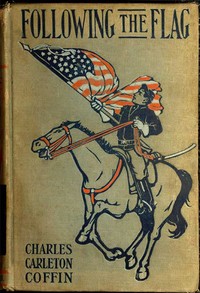
Following the Flag, from August 1861 to November 1862, with the Army of the Potomac — A Closer Reading
(0 User reviews)
117
Project Gutenberg
2013
Not confirmed
United States -- History -- Civil War, 1861-1865 -- Campaigns
Readers of public-domain and historical texts
Project Gutenberg digital edition
en
Edition facts
Words
72,637
Reading time
316 min
Text sections
10
For Following the Flag, from August 1861 to November 1862, with the Army of the Potomac — A Closer Reading, the stored edition analysis reports 72,637 words, 5 hr 16 min estimated reading time, and 10 detected text sections.
The text analysis averages about 15.5 words per sentence, while the detected sections provide another way to judge how the source is divided.
Project Gutenberg metadata also associates the work with “United States -- History -- Civil War, 1861-1865 -- Campaigns,” connecting these edition facts with the source record’s subject description.
Source:
Project Gutenberg record #43641
An 1863 account of the Army of the Potomac under McClellan, from organization through Antietam, using vivid battle scenes and a gate-swinging metaphor to describe troop movements.
Editorial Edition Score
4.8/5
★★★★★
★★★★★
Calculated from edition completeness, EPUB availability, text structure and catalogue metadata. Not a user rating.
How this score is calculated
- Description quality20 pts
- Title & short description10 pts
- Source metadata20 pts
- Text length15 pts
- Chapters / structure15 pts
- EPUB file integrity20 pts
Total of 100 points, scaled to a 2.5-5.0 range. Editions with an empty description or a missing EPUB file are not scored.
Edition quality
Public-domain source text
Read the source text
The source text is kept in the dedicated reader, separate from this catalogue record and its commentary.
Charles Carleton Coffin’s Following the Flag opens not with a grand proclamation but with the mundane machinery of war: the organization of the Army of the Potomac. From the first chapter, Coffin establishes himself as a correspondent who moves with the troops, recording not just battles but the intervals of march, camp, and siege. His narrative is built around a recurring structural device—the swinging of battle lines like a gate pivoted on its center—which he applies to Groveton and Antietam alike. This image of pivoting formations gives the reader a spatial anchor amid the chaos of shifting fronts.
A Correspondent’s View of Command
Coffin writes as an observer embedded with the army, yet he rarely inserts himself into the scene. Instead, he focuses on the decisions of generals and the movements of brigades. The preface admits the book is a sketch, not a full history, and limits itself to brigades and divisions rather than regiments. This deliberate scope allows Coffin to trace the arc of McClellan’s command from the Peninsula to Antietam without bogging down in unit-level detail. He includes an appendix for readers who want to locate specific regiments, but the narrative itself stays at a higher altitude.
One notable feature is Coffin’s willingness to quote Southern sources. He cites the historian Pollard on the battle of Groveton, letting a Confederate voice describe the Federal charge as “splendid.” This choice gives the account a rare dual perspective, even as Coffin remains firmly Union in sympathy.
The Gate-Swinging Battle Line
At Groveton, Coffin describes the Union line “swinging like a gate pivoted on its center.” The image recurs at Antietam, where Hooker’s attack drives Jackson toward Sudley, swinging him back. This mechanical metaphor—a gate on a hinge—becomes Coffin’s signature way of rendering fluid troop movements. He applies it to both offensive and defensive actions, suggesting a tactical pattern he observed across multiple engagements.
The metaphor also reflects Coffin’s interest in the geometry of battle. He diagrams key fights with simple maps, but the gate-swinging language does more: it gives the reader a mental model of how a line can pivot without breaking. When the Rebels follow Porter “cheering and shouting,” the gate swings the other way. Coffin’s prose turns the chaos of volleys and charges into a choreographed, almost mechanical, dance.
Moments of Human Scale
Amid the brigade-level maneuvers, Coffin occasionally zooms in on individual soldiers. A wounded Rebel officer tells him at Warrington, two months after Groveton, how the Federals “fell upon us like a thunderbolt” and “paid no attention to our volleys.” The officer admits cheering the enemy’s bravery. Coffin lets that voice stand without editorializing, preserving a moment of shared respect across the lines.
Elsewhere, he notes the exhaustion of Lee’s army after Antietam—too spent to pursue the retreating Federals. These human details counterbalance the abstract swings of battle lines. Coffin does not invent dialogue or emotions; he records what he saw and heard, trusting the reader to feel the weight of a soldier’s admiration for his foe.
The Shape of a Campaign
Coffin structures his narrative chronologically from August 1861 to November 1862, but he does not treat each battle equally. The Seven Days receive a chapter each, while the Maryland campaign gets two. The siege of Yorktown and the battle of Williamsburg are compressed into single chapters. This uneven pacing reflects Coffin’s own presence: he was likely closer to some actions than others.
The book ends not with a victory but with McClellan’s removal. Coffin does not editorialize on the general’s dismissal; he simply records the march from Harper’s Ferry to Warrenton and the change of command. The final chapter is titled “Removal of General McClellan,” a flat statement that closes the narrative without resolution. For a book that began with organization, it ends with reorganization—a quiet acknowledgment that the war outlasted its first commander.
Coffin’s Following the Flag is best read as a contemporary dispatch rather than a retrospective history. Its value lies in the immediacy of its observations—the gate-swinging lines, the quoted Rebel officer, the appendix for regiment-hunters. Readers interested in the mechanics of Civil War battles will find a clear, if partial, account of the Army of the Potomac’s first year. Those seeking a broader view should supplement it with modern scholarship, but Coffin’s voice remains a useful window into how the war looked to those who followed the flag.
The way Following the Flag lingers is in that strange, swinging rhythm of the armies—how it all felt like a gate moving without ever quite closing. That same ache for order amid chaos came back to me in The History of the Confederate War, Its Causes and Its Conduct, Volume 2 (of 2) A Narrative and Critical History — Reading Notes, where the causes feel heavy, almost personal. Two books, one long exhale.
There are no reviews for this eBook.
There are no comments for this eBook.
Reader reflection
Before you leave, reflect on the book
Use these questions to collect your thoughts before moving on.
Your progress
0
/
10
2
What was your overall reaction to the book?
3
Is this a title you would suggest to others?
4
What was the reading difficulty like?
5
Would you read this book again?
6
Was the book easy to understand?
7
Did the story or argument move comfortably?
8
Would you start a conversation about this book?
9
In one sentence, what did you learn?
10