1

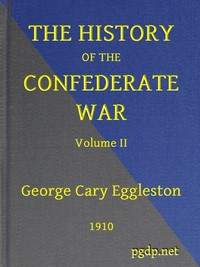
The History of the Confederate War, Its Causes and Its Conduct, Volume 2 (of 2) A Narrative and Critical History — Reading Notes
(0 User reviews)
484
Project Gutenberg
2014
Not confirmed
United States -- History -- Civil War, 1861-1865
Readers of public-domain and historical texts
Project Gutenberg digital edition
en
Edition facts
Words
98,045
Reading time
427 min
Text sections
32
The source record for The History of the Confederate War, Its Causes and Its Conduct, Volume 2 (of 2) A Narrative and Critical History — Reading Notes measures this digital text at 98,045 words, 7 hr 7 min estimated reading time, and 32 detected text sections.
The text analysis averages about 24.0 words per sentence, while the detected sections provide another way to judge how the source is divided.
Project Gutenberg metadata also associates the work with “United States -- History -- Civil War, 1861-1865,” connecting these edition facts with the source record’s subject description.
Source:
Project Gutenberg record #46175
Eggleston's narrative of the Civil War's second half uses vivid, often gruesome detail to depict combat, logistics, and leadership, with a marked emphasis on the physical and moral endurance of soldiers under extreme conditions.
Editorial Edition Score
4.9/5
★★★★★
★★★★★
Calculated from edition completeness, EPUB availability, text structure and catalogue metadata. Not a user rating.
How this score is calculated
- Description quality20 pts
- Title & short description10 pts
- Source metadata20 pts
- Text length15 pts
- Chapters / structure15 pts
- EPUB file integrity20 pts
Total of 100 points, scaled to a 2.5-5.0 range. Editions with an empty description or a missing EPUB file are not scored.
Edition quality
Public-domain source text
Read the source text
The source text is kept in the dedicated reader, separate from this catalogue record and its commentary.
Eggleston opens Volume II with the siege of Fort Wagner, describing Federal troops wading waist-deep in water, rifles held overhead, and the first assault by a regiment of negro troops. He notes the assault was met with such force that the Federals lost more than 1,500 men while inflicting fewer than 100 casualties. The author's diction is unsparing: he writes of men shot through the body as they slept, of 'poisonous miasms' and 'pestilential swamps' that killed more soldiers than enemy fire. This focus on the physical cost of war—the mud, the fever, the relentless fire at pistol-shot range—sets the tone for a history that dwells on the grit of combat rather than grand strategy.
Diction of Desperation
Eggleston's word choices consistently emphasize the extreme nature of the fighting. He describes the struggle for Fort Wagner as 'desperate in the extreme,' with a fire that was 'incessant' and 'murderous in its effects.' The phrase 'unconquerable spirit' appears, but it is earned through the accumulation of concrete horrors: men mining under boiler-iron tubes, guns moved at the cost of 'scores of lives,' and a siege where 'at no moment of the twenty-four hours was any man secure.' The author avoids abstract heroism; instead, he builds a vocabulary of attrition—'fragmentary remains,' 'slew far more,' 'terrible instruments of death.' This lexical field reinforces his thesis that the war was a grinding, physical ordeal.
Narrative Structure: The Siege as Microcosm
The extended Fort Wagner passage (Chapter XLI) exemplifies Eggleston's method. He structures the narrative around a single, protracted action, moving from assault to siege to bombardment. Each phase is marked by a specific technical detail: the first parallel, the second parallel, the use of boiler-iron tubes. The author interweaves tactical description with human cost, noting that Gillmore's sick list grew 'day by day' as men succumbed to 'country fever.' This structure—alternating between engineering progress and bodily toll—creates a rhythm of advance and suffering. Eggleston does not merely recount events; he shapes them to highlight the interplay between human will and environmental resistance.
Voice and Judgment in Battle Accounts
Eggleston frequently inserts evaluative statements that reveal his authorial stance. Of the negro troops' first assault, he writes that 'the conduct of those troops was worthy of the best traditions of battling.' This is a pointed judgment, especially given the era's racial attitudes. He also praises Gillmore as 'an engineer of the highest capacity and a soldier of the utmost courage, energy and determination.' Such direct commendation is rare; more often, he lets the action speak. Yet his voice emerges in phrases like 'here was work that must be done, and here were men resolute enough to do it,' which frames the siege as a test of character. These interjections give the narrative a moral weight without descending into sentimentality.
Recurring Details: Environment as Antagonist
Throughout the excerpts, the natural environment is portrayed as a hostile force. Eggleston emphasizes the 'narrow strip of land—a mere marsh scarcely at all elevated' on which the siege was conducted. He notes that before the war, 'no white man had ever dared spend a night' in those swamps between June and November. The 'poisonous miasms' and 'country fever' are given as much attention as Confederate artillery. This recurring motif—the landscape itself fighting against the soldiers—distinguishes Eggleston's account from more conventional military histories. He treats terrain not as a static backdrop but as an active participant in the conflict, one that exacts a toll independent of enemy action.
Eggleston's history rewards readers who attend to his language as much as his facts. His choice to dwell on the physical particulars of siege warfare—the mud, the fever, the sleepless nights under fire—offers a perspective often missing from broader strategic narratives. For those interested in how Civil War soldiers experienced combat at the tactical level, this volume provides a granular, unflinching view. The author's own background as a Confederate veteran lends his judgments a particular weight, though he does not let partisanship override his evident respect for courage on both sides.
The rain kept drumming on the windows while I read about the grinding misery of Cold Harbor, the sheer weight of endurance. It left me restless, so I picked up something smaller, a quieter record of a single soldier. That’s when I found Dinsmore Ely, One Who Served — Context and Discussion, and the mud of one campaign narrowed into one man’s feet.
There are no reviews for this eBook.
There are no comments for this eBook.
Reader reflection
Record your reading impressions
A brief reflection can help important ideas stay with you longer.
Your progress
0
/
10
2
Was reading this book enjoyable?
3
Is this a title you would suggest to others?
4
How easy was the book to follow?
5
How original did the book feel?
6
What was the strongest part of the book?
7
Did it raise ideas you would like to talk about?
8
Was the book moving at the right speed?
9
What is the main idea you are taking away?
10