1

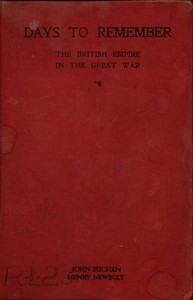
Days to Remember: The British Empire in the Great War — Reading Companion
(0 User reviews)
256
Project Gutenberg
2015
Not confirmed
World War, 1914-1918
Readers of public-domain and historical texts
Project Gutenberg digital edition
en
Edition facts
Words
55,482
Reading time
242 min
Text sections
9
This digital edition of Days to Remember: The British Empire in the Great War — Reading Companion is described by source-level measurements including 55,482 words, 4 hr 2 min estimated reading time, and 9 detected text sections.
The text analysis averages about 21.6 words per sentence, while the detected sections provide another way to judge how the source is divided.
Project Gutenberg metadata also associates the work with “World War, 1914-1918,” connecting these edition facts with the source record’s subject description.
Source:
Project Gutenberg record #49540
John Buchan and Henry Newbolt's 1922 narrative of the British Empire in World War I, blending strategic overviews with vivid battle accounts. The excerpts show a tension between patriotic framing and precise, almost eerie descriptions of military operations, such as the Gallipoli evacuation's silent, moonlit embarkations.
Editorial Edition Score
4.7/5
★★★★★
★★★★★
Calculated from edition completeness, EPUB availability, text structure and catalogue metadata. Not a user rating.
How this score is calculated
- Description quality20 pts
- Title & short description10 pts
- Source metadata20 pts
- Text length15 pts
- Chapters / structure15 pts
- EPUB file integrity20 pts
Total of 100 points, scaled to a 2.5-5.0 range. Editions with an empty description or a missing EPUB file are not scored.
Edition quality
Public-domain source text
Read the source text
The source text is kept in the dedicated reader, separate from this catalogue record and its commentary.
John Buchan and Henry Newbolt's Days to Remember: The British Empire in the Great War (1922) opens with a conventional account of the war's causes—Germany's late imperial ambition—but the excerpts reveal a more striking pattern: the authors repeatedly dwell on moments of eerie quiet and deceptive calm. The Gallipoli evacuation, described in detail, is framed as a 'daring conspiracy' with nature, where 'the sea was still as a mill-pond' and transports moved 'in dead quiet, showing no lights.' This tension between the grand imperial narrative and the intimate, almost ghostly particulars of warfare recurs throughout the text.
Silence and Deception as Narrative Devices
The excerpts from the Gallipoli evacuation chapters are remarkable for their sustained focus on silence and concealment. The authors note that 'not a shot was fired' during the embarkation, and that the British kept up 'the daily pretence of bombardment' with only enough guns to deceive Turkish observers. The language is deliberately atmospheric: 'a light blue mist clothed all the plain of Suvla, and a haze shrouded the moon.' This is not merely reportage; it is a crafted set-piece that turns a retreat into a suspenseful, almost supernatural operation. The phrase 'Nature had joined the daring conspiracy' personifies the weather as an accomplice. Such passages stand in contrast to the more straightforward battle narratives elsewhere, suggesting that Buchan and Newbolt were as interested in the psychology of deception as in the clash of arms.
The Empire as a Collective Protagonist
The table of contents and chapter headings foreground the contributions of specific Dominion and colonial forces: 'The Canadians at the Second Battle of Ypres,' 'The South Africans at Marrières Wood,' 'The Australians at Mont St. Quentin.' This structure frames the war as a shared imperial endeavor, with each section highlighting a different national contingent. However, the excerpts do not explore internal tensions or divergent experiences; instead, the narrative voice remains uniformly British and authoritative. The Gallipoli chapters, for instance, refer to 'our men' and 'the British commanders,' subsuming the Australian and New Zealand forces under a single imperial identity. The effect is a deliberate, if partial, portrait of unity—one that glosses over the strategic failures of the campaign to emphasize the skill of the evacuation.
Contrasts Between Grand Strategy and Tactical Detail
The book's structure juxtaposes broad strategic overviews (Part I: 'The Causes of the War,' 'A Bird's-Eye View of the War') with highly specific battle accounts (Part II: 'The Worcesters at the First Battle of Ypres,' 'The Tanks at Cambrai'). The excerpts from the Gallipoli section show this contrast within a single episode: the authors provide precise logistical details—'the beaches at Suvla were 5 miles from the enemy,' 'some of our gun positions there were on dizzy heights'—while also invoking literary allusions, such as the 'land beyond the North Wind, which Elizabethan mariners believed in.' This blend of technical military writing and romantic imagery is characteristic of the book's dual ambition: to inform and to commemorate. The reader is given both the mechanics of the evacuation and its emotional resonance.
Readers approaching Days to Remember should attend to the shifts in register between the panoramic and the intimate. The book is not a dry staff history but a crafted narrative that uses silence, weather, and deception as dramatic elements. The Gallipoli chapters, in particular, reward close reading for their controlled, almost novelistic prose. The authors' decision to end the evacuation with the image of 'great heaps' of stores burning on the beaches—'blazing most fiercely near Suvla Point'—leaves a haunting final impression that lingers beyond the strategic summary.
There’s something haunting in that moonlit Gallipoli evacuation—the quiet precision of it stays with you. Reading Buchan and Newbolt’s grand narrative, I kept thinking how the vast war always came down to such small, human silences. That’s why From Dartmouth to the Dardanelles: A Midshipman's Log — Reading Notes felt like a whispered reply, a boy’s own steadiness amid the same dark water. It’s just a different kind of truth, held closer.
There are no reviews for this eBook.
There are no comments for this eBook.
Reader reflection
What did you think of this book?
Answer a few questions and save a private reflection on this device.
Your progress
0
/
10
2
How much did you enjoy the reading experience?
3
Would you pass this book on to a friend?
4
How easy was the book to follow?
5
Did any part of the book feel personally relevant?
6
Would you read this book again?
7
What was the strongest part of the book?
8
How valuable was this book for your own interests?
9
In one sentence, what did you learn?
10