1

Huts in Hell — Reading Notes
(0 User reviews)
566
Project Gutenberg
2014
Not confirmed
World War, 1914-1918 -- Personal narratives
Readers of public-domain and historical texts
Project Gutenberg digital edition
en
Edition facts
Words
54,338
Reading time
237 min
Text sections
6
For Huts in Hell — Reading Notes, the stored edition analysis reports 54,338 words, 3 hr 57 min estimated reading time, and 6 detected text sections.
The text analysis averages about 21.1 words per sentence, while the detected sections provide another way to judge how the source is divided.
Project Gutenberg metadata also associates the work with “World War, 1914-1918 -- Personal narratives,” connecting these edition facts with the source record’s subject description.
Source:
Project Gutenberg record #47474
Daniel A. Poling's firsthand account of American soldiers in WWI France, focusing on their courage, humor, and the support agencies behind them, based on his observations from port to front line.
Editorial Edition Score
4.7/5
★★★★★
★★★★★
Calculated from edition completeness, EPUB availability, text structure and catalogue metadata. Not a user rating.
How this score is calculated
- Description quality20 pts
- Title & short description10 pts
- Source metadata20 pts
- Text length15 pts
- Chapters / structure15 pts
- EPUB file integrity20 pts
Total of 100 points, scaled to a 2.5-5.0 range. Editions with an empty description or a missing EPUB file are not scored.
Edition quality
Public-domain source text
Read the source text
The source text is kept in the dedicated reader, separate from this catalogue record and its commentary.
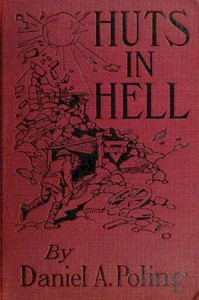
Daniel A. Poling's Huts in Hell (1918) is a firsthand report from France, where the author deliberately chose to study the American soldier exclusively, living with him from the port of entry to the front line. The book's title refers to the Red Triangle huts—welfare stations run by the YMCA—that offered respite amid the war's horrors. Poling, representing several Christian organizations, writes as an unaccompanied observer, claiming to have seen things at their best and worst. His narrative voice is direct and morally earnest, often blending reportage with patriotic exhortation.
Voice and Moral Framing
Poling's prose is marked by a preacherly cadence and a tendency to elevate individual anecdotes into moral exempla. He describes a Scottish provost who, after losing his third son in action, still chaired a meeting—Poling calls this being "in the trenches that night." Such passages reveal his method: he uses concrete incidents to illustrate abstract virtues like endurance and duty. The author frequently shifts from observation to exhortation, as when he writes that the American soldier "confesses his fear" but never turns from duty. This rhetorical pattern—specific scene followed by moral gloss—gives the book a pulpit-like rhythm, even as it grounds claims in witnessed behavior.
Pace and Structural Shifts
The book's pace varies between rapid-fire vignettes and more reflective set pieces. Early chapters move quickly through travel and first impressions, while later sections slow to dwell on trench life, gas attacks, and the work of support organizations. Poling often interrupts narrative flow with direct addresses to the reader or extended quotations from soldiers. The chapter "A Dugout Diary" suggests a shift to a more intimate, diaristic mode, though the excerpts show Poling maintaining his role as interpreter rather than letting the diary speak entirely for itself. This alternation between speed and stillness mirrors the soldier's own experience of sudden action and long waiting.
Recurring Details and Their Weight
Certain images recur: the grave, the hospital train, the flower-woman in black. Poling describes watching hospital trains pull into London stations during a "big push," noting wounded men who wave or smile at crowds. He also highlights the devotion of poor newsboys and flower-women who give beyond their means. These details serve as emotional anchors, grounding the book's larger arguments about sacrifice and home-front solidarity. The author's choice to include such scenes—rather than only combat—reflects his stated aim to document the "efficient agencies" behind the fighters. The repeated motif of civilians sharing the soldier's ordeal reinforces his thesis that the war effort was collective.
Readers should approach Huts in Hell as a document of its moment—a wartime account shaped by Poling's organizational affiliations and his desire to boost morale. The book is less a continuous narrative than a series of impressions, held together by the author's unwavering voice. Pay attention to how Poling balances specific observation with general commentary; this tension reveals both the strengths and limitations of his method. For those interested in the American experience of WWI, the book offers a contemporary, if partisan, view of the soldier's life and the institutions that supported him.
That rainy afternoon, reading Poling’s account of soldiers whistling through the mud, I kept thinking how hardship sharpens a kind of stubborn civility. Later, leafing through Huts in Hell, I found myself reaching for The Recollections of Alexis de Tocqueville — Themes and Context, wondering if every generation’s quiet dignity under pressure leaves a similar, faint watermark on its diaries.
There are no reviews for this eBook.
There are no comments for this eBook.
Reader reflection
What was your reading experience?
Capture what you thought, learned, and would like to remember.
Your progress
0
/
10
2
Did this book hold your interest?
3
Would you encourage someone else to read it?
4
How much effort did this book require?
5
Could you follow the author’s main argument?
6
Did you gain anything practical from the text?
7
Did you relate to its people, ideas, or situations?
8
Did anything about the book feel genuinely new?
9
What changed or sharpened your thinking?
10