1

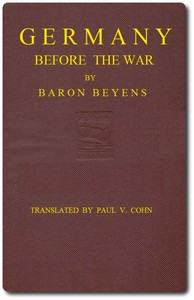
Germany before the war — Text and Context
(0 User reviews)
738
Project Gutenberg
2015
Not confirmed
World War, 1914-1918 -- Causes; Germany -- Foreign relations -- 1871-1918
Readers of public-domain and historical texts
Project Gutenberg digital edition
en
Edition facts
Words
88,029
Reading time
383 min
Text sections
8
For Germany before the war — Text and Context, the stored edition analysis reports 88,029 words, 6 hr 23 min estimated reading time, and 8 detected text sections.
The text analysis averages about 26.7 words per sentence, while the detected sections provide another way to judge how the source is divided.
Project Gutenberg metadata also associates the work with “World War, 1914-1918 -- Causes,” connecting these edition facts with the source record’s subject description.
Source:
Project Gutenberg record #48572
Baron Beyens, Belgian minister in Berlin before WWI, examines German society, politics, and militarism through firsthand observation, focusing on the Kaiser, army, and intellectual currents that shaped the path to war.
Editorial Edition Score
4.8/5
★★★★★
★★★★★
Calculated from edition completeness, EPUB availability, text structure and catalogue metadata. Not a user rating.
How this score is calculated
- Description quality20 pts
- Title & short description10 pts
- Source metadata20 pts
- Text length15 pts
- Chapters / structure15 pts
- EPUB file integrity20 pts
Total of 100 points, scaled to a 2.5-5.0 range. Editions with an empty description or a missing EPUB file are not scored.
Edition quality
Public-domain source text
Read the source text
The source text is kept in the dedicated reader, separate from this catalogue record and its commentary.
Baron Beyens, the Belgian minister at the Court of Berlin, wrote Germany before the War in 1916, drawing on his diplomatic tenure to analyze the forces that propelled Europe into conflict. Rather than a neutral survey, the book is a pointed indictment of German militarism, the Kaiser’s court, and the intellectual currents that glorified war. Beyens repeatedly contrasts the ideals of the Hague peace conferences with what he calls the “predatory instincts” and “ancestral cruelty” he sees in German conduct. His perspective is that of a diplomat from a neutral country that was invaded, and this vantage shapes every chapter.
A Diplomat’s Accusation
Beyens does not pretend to objectivity. The introduction recalls the failed peace efforts of the Hague Conferences and private pacifists like Baron d’Estournelles de Constant, only to argue that Germany’s leadership never intended to abide by them. He writes that the “observance of these rules cannot be enforced by any court of justice, and depends entirely upon the honesty or good will of the Powers.” This framing sets up his central claim: that Germany’s rulers, from the Kaiser down, were bent on war. The catalog subject “World War, 1914-1918 – Causes” is thus addressed not through abstract analysis but through a prosecutor’s brief, built on Beyens’s own observations and the public record of German policy.
The Prussian School of History
One of the most distinctive sections of the excerpts is Beyens’s attack on German historiography. He traces a line from Niebuhr, Ranke, and Mommsen to Treitschke and Delbrück, arguing that the “Prussian school writes German history as if it were the development of a single idea” – the inevitable unification under Hohenzollern rule. Beyens claims this teaching instilled in generations of students a “thirst for blood” and an “implacable hatred of France and England.” He is careful to note that similar nationalism existed elsewhere, but insists that German universities uniquely directed historical criticism toward a political goal. This is not a neutral summary of intellectual history; it is a wartime polemic linking academic culture to military aggression.
The War’s Atavistic Face
Beyens devotes striking passages to what he sees as a reversion to barbarism. He describes German soldiers “rifling the invaded country, ransacking houses, great and small, from cellar to loft, organizing convoys of booty to be sent to Germany.” He calls this “atavism, as persistent as original sin.” The language is moral and visceral, far removed from the measured tone of diplomatic memoir. Beyens also accuses the German high command of ordering “no mercy” and of knowing that their troops would obey “to the letter.” These claims, made in 1916, reflect the contemporary propaganda about German atrocities in Belgium, but they also reveal the author’s emotional investment. The excerpts do not provide evidence for these accusations; they present them as established fact.
Readers should approach Germany before the War as a primary source of wartime opinion rather than a detached historical study. Beyens’s proximity to events and his personal stake as a Belgian diplomat give the book urgency but also bias. The catalog subjects list “World War, 1914-1918 – Causes” and “Germany – Foreign relations – 1871-1918,” but the excerpts show that Beyens is less interested in diplomatic chronology than in moral condemnation. For a fuller picture, pair this with works that examine German decision-making from other national perspectives.
Baron Beyens’s quiet dread in that Berlin drawing-room—watching cheerful men march toward something unspoken—stays with me. It reminds me of another diary, where ordinary mornings in France slowly tense into war’s shadow. War Days in Brittany — Edition Insights holds that same lingering ache, a gentler echo of his unease, and I think of it often.
There are no reviews for this eBook.
There are no comments for this eBook.
Reader reflection
How will you remember this book?
Save your reaction, strongest insight, and memorable passage.
Your progress
0
/
10
2
Did this book hold your interest?
3
Would you pass this book on to a friend?
4
How demanding did the text feel?
5
Could you follow the author’s main argument?
6
How would you describe its reading pace?
7
Would you read this book again?
8
Would you like to discuss this book with someone?
9
Which lesson or insight stayed with you?
10