1

Q-Ships and Their Story — Inside the Classic
(0 User reviews)
1244
Project Gutenberg
2017
Not confirmed
World War, 1914-1918 -- Naval operations; Q-ships
Readers of public-domain and historical texts
Project Gutenberg digital edition
en
Edition facts
Words
85,401
Reading time
372 min
Text sections
11
For Q-Ships and Their Story — Inside the Classic, the stored edition analysis reports 85,401 words, 6 hr 12 min estimated reading time, and 11 detected text sections.
The text analysis averages about 21.7 words per sentence, while the detected sections provide another way to judge how the source is divided.
Project Gutenberg metadata also associates the work with “World War, 1914-1918 -- Naval operations,” connecting these edition facts with the source record’s subject description.
Source:
Project Gutenberg record #54338
A detailed account of British Q-ships in World War I, based on the author's firsthand experience and diaries, focusing on the cat-and-mouse duels between disguised merchant vessels and German U-boats off the Irish coast.
Editorial Edition Score
4.9/5
★★★★★
★★★★★
Calculated from edition completeness, EPUB availability, text structure and catalogue metadata. Not a user rating.
How this score is calculated
- Description quality20 pts
- Title & short description10 pts
- Source metadata20 pts
- Text length15 pts
- Chapters / structure15 pts
- EPUB file integrity20 pts
Total of 100 points, scaled to a 2.5-5.0 range. Editions with an empty description or a missing EPUB file are not scored.
Edition quality
Read the Text
the most famous of all the Q-ships and rendered splendid service. The dummy deck-house on the poop concealed the after gun (see p. 67).
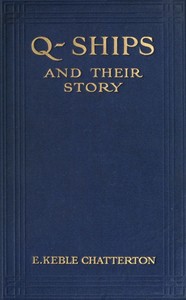
Q-SHIPS AND THEIR STORY
Author of “Sailing Ships and Their Story,” Late Lieutenant-Commander R.N.V.R.
London Sidgwick and Jackson, Ltd. 3, Adam Street, Adelphi, W.C. 1922
ADMIRAL SIR LEWIS BAYLY, C.V.O., K.C.B., K.C.M.G.,
COMMANDER-IN-CHIEF OF THE IRISH COAST DURING THE STRENUOUS YEARS OF THE SUBMARINE CAMPAIGN, WHO BY HIS ENCOURAGEMENT AND DEVELOPMENT OF THE Q-SHIP SERVICE DID SO MUCH TO THWART THE OPERATIONS OF THE ENEMY AND TO PROTECT OUR MERCANTILE MARINE
The wonderful and brave story of ships and men here presented needs but the briefest introduction. The deeds will forever remain one of the most glorious chapters in the chronicles of the sea. No excuse is offered for adding another volume to the literature of the war, for the subject is deserving of greater attention than has hitherto been possible. Lord Jellicoe once remarked that he did not think English people realized the wonderful work which these mystery ships had done in the war, and that in these vessels there had been displayed a spirit of endurance, discipline, and courage the like of which the world had never before seen.
To few naval historians, I believe, has it ever been permitted to enjoy such complete opportunities for acquiring authentic information as is here presented. Unquestionably the greatest sphere of Q-ship operations was off the south-west coast of Ireland, owing to the fact that the enemy submarines from the summer of 1915 to 1918 concentrated their attacks, with certain intervals, on the shipping in the western approaches to the British Isles. It was my good fortune during most of this period to be at sea patrolling off that part of Ireland. These Q-ships were therefore familiar in their various disguises at sea or in harbour at Berehaven and Queenstown during their well-earned rest. Throughout this time I kept a diary, and noted down much that would otherwise have been forgotten. Many of the Q-ship officers were my personal friends, and I have enjoyed the hospitality of their ships. Valuable data, too, were obtained from officers of merchant ships who witnessed Q-ships engaging submarines.
A considerable number of authentic manuscripts has been examined. By the courtesy of commanding officers I have been lent documents of priceless historical value, such as copies of official reports and private diaries, plans, sketches, photographs, and so on. All this information has been further augmented by personal conversation, correspondence, and valuable criticism. I submit, therefore, that with all these sources of information available, and with knowledge of much that has been published from the German side, it is possible to offer a monograph that is at once accurate in detail and correct in perspective.
‘With respect to single-ship actions,’ wrote James in his monumental Naval History a hundred years ago, ‘the official documents of them are also very imperfect. The letters are generally written an hour or so after the termination of the contest, and, of course, before the captain has well recovered from the fatigue and flurry it occasioned. Many captains are far more expert at the sword than at the pen, and would sooner fight an action than write the particulars of one.’ That statement is true to-day of the Q-ships, and it would have been negligent not to have availed oneself now of the calm and considered version of the chief actors in the great mystery-ship drama while they are still alive. Although the time for secrecy has long since passed, nothing has here been included of a confidential nature that can be of assistance to enemies past or potential. In one instance, for political reasons and in the interests of the service, I have made a certain omission. Those concerned will recognize this and understand: the rest will not notice it.
Among those who have rendered me the greatest assistance in regard to information, advice, criticism, the loan of manuscripts, illustrations, and in other ways, I desire especially to return thanks to Admiral Sir Lewis Bayly, C.V.O., K.C.B., K.C.M.G., and Miss Voysey, C.B.E.; to Captain F. H. Grenfell, D.S.O., R.N., Captain Gordon Campbell, V.C., D.S.O., R.N., Captain W. C. O’G. Cochrane, R.N., Commander Godfrey Herbert, D.S.O., R.N., Commander Stopford C. Douglas, R.N., and to Lieutenant G. H. P. Muhlhauser, R.N.R.
E. KEBLE CHATTERTON. _March, 1922._
I. THE HOUR AND THE NEED 1
II. THE BEGINNING OF SUCCESS 13
III. Q-SHIP ENTERPRISE 26
IV. THE STORY OF THE ‘FARNBOROUGH’ 39
V. THE ‘MYSTERY’ SAILING SHIPS 52
VI. THE ‘MARY B. MITCHELL’ 67
VII. MORE SAILING SHIPS 77
VIII. SUBMARINES AND Q-SHIP TACTICS 92
IX. THE SPLENDID ‘PENSHURST’ 109
E. Keble Chatterton's Q-Ships and Their Story opens with a striking claim: that the deeds of these mystery ships form 'one of the most glorious chapters in the chronicles of the sea.' The author, a naval officer who served off south-west Ireland during the submarine campaign, draws on his own diary and friendships with Q-ship crews. The catalog subjects—World War I naval operations and Q-ships—accurately frame the book, but the excerpts reveal a narrower focus: the tactical duel between a disguised schooner and a U-boat, described in minute, tense detail. Chatterton's voice is that of an insider, not a distant historian.
A Duel of Deception and Patience
The extended excerpt from the action of HMS Prize against U-93 exemplifies the book's core drama. Chatterton emphasizes the psychological ordeal: the crew lay 'immobile, unseen' for twenty minutes while shells struck the ship. The author notes that the submarine commander, von Spiegel, was a 'star-turn' artist, framing the encounter as a contest between two skilled deceivers. The description of the patent log being carried away as the U-boat closed to 70 yards is a precise, sensory detail that grounds the narrative in physical reality. Chatterton's language is technical but vivid—'the inboard end of a patent log fits into a small slide'—and he repeatedly stresses the discipline required to remain hidden under fire.
The Author's Embedded Perspective
Chatterton's preface reveals that he was at sea off Ireland during the period he describes, keeping a diary and noting details 'that would otherwise have been forgotten.' This personal involvement shapes the book's authority and its limitations. He claims 'complete opportunities for acquiring authentic information,' yet the excerpts show no broader strategic analysis; the focus stays on individual ship actions. The catalog subject 'World War, 1914-1918 -- Naval operations' is accurate but broad—Chatterton's lens is tightly trained on the Q-ship service, not the wider war. His dedication to Admiral Sir Lewis Bayly, who 'did so much to thwart the operations of the enemy,' hints at a partisan, admiring tone that runs through the narrative.
Structure and Voice in the Excerpts
The excerpted action is built around a clear temporal structure: the submarine's approach, the Q-ship's concealment, the moment of revelation. Chatterton uses short, punchy sentences for climax—'Down screens! Open fire!'—and longer, cumulative ones for tension. He frequently addresses the reader directly ('you will remember she was built of iron and steel'), creating a conversational but authoritative tone. The catalog lists 'music' as a secondary topic, but the excerpts contain no reference to music; this may reflect a minor theme elsewhere in the book. The text's word count (85,401) suggests a substantial work, but the excerpts offer only a single, extended episode, leaving the book's overall structure unclear.
Readers should approach Q-Ships and Their Story as a participant's account rather than a comprehensive history. Chatterton's diary-based narrative offers granular detail on specific engagements, but the excerpts do not reveal how he handles the broader campaign or the strategic context. The book's value lies in its immediacy and technical precision, not in detached analysis. Those interested in the mechanics of deception at sea will find the core action compelling, but the work's scope may be narrower than its catalog subjects suggest.
Reading about the silent waiting aboard those Q-ships, I remembered my grandfather’s stories of the muddy, patient horror at Ypres. That same odd stillness before violence, the held breath. The First Seven Divisions Being a Detailed Account of the Fighting from Mons to Ypres — Reading Companion gave me that identical ache—men, invisible, simply enduring before the world erupts. It is a strange companionship, these old voices.
There are no reviews for this eBook.
There are no comments for this eBook.
Reader reflection
How did this book work for you?
Your answers remain private and are stored only in this browser.
Your progress
0
/
10
2
How did the book work for you overall?
3
How likely are you to recommend this book?
4
Did the language feel accessible?
5
Did anything about the book feel genuinely new?
6
Was the book easy to understand?
7
How personally connected did you feel to the book?
8
Did the book deliver what you hoped for?
9
What changed or sharpened your thinking?
10