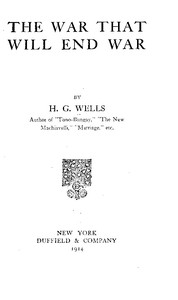
The War That Will End War — A Closer Reading

(1 User reviews)   269
In Category - Modern Nations
Wells, H. G. (Herbert George), 1866-1946 Project Gutenberg 2018 Not confirmed
World War, 1914-1918 Readers of public-domain and historical texts
Project Gutenberg digital edition en

Edition facts

Words 26,070
Reading time 114 min
Text sections 13

The catalog record for The War That Will End War — A Closer Reading provides practical reading context through 26,070 words, 1 hr 54 min estimated reading time, and 13 detected text sections.

The text analysis averages about 22.8 words per sentence, while the detected sections provide another way to judge how the source is divided.

Project Gutenberg metadata also associates the work with “World War, 1914-1918,” connecting these edition facts with the source record’s subject description.

H.G. Wells's 1914 essay collection argues Britain's entry into World War I is a fight against German militarism, urging readers to see the conflict as an opportunity to reshape Europe through liberal internationalism and collective disarmament.
Share
Editorial Edition Score 4.7/5

Calculated from edition completeness, EPUB availability, text structure and catalogue metadata. Not a user rating.

How this score is calculated
  • Description quality20 pts
  • Title & short description10 pts
  • Source metadata20 pts
  • Text length15 pts
  • Chapters / structure15 pts
  • EPUB file integrity20 pts

Total of 100 points, scaled to a 2.5-5.0 range. Editions with an empty description or a missing EPUB file are not scored.

Edition quality

Read the Text

minance as Bulgaria is to-day. The way will be open at last for all these Western Powers to organise peace. That is why I, with my declared horror of war, have not signed any of these “stop-the-war” appeals and declarations that have appeared in the last few days. Every sword that is drawn against Germany now is a sword drawn for peace.

III HANDS OFF THE PEOPLE’S FOOD

This is a war-torn article, a convalescent article.

It is characteristic of the cheerful gallantry of the time that after being left for dead on Saturday evening this article should be able, in an only very slightly bandaged condition, to take its place in the firing-line again on Thursday morning.

It was first written late on Friday night; it was written in a mood of righteous excitement, and it was an extremely ineffective article. In the night I could not sleep because of its badness, and because I did so vehemently want it to hit hard and get its effect. I turned out about two o’clock in the morning and redrafted it, and the next day I wrote it all over again differently and carefully, and I think better. In the afternoon it was blown up by the discovery that Mr. Runciman had anticipated its essential idea. He had brought in, and the House had passed through all its stages, a Bill to give the Board of Trade power to requisition and deal with hoarded or reserved food. That was exactly the demand of my article. My article, about to die, saluted this most swift and decisive Government of ours....

Then I perceived that there were still many things to be said about this requisitioning of food. The Board of Trade has got its powers, but apparently they have still to be put into operation. It is extremely desirable that there should be a strong public opinion supporting and watching the exercise of these powers, and that they should be applied at the proper point immediately. The powers Mr. Runciman has secured so rapidly for the Board of Trade have to be put into operation; there must be an equally rapid development of local committees and commandos to carry out his idea. The shortage continues. It is not over. The common people, who are sending their boys so bravely and uncomplainingly to the front, must be relieved at once from the intolerable hardships which a certain section of the prosperous classes, a small section but an actively mischievous section, is causing them. It is a right; not a demand for charity. It is ridiculous to treat the problem in any other way.

So far the poorer English have displayed an amazing and exemplary patience in this crisis, a humility and courage that make one the prouder for being also English. Apart from any failure of employment at the present time, it must be plain to anyone who has watched the present rise of prices and who knows anything either at first hand of poor households or by reading such investigations as those of Mrs. Pember Reeves upon the family budgets of the poor, that the rank and file of our population cannot now be getting enough to eat. They are suffering needless deprivation and also they are suffering needless vexation. And there is no atom of doubt why they are suffering these distresses. It is that pretentious section of the prosperous classes, the section we might hit off with the phrase “automobile-driving villadom,” the “Tariff Reform and damn Lloyd George and Keir Hardie” class, the most pampered and least public-spirited of any stratum in the community, which has grabbed at the food; it has given way to an inglorious panic; it has broken ranks and stampeded to the stores and made the one discreditable exception in the splendid spectacle of our national solidarity.

While the attention of all decent English folk has been concentrated upon the preparations for our supreme blow at Prussian predominance in Europe, villadom has been swarming to the shops, buying up the food of the common people, carrying it off in the family car (adorned, of course, with a fluttering little Union Jack); father has given a day from business, mother has helped, even those shiny-headed nuts, the sons, have condescended to assist, and now villadom, feeling a little safer, is ready with the dinner-bell, its characteristic instrument of music, to maffick at the victories it has done its best to spoil. And villadom promoted and distended, villadom in luck, turned millionaire, villadom on a scale that can buy a peerage and write you its thousands-of-pounds cheque for a showy subscription list, has been true to its origins. Lord Maffick, emulating Mr. and Mrs. Maffick, swept his district clean of flour; let the thing go down to history. Lord Maffick now explains that he bought it to distribute among his poorer neighbours—that is going to be the stock excuse of these people—but that sort of buying is just exactly as bad for prices as buying for Lord Maffick’s personal interior. The sooner that flour gets out of the houses of Lord Maffick and Horatio Maffick, Esquire, and young Mr. Maffick and the rest of them, and into the houses of their poorer neighbours, the better for them and the country. The greatest danger to England at the present time is neither the German army nor the German fleet, but this morally rotten section of our community.

Now it is no use scolding these people. It is no use appealing to their honour and patriotism. Honour they have none, and their idea of patriotism is to “tax the foreigner,” wave Union Jacks, and clamour for the application to England of just that universal compulsory service which leads straight to those crowded, ineffective massacres of common soldiers that are beginning upon the German war-front. Exhortation may sway the ninety-and-nine, but the one mean man in the hundred will spoil the lot. The thing to do now is to get to work at once in every locality, requisitioning all excessive private stores of food or gold coins—they can be settled for after the war—not only the stores of the private food-grabbers, but also the stores of the speculative wholesalers who are holding up prices to the retail shops. Only in that way can the operations of this intolerable little minority be completely checked. Under every county council food committees should be formed at once to report on the necessities of the general mass and conduct inquiries into hoarding and the seizure and distribution of hoards, small and great.

Now this is a public work calling for the most careful and open methods. Food distribution in England is partly in the hands of great systems of syndicated shops and partly still in the hands of one-shop local tradesmen. It is imperative that the brightest light should be kept upon the operations of both small and large provision dealers. The big firms are in the control of men whose business successes have received in many instances marks of the signal favour and trust of our rulers. Lord Devonport, for example, is a peer; Sir Thomas Lipton is a baronet; they are not to be regarded as mere private traders, but as men honoured by association with the hierarchy of our national life on account of their distinguished share in the public food service. It will help them in their quasi-public duties to give them the support of our attention. Are they devoting their enormous economic advantages to keeping prices at a reasonable level, or are these various systems of syndicated provision shops also putting things up against the consumer? With concerted action on the part of these stores the most perfect control of prices is possible everywhere, except in the case of a few out-of-the-way villages. Is it being done? Nobody wants to see the names of Lord Devonport or Sir Thomas Lipton or the various other rich men associated with them in the food supply flourishing about on royal subscription lists at the present time; their work lies closer at hand. What we all want is to feel that they are devoting their utmost resources to the public food service of which they constitute so important a part. Let me say at once that I have every reason to believe they are doing it, and that they are alive to the responsibilities of their positions. But we must keep the limelight on them and on their less honoured and conspicuous fellow-merchants. They are playing as important and vital a part—indeed, they are called upon to play as brave and self-sacrificing a part—as any general at the front. If they fail us it will be worse than the loss of many thousands of men in battle. Let us watch them, and I believe we shall watch them with admiration. But let us watch them. Let us report their movements, ask them to reassure us, chronicle their visits to the Board of Trade.

I will not expatiate upon the possible heroisms of the wholesale provision trade. I do but glance at the possibility of Lord Devonport or Sir Thomas Lipton, after the war, living, financially ruined, but glorious, in a little cottage. “I gave back to the people in their hour of need what I made from them in their hours of plenty,” he would say. “I have suffered that thousands might not suffer. It is nothing. Think of the lads who died in Belgium.”

By all accounts, the small one-shop provision dealers are behaving extremely well. In my own town of Dunmow I know of two little shopkeepers who have dared to offend important customers rather than fulfil panic orders. They deserve medals. In poor districts many such men are giving credit, eking out, tiding over, and all the time running tremendous risks. Not all heroes are upon the battlefield, and some of the heroes of this war are now fighting gallantly for our land behind grocers’ counters and in village general shops, and may end, if not in the burial trench, in the bankruptcy court. Indeed, many of them are already on the verge of bankruptcy. The wholesalers have, I know, in many cases betrayed them, not simply by putting up prices, but by suddenly stopping customary credits, and this last week has seen some dismal nights of sleepless worry in the little bedrooms over the isolated grocery. While we look to the syndicated shops to do their duty, it is of the utmost importance also that we should not permit a massacre of the small tradespeople. A catastrophe to the small shopkeeper at the present time will not only throw a multitude of broken men upon public resources, but leave a gap in the homely give-and-take of back-street and village economies that will not be easily repaired. So that I suggest that the requisitioned stocks of forestalling wholesalers—there ought to be a great bulk of such food-stuff already in the hands of the authorities—shall be sold in the first instance at wholesale prices to the isolated shopkeepers, and not directly to the public. Only in the event of a local failure of duty should the direct course be taken.

It must be remembered that the whole of the present stress for food is an artificial stress due to the vehement selfishness of vulgar-minded prosperous people and to the base cunning of quite exceptional merchants. But under the strange and difficult and planless conditions of to-day quite a few people can start a rush and produce an almost irresistible pressure. The majority of people who have hoarded and forestalled have probably done so very unwillingly, because “others will do it.” They would welcome any authoritative action that would enable them to disgorge without feeling that somebody else would instantly snatch what they had surrendered and profit by it. It is for that reason that we must at once organise the commandeering and requisitioning of hoards and reserved goods. The mere threat will probably produce a great relaxation of the situation, but the threat must be carried out to the point of having everything ready as soon as possible to seize and sell and distribute. Until that is done this food crisis will wax and wane, but it will not cease; if we do not carry out Mr. Runciman’s initiatives with a certain harsh promptness food trouble will be an intermittent wasting fever in the body politic until the end of the war.

And the business will not be over at the end of the war. The patience of the common people has been astonishing. In countless homes there must have been the extremest worry and misery. But except for a few trivial rows, such as the smashing of the windows of Mr. Moss, at Hitchin, who was probably not a bit to blame, an attack on a bakery somewhere, and some not very bad behaviour in the way of threats and demonstrations on the part of East End Jews, there has been no disorder at all. That is because the people are full of the first solemnity of war, eagerly trustful, and still—well nourished.

At the end unless the more prosperous people pull themselves together it will not be like that.

IV CONCERNING MR. MAXIMILIAN CRAFT

I find myself enthusiastic for this war against Prussian militarism. We are, I believe, assisting at the end of a vast, intolerable oppression upon civilisation. We are fighting to release Germany and all the world from the superstition that brutality and cynicism are the methods of success, that Imperialism is better than free citizenship and conscripts better soldiers than free men.

And I find another writer who is also being, he declares, patriotically British. Indeed, he waves the Union Jack about to an extent from which my natural modesty recoils. Because you see I am English-cum-Irish, and save for the cross of St. Andrew that flag is mine. To wave it about would, I feel, be just vulgar self-assertion. He, however, is not English. He assumes a variety of names, and some are quite lovely old English names. But his favourite name is Craft, Maximilian Craft—and I understand he was born a Kraft. He shoves himself into the affairs of this country with an extraordinary energy; he takes possession of my Union Jack as if St. George was his father. At present he is advising me very actively how to conduct this war, and telling me exactly what I ought to think about it. He is, in fact, the English equivalent of those professors of Welt Politik who have guided the German mind to its present magnificent display of shrewd, triumphant statecraft. I suspect him of a distant cousinship with Professor Delbruck. And he is urging upon our attention now a magnificent _coup_, with which I will shortly deal.

In appearance Kraft is by no means completely anglicised himself. He is a large-faced creature with enormous long features and a woolly head; he is heavy in build and with a back slightly hunched; he lisps slightly and his manner is either insolently contemptuous or aggressively familiar. He thinks all born Englishmen, as distinguished from the naturalised Englishmen, are also born fools. Always his manner is pervaded by a faint flavour of astonishment at the born foolishness of the born Englishmen. But he thinks their Empire a marvellous accident, a wonderful opportunity—for cleverer people.

So, with a kind of disinterested energy, he has been doing his best to educate Englishmen up to their Imperial opportunities, to show them how to change luck into cunning, take the wall of every other breed and swagger foremost in the world. He cannot understand that English blood does not warm to such ambitions. When he has wealth it is his nature to show it in watch-chains and studs and signet-rings; if he had a wife she would dazzle in diamonds; the furniture of his flat is wonderfully “good,” all picked English pieces and worth no end; he thinks it is just dulness and poorness of spirit that disregards these things. He came to England to instruct us in the arts of Empire, when he found that already there was a glut of his kind of wisdom in the German universities. For years until this present outbreak I have followed his career with silent interest rather than affection. And the first thing he undertook to teach us was, I remember, Tariff Reform, “taxing the foreigner.” Limitless wealth you get, and you pay nothing. You get a huge national income in imported goods, and also, as your tariff prevents importation, you develop a tremendous internal trade. Two birds (in quite opposite directions) with the same stone. It seemed just plain common sense to him. Anyhow, he felt sure it was good enough for the born English....

He is still a little incredulous of our refusal to accept that delightful idea. Meanwhile his kind have dominated the more docile German intelligence altogether. They have listened to the whisper of Welt Politik, or at least their rulers have attended; they have sown exasperation on every frontier, taken the wall, done all the showily aggressive and successful things. They were the pupils he should have taught. A people at once teachable and spirited. Almost tearfully Kraft has asked us to mark that glorious progress of a once philosophical, civilised, and kindly people. And indeed we have had to mark it and polish our weapons, and with a deepening resentment get more and more weapons, and keep our powder dry, when we would have been far rather occupied with other things.

But amazingly enough we would not listen to his suggestion of universal service. Kraft and his kind believe in numbers. Even the Boer War could not shake his natural aptitude for political arithmetic. He has tried to bring the situation home to us by diagrams, showing us enormous figures, colossal soldiers to represent the German forces and tiny little British men, smaller than the army figures for Bulgaria and for Servia. He does not understand that there can be too many soldiers on a field of battle; he could as soon believe that one could have too much money. And so he thinks the armies of Russia _must_ be more powerful than the French. When I deny that superiority—as I do—he simply notes the fact that I am unable to count.

And when it comes to schemes of warfare then a kind of delirium of cunning descends upon Kraft. He is full of devices such as we poor fools cannot invent; sudden attacks without a declaration of war, vast schemes for spy systems and assassin-like disguises, the cowing of a country by the wholesale shooting of uncivil non-combatants, breaches of neutrality, national treacheries, altered dispatches, forged letters, diplomatic lies, a perfect world-organisation of Super-sneaks. Our poor cousin, Michael, the German, has listened to such wisdom only too meekly. Poor Michael, with his honest blue eyes wonder-lit, has tried his best to be a very devil, and go where Kraft’s cousin, Bernhardi, the military “expert,” has led him. (So far it has led him into the ditches of Liège and the gorges of the Ardennes and much hunger and dirt and blood.) And Kraft over here has watched with an intolerable envy Berlin lying and bullying and being the very Superman of Welt Politik. He has been talking, writing, praying us to do likewise, to strike suddenly before war was declared at the German fleet, to outrage the neutrality of Denmark, to seize Holland, to do something nationally dishonest and disgraceful. Daily he has raged at our milk and water methods. At times we have seemed to him more like a lot of Woodrow Wilsons than reasonable sane men.

And he is still at it.

H.G. Wells opens The War That Will End War with a sharp distinction between the cause and the object of the conflict. He states plainly that Britain entered the war because of its treaty obligations to Belgium, not out of interest in France's eastern frontier. But once engaged, he insists, the war must become a mortal struggle against German Imperialism, not a limited diplomatic settlement. This initial chapter sets a tone of urgent, reasoned argument, blending legal analysis with a call for total victory.

A War of Peoples, Not Soldiers

Wells repeatedly emphasizes that this is a war of whole populations, not just armies. He quotes Mr. Sidney Low to reinforce that the conflict touches every man and home. This framing allows him to argue that the war demands a thorough reckoning, not a negotiated peace that leaves German Imperialism intact. The language is direct and uncompromising, reflecting the early-war conviction that only total defeat of the enemy can secure lasting peace.

The Collapse of Old Certainties

In a later chapter, Wells describes the rapid dissolution of pre-war social and economic norms. He observes that ideas once considered divine truths—such as the rights of property and individualism—are being abandoned as the state takes over food supply and railways. He notes that even shareholders do not object. This passage captures the sense of radical transformation, where the war has made collectivism and state control suddenly acceptable. Wells presents this not as prophecy but as observation of immediate events.

The Opportunity for Liberal Ideas

Wells sees the crisis as a test for liberal thought. He asks whether liberals can produce and express ideas that will rule the new world, or whether they will be swept aside by brute accident. He calls for planning the confederation and collective disarmament of Europe now, while the map can be redrawn. This section reveals his belief that will and ideas can shape the future, and that the moment demands constructive action from those who know what they want.

A Call to American Readers

In an appeal to the American people, Wells argues that the war is not merely a European affair but a global struggle for freedom. He urges the United States to recognize the stakes and support the cause of liberal internationalism. This section broadens the book's audience, showing Wells's awareness of the war's transatlantic dimensions and his hope for American involvement in shaping the post-war order.

Readers approaching The War That Will End War should note that it is a collection of essays written in the heat of 1914, not a retrospective analysis. Wells's arguments are shaped by the urgency of the moment, and his predictions are necessarily provisional. The book offers a window into the mindset of a prominent intellectual grappling with the outbreak of a world war, and it rewards attention to the specific rhetorical strategies he employs to persuade his contemporaries.

Reading The War That Will End War, I kept thinking of the quiet certainty in that midshipman’s log, the way a young man’s entries hold hope without noise. Wells argued for a future shaped by will; the diary simply recorded days. Both feel strangely tender now, like letters from a self we no longer recognize. From Dartmouth to the Dardanelles: A Midshipman's Log — Reading Notes sits beside it on my shelf, a softer echo.

Ava Harris
1 month ago

4
4 out of 5 (1 User reviews )

Add a Review

Your Rating *
  • ...
    Louis Rowland - 1 month ago
    {'rating': 2, 'text': "Despite its famous title, this collection of essays is mostly a jingoistic and shortsighted defense of the war. Wells's belief that this war would end all wars seems naive and tragic in hindsight. The writing is dense and lacks the nuance needed to address the complex geopolitical realities. A disappointing work from an otherwise brilliant author."}

  • ...
    Brian White - 3 weeks ago
    {'rating': 3, 'text': 'Wells raises important arguments about the necessity of this war to end future conflicts, and his writing is as provocative as ever. However, the book is very much a product of its time, heavily focusing on defeating Germany and less on the broader implications for global peace. An interesting read, but it requires understanding the historical context to fully appreciate.'}

  • ...
    Melissa Gould - 2 weeks ago
    {'rating': 5, 'text': "H.G. Wells's impassioned essays are a brilliant and still-relevant critique of war and the forces that drive it. His call to end all wars by defeating the German military machine is argued with keen insight and moral clarity. This is not just a historical document but a timeless plea for peace and reason, written with the eloquence of a master storyteller."}


Reader reflection

How will you remember this book?

Save your reaction, strongest insight, and memorable passage.

Your progress 0 / 10
1

How far have you progressed with this book?

2

Was reading this book enjoyable?

3

How likely are you to recommend this book?

4

Did the language feel accessible?

Related eBooks