1

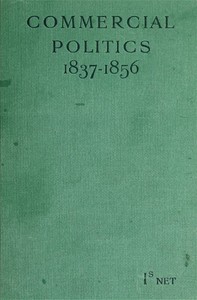
Commercial Politics (1837-1856) — Reading Notes
19
2
Project Gutenberg
2017
Great Britain -- History -- 19th century -- Sources
Readers of public-domain and historical texts
Project Gutenberg digital edition
en
Edition facts
Words: 45,118
Reading time: 197 min
Text sections: 43
Source:
Project Gutenberg record #54461
A source-book of documents from 1837-1856, focusing on Britain's shift from protectionism to free trade, with speeches, letters, and parliamentary debates revealing the political and economic arguments of the era.
The volume opens with a letter from Sir Robert Peel to his Tamworth constituents, dated July 1847, in which he explains his changed views on the Corn Laws. Peel recounts how his confidence in agricultural protection was 'materially weakened' by 'the conflict of arguments on the principle of a restrictive policy' and by evidence that wages do not vary with corn prices. The letter is a central piece in a collection that traces the political and commercial debates of the period 1837–1856.
As part of Bell's English History Source Books series, this compilation by R. H. Gretton presents primary sources—parliamentary speeches, official correspondence, and public letters—without narrative commentary. The documents are arranged to show the evolution of policy, from the Corn Law of 1842 to the later embrace of free trade, and they capture the voices of key figures such as Peel, Cobden, and Russell.
Peel's Shifting Position on Protection
The excerpt from Peel's 1847 letter is the most substantial document in the sample. It reveals a politician carefully justifying a reversal of policy. Peel lists specific reasons for his change of mind: the failure of predictions that free imports of meat would ruin farmers, the 'contrast presented in two successive periods of dearth and abundance' in public health and tranquillity, and the narrowing ground on which Corn Laws could be defended after other protective duties had been repealed. He notes that the admission of foreign meat in 1842 caused a 'panic' and 'forced sale of stock', but five years later those fears had proved unfounded. The letter is measured in tone, using phrases such as 'it is unnecessary for the purposes of this memoir that I should refer in detail' to avoid recounting the political turmoil of 1845–46. Peel's language is that of a statesman seeking to persuade by reasoned argument rather than passion.
The Structure of a Source-Book
The volume is part of a series designed for classroom use, as the general introduction explains. The editors state that such source books are 'intended for use with any ordinary textbook of English History' and can serve either as 'lively illustration at the close of a lesson' or for 'inference-drawing' before the textbook is read. The series includes volumes covering periods from 449 to 1913, each edited by a scholar. The present compiler, R. H. Gretton, is identified as a former Demy of Magdalen College, Oxford, and author of Modern History of the English People. The book's 43 text sections and 45,118 words suggest a concise selection of documents, each likely introduced by a brief headnote. The excerpts provided do not include any editorial commentary on the documents, so the reader encounters the primary sources directly.
Voice and Argument in the Documents
The sample documents show a consistent reliance on first-person testimony and reasoned argument. Peel's letter is addressed 'To the Electors of Tamworth' and uses personal reflection ('my confidence… had been materially weakened') alongside empirical claims about wages and prices. The language is formal but not oratorical; it avoids the rhetorical flourishes of parliamentary speech. Another document, though not excerpted in full, is referenced as a 'public letter' from Peel to his constituents before the 1847 election. The collection appears to favour such epistolary sources, which allow for sustained exposition of policy positions. The absence of opposing voices in the sample—no speech by Cobden or Bright is included—may reflect the compiler's focus on the governing perspective, but the full volume likely includes a range of viewpoints. The reader should attend to how each document constructs its case: through appeals to experience, statistical inference, or moral principle.
Readers approaching this source-book should treat each document as a piece of evidence to be weighed against others. The excerpts show that the compilers have selected materials that foreground the reasoning of political actors, not merely the outcomes of legislation. Pay attention to the dates and contexts of each document: Peel's 1847 letter, for instance, was written after the repeal of the Corn Laws in 1846, and it serves as a retrospective justification. Comparing the tone and argument of earlier documents with later ones will reveal how the terms of debate shifted over the two decades covered.
Reader reflection
Your personal reading reflection
Build a private reading journal entry for this title.
Your progress
0
/
10
2
How did the book work for you overall?
3
How likely are you to recommend this book?
4
How easy was the book to follow?
5
Did this book create an emotional response?
6
Did the book offer a fresh perspective?
7
Could you apply anything you learned?
8
Did any part of the book feel personally relevant?
9
What changed or sharpened your thinking?
10