1

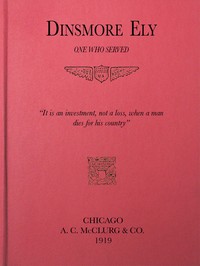
Dinsmore Ely, One Who Served — Context and Discussion
(0 User reviews)
509
Project Gutenberg
2016
Not confirmed
World War, 1914-1918 -- Personal narratives, American
Readers of public-domain and historical texts
Project Gutenberg digital edition
en
Edition facts
Words
50,066
Reading time
218 min
Text sections
11
The source record for Dinsmore Ely, One Who Served — Context and Discussion measures this digital text at 50,066 words, 3 hr 38 min estimated reading time, and 11 detected text sections.
The text analysis averages about 16.8 words per sentence, while the detected sections provide another way to judge how the source is divided.
Project Gutenberg metadata also associates the work with “World War, 1914-1918 -- Personal narratives, American,” connecting these edition facts with the source record’s subject description.
Source:
Project Gutenberg record #51720
A collection of letters and a prelude by his father reveal Dinsmore Ely's voice as a young American volunteer in the Lafayette Flying Corps, detailing training, aircraft, and daily life in 1917 France.
Editorial Edition Score
4.8/5
★★★★★
★★★★★
Calculated from edition completeness, EPUB availability, text structure and catalogue metadata. Not a user rating.
How this score is calculated
- Description quality20 pts
- Title & short description10 pts
- Source metadata20 pts
- Text length15 pts
- Chapters / structure15 pts
- EPUB file integrity20 pts
Total of 100 points, scaled to a 2.5-5.0 range. Editions with an empty description or a missing EPUB file are not scored.
Edition quality
Public-domain source text
Read the source text
The source text is kept in the dedicated reader, separate from this catalogue record and its commentary.
The editorial note that opens this volume, written by Dinsmore Ely's father, James O. Ely, frames the letters as the record of a 'knightly soul' and compares the author to Bayard 'without fear and without reproach.' Yet the letters themselves resist such romantic gloss. Ely's prose is practical, wry, and often technical: he describes the Nieuport's wing surface in square meters, notes landing speeds of ninety miles an hour, and explains the progression from 'Penguin to Spad' as a series of mechanical upgrades. The father's prelude and the son's correspondence sit in productive tension, the one reaching for chivalric archetypes, the other grounding the reader in compressed air and steering buckles.
Diction of the Cockpit
Ely writes about flying with the precision of a mechanic and the wonder of a convert. He tells his mother that 'every experience so totally eclipses all expectations that you realize you were totally incapable of imagination in that field.' The sentence is characteristic: it builds from a general observation to a sharp, self-deprecating conclusion. He does not call flying sublime; he says the imagination fails. Elsewhere, he describes the eighteen-meter Nieuport as 'wonderful little things' that 'will do anything in the air.' The modesty of the phrasing—'little things'—contrasts with the daring of the activity. His vocabulary is drawn from the cockpit: 'double command,' 'solo,' 'twenty-eight meter,' 'eighteen.' He uses these terms without explanation, as if writing to an audience already initiated. This insider's lexicon gives the letters a documentary quality, recording not just events but the language of a specific community in a specific moment.
Structure and the Waiting Self
The letters are organized by date and addressed to different family members—Father, Mother, Bob—but they share a consistent structural pattern. Ely typically opens with a report on his training progress, then shifts to a reflection on the emotional or intellectual life of the aviator. On November 12, 1917, he tells his brother Bob: 'We go to work at six in the morning, and return at six in the evening, but the hardest work is waiting when there is too much wind to fly.' The sentence pivots from a schedule to a confession: waiting, not flying, is the trial. He fills that waiting with storytelling, toast-making, and reading a history of France. The structure of the letters—moving from action to reflection—mirrors the rhythm of the aviator's day, where bursts of intense activity are followed by long, communal pauses. Ely's voice is most vivid in these interludes, when he steps back from the technical and into the personal.
Recurring Details of Risk and Luck
Ely does not dwell on danger, but he registers it in offhand remarks. He mentions to his father that 'a two-passenger plane struck a solo plane in the air' and that 'all three aviators were killed,' then adds: 'That is a very rare accident, though.' The qualification is telling: he normalizes the extraordinary. In the same letter, he writes that 'the god of luck is the aviator's saint' and that 'those who doubt are probably those who do not come back.' These are not confessions of fear but observations of a professional culture. He treats risk as a variable to be managed, not a theme to be explored. The recurrence of such details—the rare accident, the luck, the doubters who do not return—creates a subdued pattern of awareness. Ely never says he is afraid; he says that fear is a practical liability. The letters thus offer a portrait of courage as a kind of applied pragmatism.
Voice Across Audiences
Ely adjusts his tone and content depending on his correspondent. To his mother, he writes of the beauty of a 'clear, crisp November day' and the wonder of aviation. To his father, he is more analytical, comparing the steering buckle of an automobile to 'hanging on wires and compressed air.' To his brother Bob, he is colloquial and confiding: 'You do not know how much your letters help to buck up a lonely brother sometimes.' The range is narrow but distinct. He never becomes sentimental or grandiose; even when he tells his mother that aviation 'totally eclipses all expectations,' the sentence is controlled. The letters to Bob are the most relaxed, filled with flying stories and the camaraderie of the training field. This variation suggests a writer who is aware of his audience and who uses the letter form to maintain different relationships across distance. The voice is consistent in its intelligence and restraint, but it is not uniform.
The letters of Dinsmore Ely do not constitute a memoir or a history. They are occasional writings, shaped by the exigencies of military training and the conventions of family correspondence. Readers should approach them as a record of a young man's voice in a specific time and place, not as a comprehensive account of the war or of aviation. The father's editorial framing—the prelude, the selection, the title—imposes a narrative of sacrifice that the letters themselves only partially support. To read them is to encounter a writer who is more interested in the mechanics of flight than in the metaphysics of duty, and whose most striking passages are those in which he describes not what he feels, but what he sees and does.
Reading Dinsmore Ely’s letters, I remembered my grandfather’s short notes from his own war—mundane details about mud and rations that somehow felt sacred. The War That Will End War — A Closer Reading once gave me that same ache, the gulf between what young men hoped and what they were given. Ely’s quiet voice stays with me now, like a photograph fading at the edges.
There are no reviews for this eBook.
There are no comments for this eBook.
Reader reflection
How will you remember this book?
Save your reaction, strongest insight, and memorable passage.
Your progress
0
/
10
2
Did this book hold your interest?
3
Would you recommend this book to another reader?
4
What was the reading difficulty like?
5
Did any part of the book stay with you emotionally?
6
Did the book give you something worth debating?
7
What did you appreciate most?
8
Did the book meet your expectations?
9
In one sentence, what did you learn?
10