1

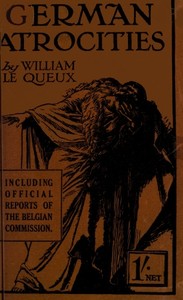
German Atrocities: A Record of Shameless Deeds — Context and Discussion
(0 User reviews)
321
Project Gutenberg
2016
Not confirmed
World War, 1914-1918 -- Atrocities
Readers of public-domain and historical texts
Project Gutenberg digital edition
en
Edition facts
Words
31,219
Reading time
136 min
Text sections
5
Before opening German Atrocities: A Record of Shameless Deeds — Context and Discussion, the edition data offers a quick orientation: 31,219 words, 2 hr 16 min estimated reading time, and 5 detected text sections.
The text analysis averages about 20.6 words per sentence, while the detected sections provide another way to judge how the source is divided.
Project Gutenberg metadata also associates the work with “World War, 1914-1918 -- Atrocities,” connecting these edition facts with the source record’s subject description.
Source:
Project Gutenberg record #52082
William Le Queux's 1915 compilation of wartime propaganda presents alleged German atrocities in Belgium and France, structured as a series of numbered chapters each detailing a specific incident or location, such as the destruction of Louvain.
Editorial Edition Score
4.7/5
★★★★★
★★★★★
Calculated from edition completeness, EPUB availability, text structure and catalogue metadata. Not a user rating.
How this score is calculated
- Description quality20 pts
- Title & short description10 pts
- Source metadata20 pts
- Text length15 pts
- Chapters / structure15 pts
- EPUB file integrity20 pts
Total of 100 points, scaled to a 2.5-5.0 range. Editions with an empty description or a missing EPUB file are not scored.
Edition quality
Public-domain source text
Read the source text
The source text is kept in the dedicated reader, separate from this catalogue record and its commentary.
William Le Queux's German Atrocities: A Record of Shameless Deeds is organized as a sequence of discrete, numbered chapters, each focusing on a particular incident or location—a structure that allows the reader to move from one reported outrage to the next without a continuous narrative. The work opens with a preface that frames the contents as a 'plain unvarnished statement' and immediately invokes the figure of the Kaiser and the concept of 'frightfulness' as a deliberate policy. This episodic arrangement, combined with the inclusion of photographic plates (e.g., 'How the German Vandals Dealt with the World-Famed Library of Louvain'), creates a rhythm of accusation and evidence that drives the reader through the text.
Episodic Structure and the Accumulation of Evidence
The book's structure relies on the cumulative effect of short, self-contained chapters. Each chapter typically begins with a bold claim or a quotation from a newspaper or official source, then presents a description of the alleged atrocity. For instance, Chapter XI, 'The Crime of Louvain,' opens with a statement from the Press Bureau and then builds a case through multiple quoted authorities—Mr. Asquith, Sir William Robertson Nicoll—before detailing the destruction. This method of stacking testimonies within a single chapter mirrors the overall strategy of the book: to overwhelm the reader with repeated, varied instances of misconduct. The chapters do not follow a chronological or geographical order that is immediately apparent from the excerpts; instead, they seem arranged to maximize emotional impact, moving from general accusations to specific, vivid examples.
Recurring Images of Fire, Ruin, and Violation
Throughout the excerpts, certain images recur with notable frequency. Fire appears as a central motif: Louvain is 'reduced to ashes,' a 'shameless holocaust of irreparable treasures.' The language of burning and destruction is paired with that of violation—'violate young girls,' 'subject to degradation and insult.' The repeated use of the word 'shameless' in the title and in descriptions ('shameless holocaust') reinforces a moral judgment. Another recurring image is that of the 'heap of ashes,' used to describe both Louvain and, by implication, other destroyed towns. These visual, almost tactile details—ashes, fire, blood—give the text a sensory weight that compensates for the lack of continuous narrative. The reader is invited to picture each scene of devastation as a separate, complete tableau.
Movement Between Official and Personal Voices
The text shifts abruptly between different registers of language. The preface uses the formal, indignant tone of a public indictment: 'a fearful and disgraceful record of a Nation’s shame.' But within chapters, the voice can change to that of a victim, as in the quoted testimony of a woman who 'prayed all the time to the Blessed Virgin.' This movement from official pronouncements (the Press Bureau, the Daily Telegraph) to personal, often anguished, accounts creates a layered effect. The reader encounters the same event—the sack of Louvain—first through the measured words of the Press Bureau, then through the more emotional language of a newspaper editorial, and finally through the implied perspective of the victims. This technique of alternating sources gives the impression of a comprehensive, multi-angled report, even though the excerpts do not reveal how the author selected or arranged these voices.
The Role of Photographs and Captions
The excerpts include references to photographic plates, such as the image of the Kaiser and the photo of Louvain's library with the caption 'How the German Vandals Dealt with the World-Famed Library of Louvain.' These captions function as mini-headlines, condensing the chapter's argument into a single, damning phrase. The placement of the photograph facing page 73 suggests a deliberate pairing of image and text, where the visual evidence is meant to corroborate the written account. The captions themselves employ the same rhetorical strategies as the prose: they name the perpetrators ('German Vandals'), specify the act ('dealt with'), and attach a value judgment ('World-Famed'). This interplay between image and word is a structural feature that the excerpts hint at but do not fully reveal; the reader must infer how the photographs punctuate the text and whether they follow a thematic or chronological order.
Readers approaching German Atrocities should attend to how the book's structure—its numbered chapters, its shifts in voice, its pairing of image and text—shapes the experience of the material. The work does not argue a single thesis so much as present a series of tableaux, each designed to provoke a specific response. Noticing the patterns in these tableaux, from the recurring imagery of fire to the alternation between official and personal testimony, can illuminate the rhetorical machinery at work beneath the surface of the 'plain unvarnished statement.'
There’s something haunting about Le Queux’s numbered litany of burned towns, each entry a small, unbearable weight. I found myself setting it down often. Some evenings, I preferred the quieter companionship of My Year of the Great War — A Reader’s Guide, which feels less like a record and more like a hand on the shoulder, remembering alongside you. The one stays with you; the other helps you carry it.
There are no reviews for this eBook.
There are no comments for this eBook.
Reader reflection
What did you think of this book?
Answer a few questions and save a private reflection on this device.
Your progress
0
/
10
2
Was reading this book enjoyable?
3
Is this a title you would suggest to others?
4
How demanding did the text feel?
5
Did any part of the book stay with you emotionally?
6
What did you think about the pace?
7
How well did it match your expectations?
8
Would you like to discuss this book with someone?
9
What did this book teach you most?
10