1

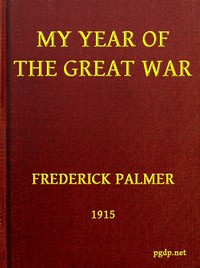
My Year of the Great War — A Reader’s Guide
(0 User reviews)
883
Project Gutenberg
2016
Not confirmed
World War, 1914-1918 -- Personal narratives
Readers of public-domain and historical texts
Project Gutenberg digital edition
en
Edition facts
Words
138,176
Reading time
601 min
Text sections
39
Before opening My Year of the Great War — A Reader’s Guide, the edition data offers a quick orientation: 138,176 words, 10 hr 1 min estimated reading time, and 39 detected text sections.
The text analysis averages about 18.9 words per sentence, while the detected sections provide another way to judge how the source is divided.
Project Gutenberg metadata also associates the work with “World War, 1914-1918 -- Personal narratives,” connecting these edition facts with the source record’s subject description.
Source:
Project Gutenberg record #52886
Frederick Palmer's 1915 memoir of the first year of World War I, structured around his movements between the French and British fronts, with recurring attention to the physical details of trenches, breastworks, and the aftermath of battle.
Editorial Edition Score
4.9/5
★★★★★
★★★★★
Calculated from edition completeness, EPUB availability, text structure and catalogue metadata. Not a user rating.
How this score is calculated
- Description quality20 pts
- Title & short description10 pts
- Source metadata20 pts
- Text length15 pts
- Chapters / structure15 pts
- EPUB file integrity20 pts
Total of 100 points, scaled to a 2.5-5.0 range. Editions with an empty description or a missing EPUB file are not scored.
Edition quality
Public-domain source text
Read the source text
The source text is kept in the dedicated reader, separate from this catalogue record and its commentary.
Frederick Palmer opens My Year of the Great War not with a declaration of war but with a reflection on his own novel The Last Shot, noting how reality outstripped his predictions. This self-aware beginning sets the tone for a narrative that moves restlessly between sectors of the Western Front. Palmer’s account is built on a series of journeys: from Paris to the Aisne, from British headquarters to the trenches at Neuve Chapelle. The structure follows the war’s own shifting geography, with each chapter anchored to a specific place or phase. What emerges is less a continuous story than a mosaic of scenes, each rendered through precise physical detail—the feel of a bayonet, the height of a breastwork, the smell of mud.
The Observer’s Itinerary
Palmer’s narrative is organized as a travelogue of the front, with chapters titled by location or event: “The Aisne,” “The Coming of the British,” “Neuve Chapelle.” He does not attempt a comprehensive history but instead records what he saw at each stop. The reader follows him from the Marne to the British lines near Ypres, then to the French sector at Arras. This structure mirrors the war’s own mobility in 1914, before the trenches became fixed. Palmer notes the difficulty of moving between armies: each required separate passes, and the landscape itself—roads clogged with refugees, fields turned to mud—dictated the pace. His itinerary is not chosen for convenience but for access, and he often arrives just after a battle, viewing the aftermath rather than the fight.
Trenches and Breastworks
Palmer repeatedly distinguishes between trenches and breastworks, a technical detail that becomes a recurring motif. At Neuve Chapelle, he describes how “a trench is dug in the ground; a breastwork is raised from the level of the ground.” This distinction matters because it shapes the soldiers’ experience: breastworks offer less protection from artillery, and their construction reveals the haste of the advance. Palmer’s eye for such details—the height of sandbags, the placement of rifles—gives his account a tactile quality. He notes that the new British breastworks still had “spotty white” sandbags, while the German ones were darker, weathered. These observations are not merely descriptive; they imply the relative newness of the British position and the age of the German line.
The Cleanliness of a Rifle
In a striking passage, Palmer focuses on a single rifle leaning against a breastwork: “I felt of the edge of one and it was sharp, quite prepared for business. In the surroundings of damp earth and mud-bespattered men, this rifle seemed the cleanest thing of all.” The contrast between the weapon’s meticulous upkeep and the squalor of the trenches becomes a symbol of the soldier’s discipline. Palmer extends this observation to the infantry’s training: the rifle’s “well-aimed and telling fire” is the goal of all drill. He does not romanticize the weapon; instead, he treats it as a tool, its sharpness a matter of practical necessity. This attention to a single object—its feel, its cleanliness, its purpose—exemplifies Palmer’s method of letting small details stand for larger truths.
The Invitation to Shoot
One of the most telling moments occurs when a sentry asks Palmer, “Will you have a shot, sir?” Palmer declines, reasoning that even a stray bullet might find a target. The exchange reveals the casual proximity of violence: the sentry treats shooting as a routine amusement, while Palmer, as a non-combatant, must maintain a different ethic. He does not moralize; he simply notes that “no bullet is quite waste.” This incident encapsulates the war’s strange normalcy, where killing becomes a matter of probability. Palmer’s refusal is not heroic but practical, grounded in the same logic that governs the soldier’s work. The scene also highlights Palmer’s role as an observer who is present but not part of the fighting, a position he maintains throughout the book.
Palmer’s memoir rewards readers who attend to its physical details: the height of a breastwork, the feel of a bayonet, the color of sandbags. These observations, repeated across different sectors, build a cumulative picture of the front as a place of constant labor and improvisation. The book’s structure—a series of visits rather than a continuous narrative—mirrors the fragmented experience of war itself. For those seeking a ground-level view of the first year, Palmer offers a patient, unsentimental eye.
There are moments in My Year of the Great War when Palmer just stops and looks at the mud, the quiet after a push. I remember feeling the weight of that ordinary dread. It made me think of an older, quieter book, The War That Will End War — A Closer Reading, which holds that same strange stillness between the lines. Some books just stay with you that way.
There are no reviews for this eBook.
There are no comments for this eBook.
Reader reflection
How will you remember this book?
Save your reaction, strongest insight, and memorable passage.
Your progress
0
/
10
2
What was your overall reaction to the book?
3
Is this a title you would suggest to others?
4
How demanding did the text feel?
5
Which part made the strongest impression?
6
Did the book give you something worth debating?
7
Was the book easy to understand?
8
Did the book deliver what you hoped for?
9
In one sentence, what did you learn?
10