1

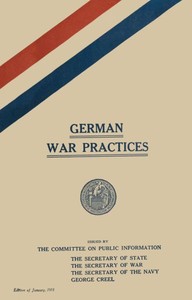
German War Practices, Part 1: Treatment of Civilians — Themes and Context
(0 User reviews)
370
Project Gutenberg
2017
Not confirmed
World War, 1914-1918 -- Atrocities
Readers of public-domain and historical texts
Project Gutenberg digital edition
en
Edition facts
Words
37,496
Reading time
164 min
Text sections
5
German War Practices, Part 1: Treatment of Civilians — Themes and Context can be approached with a clearer sense of reading commitment from its source measurements: 37,496 words, 2 hr 44 min estimated reading time, and 5 detected text sections.
The text analysis averages about 21.0 words per sentence, while the detected sections provide another way to judge how the source is divided.
Project Gutenberg metadata also associates the work with “World War, 1914-1918 -- Atrocities,” connecting these edition facts with the source record’s subject description.
Source:
Project Gutenberg record #55442
A 1917 U.S. government report documenting alleged German atrocities against civilians in occupied Belgium during World War I, compiled from official statements, diplomatic dispatches, and eyewitness accounts.
Editorial Edition Score
4.6/5
★★★★★
★★★★★
Calculated from edition completeness, EPUB availability, text structure and catalogue metadata. Not a user rating.
How this score is calculated
- Description quality20 pts
- Title & short description10 pts
- Source metadata20 pts
- Text length15 pts
- Chapters / structure15 pts
- EPUB file integrity20 pts
Total of 100 points, scaled to a 2.5-5.0 range. Editions with an empty description or a missing EPUB file are not scored.
Edition quality
Public-domain source text
Read the source text
The source text is kept in the dedicated reader, separate from this catalogue record and its commentary.
This volume, issued in 1917 by the U.S. Committee on Public Information, presents a curated selection of evidence regarding the treatment of civilians in German-occupied Belgium. The editors—historians Dana C. Munro, George C. Sellery, and August C. Krey—draw on diplomatic reports, official German communications, and eyewitness testimony to build a case that German military policy deliberately violated the Hague and Geneva Conventions. The work is structured as a documentary brief, with each section introduced by editorial commentary that frames the excerpts as proof of a systematic policy of “frightfulness.”
The Pledge and the Practice
The introduction establishes a stark contrast between Germany’s formal commitments and its military conduct. The editors note that Germany accepted all Hague Regulations except Article 44, which forbade forcing conquered populations to give information. Yet the excerpts that follow describe mass deportations, hostage-taking, and forced labor—actions that the editors argue violate the very conventions Germany signed. A recurring pattern is the invocation of military necessity to justify what the report terms “frightfulness.” For instance, General von Bissing is quoted as saying that starvation would be used “to compel the Belgian workingmen … to go into Germany.” The report treats such statements not as isolated remarks but as evidence of a premeditated strategy.
Deportations as Documented by Diplomats
The longest section reproduces Minister Brand Whitlock’s detailed account of the deportations from Brussels in late 1916. Whitlock describes a system of summonses, medical examinations, and forced transport, noting that “the men shivering from cold and fear, the parting from weeping wives and children” were held back by “barriers of brutal Uhlans.” The report includes specific numbers: of 1,500 men ordered to report, 750 appeared, and 300 were taken. Whitlock’s tone is clinical, but the editorial framing emphasizes the human cost. The editors also include a footnote explaining that the étapes—areas under martial law—were where deportations began, suggesting a deliberate geographic strategy.
The Logic of Total War
A striking excerpt from Frederic C. Walcott’s article in The National Geographic Magazine (May 1917) presents a German official’s frank explanation of deportation plans. The official states that starvation would be used to compel skilled workers to go to Germany, while “the weak remaining, the old and the young, we would concentrate opposite the firing line, and put firing squads back of them.” The editors offer no commentary on this passage, letting the official’s own words stand as evidence of a ruthless calculus. This section underscores the report’s broader argument: that German policy treated civilian populations as instruments of military strategy, not as protected noncombatants.
Readers should approach this document as a wartime publication with an explicit propaganda purpose—it was produced by a government committee to influence public opinion. The evidence it presents is drawn from sources that may themselves be partial or contested. Yet the specificity of the accounts, the inclusion of official German statements, and the careful documentation of dates, places, and numbers make it a valuable primary source for understanding how atrocities were reported and framed during the First World War.
I keep thinking about those 1917 dispatches, the way official language strains to hold what eyewitnesses described. It felt heavier than history class made it seem. Finding German Atrocities: A Record of Shameless Deeds — Context and Discussion was like finally hearing the rest of that echoing room—not a new story, just the same one, breathed out quieter, staying with me longer. Strange how a century-old report still hums.
There are no reviews for this eBook.
There are no comments for this eBook.
Reader reflection
What did you think of this book?
Answer a few questions and save a private reflection on this device.
Your progress
0
/
10
2
How much did you enjoy the reading experience?
3
Would you encourage someone else to read it?
4
How much effort did this book require?
5
How understandable was the text?
6
Did any part of the book feel personally relevant?
7
What did you think about the pace?
8
Was the book what you thought it would be?
9
What did this book teach you most?
10