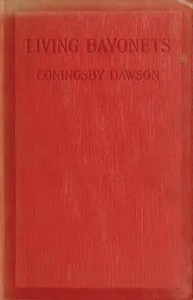
Living Bayonets: A Record of the Last Push — Inside the Classic

(12 User reviews)   3671
In Category - Modern Nations
Dawson, Coningsby, 1883-1959, Dawson, Muriel, 1889- [Editor] Project Gutenberg 2016 Not confirmed
World War, 1914-1918 -- Personal narratives, English Readers of public-domain and historical texts
Project Gutenberg digital edition en

Edition facts

Words 52,142
Reading time 227 min
Text sections 5

This digital edition of Living Bayonets: A Record of the Last Push — Inside the Classic is described by source-level measurements including 52,142 words, 3 hr 47 min estimated reading time, and 5 detected text sections.

The text analysis averages about 17.6 words per sentence, while the detected sections provide another way to judge how the source is divided.

Project Gutenberg metadata also associates the work with “World War, 1914-1918 -- Personal narratives, English,” connecting these edition facts with the source record’s subject description.

Coningsby Dawson's letters from the Western Front, edited by his sister, capture the tension between domestic longing and combat duty, the shift in American sentiment after entering WWI, and the soldier's pride in a humble role over literary ambition.
Share
Editorial Edition Score 4.7/5

Calculated from edition completeness, EPUB availability, text structure and catalogue metadata. Not a user rating.

How this score is calculated
  • Description quality20 pts
  • Title & short description10 pts
  • Source metadata20 pts
  • Text length15 pts
  • Chapters / structure15 pts
  • EPUB file integrity20 pts

Total of 100 points, scaled to a 2.5-5.0 range. Editions with an empty description or a missing EPUB file are not scored.

Edition quality

Read the Text

ss the lawn from England, the nearest of near neighbours. I wish with all my heart that I could drop in on you for a day and just sit down on the sunny verandah and talk and talk. There’s so much I want to hear and so much I want to understand in the changed attitude of America. I’m sure everyone must be much more happy now that the cloud of reproach has lifted and the brightness of heroism is in the air. It shines in my imagination like the clear blueness above the white towers of New York. There’s one thing certain; now that the President has made up his mind, the country will go as baldheadedly for war as it has for everything else it ever set out to attain. The real momentousness of this happening hasn’t been appreciated by the fighting men out here yet. With a sublime arrogance they feel themselves quite capable of licking Germany without the assistance of anyone.

France April 17, 1917

Last night I was out on a working party—a moonlight night with sleet falling, and did not get back till past two. The first thing my flash-light fell on as I entered my dug-out was a pile of letters from home. At past 3 a.m. I was still reading them, when H. and B. woke up and asked if there was anything for them. There was. So there we were all lying in our bunks and reading our love-letters till nearly 4 a.m.

Yesterday I had a very exciting time. I was doing some reconnoitring along the front when a bullet whizzed by and almost scorched the ear of my sergeant. We hopped into a trench about two feet full of water. But whenever we showed ourselves the sniping started up again. At last we got tired of wading, so climbed out and made a dash across the open. None of us was caught, but by pure bad luck another sergeant of mine, who was waiting quite 300 yards away, got it in the back. He was a big, heavy chap, and we had quite a slippery time carrying him out on a stretcher to the dressing-station. That’s the second N.C.O. who’s been hit with me in the last ten days. The other chap got it in his side.

Either of these wounds would have been nice to get for anyone who wanted a rest. But I don’t want to get out yet; all the really sporting part of this war will be this summer. We are praying that we may come into action at the gallop, “Halt, action front!” bang off our rounds and follow up again.

For some reason, to-day my memory has been full of pictures of that wonderful leave we had together in London. Things have come back that I’d forgotten—visits to theatres, to restaurants, rides in taxis, so many things—all the time there’s that extraordinary atmosphere of intense love. I suppose I must have spent the night dreaming of you. Living in the daylight hours in this deep dug-out makes spring seem like winter; I expect that helps me to remember. How I wish I could have those ten days again. Perhaps our next will be in New York, when I come back in khaki for an odd week. The thought of such a happening in the future and the recollection of the meeting that is past are like coming to a fire out of a dark, cold night. This war is so monstrously impersonal; the attachments one forms with those among whom he lives are so few, that the passionately personal affections of the old days shine out like beacon fires. It will be wonderful when the war ends and one can sit still in a great hush.

Yesterday I had a day off for a bath behind the lines—I hadn’t tubbed for well over a month and hadn’t been back of the guns; also I had slept in my clothes—so you may judge that warm water and soap were a necessity. Afterwards I had great fun shopping for the mess, but I didn’t manage to buy much, as the country is all eaten up. All that is beautiful in the way of landscape lies ahead, so we’re very anxious to capture it from the Hun. One looks out over his back country, so green and beautiful and untouched, and feels like an Old Testament spy having a peep at the Promised Land. Without doubt it will be ours in the ordained time. When I went out this morning it was to see a blue, blue sky, a battery pulling into action and behind it a desolated town. But the feature that caught my attention was the spring sky. I stared and stared at it and thought of when the war is ended. To-day I had to go to another town which is in process of being battered. On my way back I passed through a wood—most of the trees were levelled to the ground. In the wood I found a hawk wounded by shrapnel, and pressing close behind a fallen trunk. And I found my first spring flower—a daffodil—which I am enclosing to you. I’ve sent you many flowers, but none which carries with it more love than this little withered daffodil—my first token of spring—gathered from a fought-over woodland of France.

Since writing thus far it has been raining cats and dogs, and I’ve been catching the mud, which leaks through my roof, in a soup-plate. Little things like mud and rain don’t damp our ardour, however; we press on and on to certain victory.

One of our officers came back from leave to-day—he’d spent his freedom in Devon, and was full of the beauty of the spring-time there. Happy Devon! War has changed the seasons in France. Winter started in October; it’s the middle of April and winter has not yet ended. Oh, to wake up again with the splendid assurance of a summer day with nothing but beauty—such a peaceful day as we have so often spent at Kootenay. That wounded hawk, crouching among the daffodils, is a symbol—we’re like that: beasts of prey for our country’s sake, maimed in mind and spirit, and waiting till our wings grow strong again. And yet—who would be anywhere else but here so long as the war lasts? Oh, the fine clean courage of the men in the face of danger and their brave endurance in the presence of privation! It passes understanding. I saw a chap with a mortal wound the other day thinking nothing of himself—only of his pal, who was but slightly wounded. The most unendurable people act like heroes in the face of death. There’s a fundamental nobility in all men which comes to the surface when life is most despairing.

France April 19, 1917

I sit in a hole in a recent battlefield. Over my head is some tattered canvas, upheld by Fritzie shovels. In a battered bucket wood splutters, and the rain it raineth every day. To make my appearance more gipsy-like I may add that my hands are cracked with the mud. When the war is ended I shall lie in bed for a month.

We’ve come through some very lively times of late, and I shall have plenty of local colour to impart to you when the war is ended. My mind is packed with vivid pictures which I cannot tell. This huge silence which rests between individuals is the most terrific thing about the war. You get the terror made concrete for you when you creep to your Observation Post and spy upon the Hun country. In the foreground is a long stretch of barbed wire, shell-holes and mud. Behind that a ruined town; then gradually, greenness growing more vivid as it recedes to the horizon. Nothing stirs. You may look through your telescope all day, but nothing stirs.

Yet you know that in every hole the hidden death lurks; should you for a moment forget and raise your head unwarily, you are reminded of your folly by the crack of a rifle. I’ve always made the mistake of believing the best of everyone—and, as a soldier, I’ve never been able to credit the fact that anyone of a big nation would count himself happy to get my scalp. The actual passes belief. I recall so vividly that story of the final war, written by a German, The Human Slaughter-house. The chap never realizes the awfulness of his job until for the first time he comes face to face with the young boy he’s called upon to kill. We kill by hundreds from a distance, but the destroyed and the destroyers rarely have a hint of each other’s identity. I came to a dug-out the other day in a battered trench. Even the water in the shell-holes was dyed by explosives to the colour of blood. Outside lay a German, face downwards in the mud—an old man with grizzled hair. I shoved my revolver round the mouth of the dug-out and called to anyone who was there to come out. A Cockney voice answered; then followed a scrambling; two huge feet came up through the dark; they belonged to a dead German; two of his comrades grinned cheerfully at me from behind the corpse and propelled it none too reverently into the mud. Behind the party I discovered my Cockney-adventurer—a machine-gunner who, having lost his company, made amends by capturing three Fritzes and killing two others with the aid of a pal with a shattered leg. I told him to bring his pal up. Under his directions the Fritzes trotted back into the hole and brought out the wounded fellow. They were extraordinarily meek-looking and quite surprisingly gentle; when I’d told them where the dressing-station was, they made a bandy-chair of their hands, placed our fellow’s arms about their necks and staggered away through the barrage—or curtain of fire, as the papers like to call it—back to safety with their wounded enemy. And yet within the hour all these people had been chucking bombs at one another.

A few days ago I was detailed for a novel experience—to follow up the infantry attack across No Man’s Land to the Hun Front line and as far as his support trenches. I called for volunteers to accompany me and had a splendid lot of chaps. My party got away with the adventure without a scratch—which was extraordinarily lucky. Moreover, we accomplished the particular job that we were called upon to do.

To-night I’m out from dusk to daylight poking through the darkness in a country where one dare not use a flash-light. Between two ruined towns I have to pass a battered Calvary.

The Christ upon His Cross is still untouched, though the shrine and surrounding trees are smashed to atoms. I think He means more to me like that—stripped of His gorgeousness—than ever. He seems so like ourselves in His lonely and unhallowed suffering. The road which leads to and from Him is symbolic—shell-torn, scattered with dead horses and men, while ahead the snarl of shrapnel darts across the sky and spends itself in little fleecy puffs. All this desolation will be re-created one day, the country will grow green and, in another country, greener than any upon earth, those dead men will walk and laugh—and in that other country the Christ will no longer hang alone and aloofly. I like to think of that—of the beauty in the future, if not in this, then in some other world. One grows tired, just like that image on the Cross. How little the body counts! War teaches us that.

France April 22, 1917

I had a letter from each one of you the day before last, and they reached me within three weeks of being written—it made you all seem very near.

I am writing this to you from a mercifully deep dug-out, which was the home of Huns considerably less than a fortnight ago. I’m sure it was very obliging of them to think ahead and provide us with such safe hiding-places from their villainous shells. They have knocked the house down overhead. In the yard is a broken bird-cage—the owner must have set the captive free before he made good his own escape. Hanging at the head of my bunk is an iron crucifix and on the wall is a beautiful woman’s portrait. One hardly thinks of his enemy as being human these days—he seems only an impersonal devastating force; but it was a man with affections who lately tenanted my dug-out.

In a recent attack I saw a curious happening. I was up with the infantry as liaison officer when one of our planes was shot down. The pilot made an effort to land behind our trenches, but his machine was unmanageable and he came down in Boche territory—or what had been Boche territory a quarter of an hour before. Through my glasses I saw the pilot and observer get out and start to creep cautiously back. We ourselves didn’t know for certain where the Huns were—all we knew was that they were supposed to be withdrawing. When the airmen arrived at our battalion headquarters they were still scarcely convinced that our chaps were not Huns in khaki. When we gave them a meal of bully-beef they knew that wc were British. So very much I could tell you which is thrilling and heroic if only I were allowed.

Do you know, sometimes I marvel at my contented loneliness? It isn’t like me. I ought to be homesick and—but I’m not. I’m too much consumed with the frenzy of an ideal to care for anything but to see the principle for which we fight established. What one man can do isn’t much—only a Jesus can save the world singlehanded; the real satisfaction is in one’s own soul, that softness and success had not made him deaf to the voice of duty when she called to him. For me this undertaking is as holy as a crusade; if it were not I could not endure the sights. As it is I keep quiet in my soul, feeling humbly glad that I am allowed to fulfil the dreams of my boyhood. I always wanted to do something to save the world, you remember. First I was going to be a missionary; then a reformer; then a preacher; then a poet. Instead of any of these I “struck luck” as a novelist—and I can see now how success was corroding to one’s ideals. Success in America is so inevitably measured in terms of praise and money. I wanted to save the world; never in my wildest dreams did it occur to me that I should get my chance as a soldier. I remember when I was studying history at Oxford how I used to shudder at the descriptions of battles, especially mediaeval battles waged by mailed Titans. I don’t know what change has taken place in me; this is a more damnable war in its possibilities for suffering than any of a bygone age; in comparison, those old wars seem chivalrous and humane. And yet because of the spiritual goal for which we fight I no longer shudder. Yes, that is the reason for the change. A man doesn’t often get the chance in these commercial times to risk all that he holds most dear for humanity’s sake. I think of the morning family prayers of childhood in the old panelled room in Highbury and the petitions you used to make for us—everything has shaped towards this great moment in our lives; the past was a straight road leading to this crisis. I don’t forget the share you three contribute—the share of your brave loneliness and waiting. Your share is the greatest. God bless you.

Our major was twice wounded in the recent offensives and has now left us for a higher position. I was terribly sorry to lose him.

The mud has gone. Spring is here and the sun shines all the time. Oh, a most enjoyable war, I do assure you. When I wakened this morning I wandered up the thirty stairs from my dug-out into the former garden, which is now a scene of the utmost desolation. A row was going on as though the Celestial housemaid had lost her temper and given notice, and was tumbling all the plates from the pantry through the clouds. Above the clatter I heard a sound which was almost alarming: the clear, brave note of a thrush, piping, piping, piping. He didn’t seem to care a rap how often the guns blew their noses or how often the Hun shrapnel clashed like cymbals overhead; he had his song to sing in the sunshine, and was determined to sing it, no matter that the song might go unheard. So there I stood and listened to him among the ruins, as one might listen to a faithful priest in a fallen church. I re-created in imagination the people who had lived here for generations, their tragedies, kindnesses, love-affairs. It must have been a beautiful place once, for everywhere there are stumps of fruit-trees, hedges of box trodden almost underground, circular patches which were flower-beds. I can picture the exiles’ joy when they hear that their village has been recaptured. Presently they’ll come back, these old women and men—for their sons are fighting—and they’ll look in vain for even the landmarks of the little house which once sheltered their affections. The thrush in the tree is all that the Huns have left of past history. We British lose our men in the fight, but the sacrifice of the French is immeasurable, for when their sons are dead they have no quiet place of recollections. They can’t say, “Do you remember how he walked here two years back?” or “These hollyhocks he planted,” or “How he waved us goodbye as we watched him from the gate!” The same cyclone of passion which has taken their sons’ fives, has robbed them of everything tangible which would remind them of him.

As regards the U.S.A. joining with us, I have spoken with several Huns. They one and all seem very dejected about it, and seem to consider the loss of America’s friendship one of the greatest blows of the war.

Coningsby Dawson's letters, edited by his sister Muriel and published as a sequel to Khaki Courage, open with the writer lighting a candle in a bunk recently vacated by a German soldier. The date is April 14, 1917, and America has just entered the war. Dawson's voice immediately registers the shift: he imagines returning to New York in khaki, no longer slinking in as a civilian. The letters are not retrospective; they are written in the moment, from dugouts, cottages, and saddle, with the guns audible in the background.

Domestic Intimacy Amid Gunfire

Dawson's letters weave together the mundane and the violent. In one passage, he describes the smell of sweet myrtle drifting through a cottage window, mixed with the croaking of frogs and the distant pounding of guns. He writes of a toddler named Tinker who refuses to sleep until he kisses her goodnight; after he leaves, the family pretends he is entering the hall to calm her. These details—a child pointing to the window and saying “Dorn walk in park”—ground the narrative in a specific, affectionate domesticity that contrasts sharply with the surrounding war. Dawson notes that the love of a little child is more truthful than that of a woman, and he cannot lie to her. The letters thus become a record of how a soldier maintains emotional continuity with home while facing an uncertain future.

Pride in Soldiering Over Writing

Dawson repeatedly measures his worth by his military role, not his literary career. In a letter from May 1918, he states flatly: “I'm only a subaltern—and far prouder to be that than a writer.” He adds that he is estimated by none but his soldiering qualities and “power to show guts.” This self-assessment is not false modesty; it reflects a deliberate reordering of priorities. Earlier, he contrasts his former self with Hamlet, thinking himself into “a green sickness,” and now sees life in “courageous vistas of actions.” The letters document a man who has shed literary ambition for a simpler, more dangerous code. The editor's foreword notes that these letters were published in response to requests from readers of Khaki Courage, suggesting that Dawson's transformation resonated with a public eager for authentic soldier testimony.

The Moral Weight of America's Entry

Dawson's April 1917 letter treats America's declaration of war as a personal and moral turning point. He writes that the “moral advantage” of having the United States as an ally is “the greatest wound to the spirit of Germany that she has received since the war started.” He imagines New York and the Hudson as “just across the lawn from England,” a striking spatial compression that conveys emotional proximity. The letter also reveals a shift in public sentiment: Dawson is glad that his family feels as they do about his returning to the Front, and he expresses relief that the “cloud of reproach” has lifted. His tone is almost gay, and he predicts that America will go “baldheadedly for war.” This section of the correspondence captures a specific historical moment—April 1917—when the war's moral calculus changed for many English-speaking soldiers.

Dawson's letters resist easy categorization: they are neither pure combat report nor sentimental home-front narrative. Readers will find a writer who is acutely aware of his dual identity as soldier and correspondent, and who uses the letter form to bridge those worlds. The editor has preserved the original sequence and dates, allowing the reader to trace Dawson's shifting moods across the final push of the war. Pay attention to the recurring sensory details—smells, sounds, the texture of a sleeping-sack on a tiled floor—as they often carry more weight than the strategic commentary.

Some evenings I think of Dawson’s letters, that ache for home beside the mud’s grind. Beside them on my shelf sits The History of the 36th (Ulster) Division — Inside the Classic, and I see how both books hold a similar quiet — men who wrote their pride not in grand phrases, but in what they endured together.

Liam Campbell
2 weeks ago

Oliver Rodriguez
2 weeks ago

Benjamin Adams
1 week ago

Harper Hernandez
1 week ago

Victoria Moore
1 month ago

4.5
4.5 out of 5 (12 User reviews )

Add a Review

Your Rating *
  • ...
    Carolyn Glen Lawson - 4 weeks ago
    "Living Bayonets" suffers from a lack of focus and a meandering narrative. The author's personal reflections often overshadow the historical events, leaving the reader with a fragmented account. While the subject is important, the execution is poor; the prose is dense and repetitive, and the lack of a coherent structure makes it a tedious read. Not recommended for casual history buffs.

  • ...
    Ashlee Walker - 4 weeks ago
    "Living Bayonets" offers a valuable firsthand perspective on the last push of WWI. The strength lies in its authentic detail and personal anecdotes, making the history tangible. However, the narrative can be somewhat disjointed, jumping between events without a clear chronological flow, which might confuse readers unfamiliar with the campaign's broader context.

  • ...
    Mary Stark - 1 week ago
    "Living Bayonets" is a gripping, visceral account of the final push of World War I. The author's firsthand perspective brings the brutal reality of trench warfare to life with unflinching detail. The prose is stark yet poetic, capturing both the horror and the grim determination of the soldiers. This is an essential read for anyone seeking a raw, human understanding of the war's end.


Reader reflection

What did you think of this book?

Answer a few questions and save a private reflection on this device.

Your progress 0 / 10
1

Which reading stage best describes you?

2

Did this book hold your interest?

3

Would you pass this book on to a friend?

4

How much effort did this book require?

Related eBooks