1

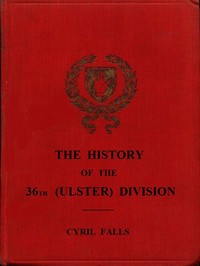
The History of the 36th (Ulster) Division — Inside the Classic
(0 User reviews)
697
Project Gutenberg
2015
Not confirmed
World War, 1914-1918 -- Regimental histories -- Great Britain; Great Britain. Army. Division, 36th
Readers of public-domain and historical texts
Project Gutenberg digital edition
en
Edition facts
Words
134,102
Reading time
584 min
Text sections
32
This digital edition of The History of the 36th (Ulster) Division — Inside the Classic is described by source-level measurements including 134,102 words, 9 hr 44 min estimated reading time, and 32 detected text sections.
The text analysis averages about 20.1 words per sentence, while the detected sections provide another way to judge how the source is divided.
Project Gutenberg metadata also associates the work with “World War, 1914-1918 -- Regimental histories -- Great Britain,” connecting these edition facts with the source record’s subject description.
Source:
Project Gutenberg record #48716
Cyril Falls's regimental history of the 36th (Ulster) Division draws on firsthand experience and official records, focusing on the division's formation, training, and combat in France and Flanders. The narrative emphasizes the logistical and human challenges of trench warfare, with particular attention to the division's role in key battles and its interactions with Allied forces.
Editorial Edition Score
4.9/5
★★★★★
★★★★★
Calculated from edition completeness, EPUB availability, text structure and catalogue metadata. Not a user rating.
How this score is calculated
- Description quality20 pts
- Title & short description10 pts
- Source metadata20 pts
- Text length15 pts
- Chapters / structure15 pts
- EPUB file integrity20 pts
Total of 100 points, scaled to a 2.5-5.0 range. Editions with an empty description or a missing EPUB file are not scored.
Edition quality
Public-domain source text
Read the source text
The source text is kept in the dedicated reader, separate from this catalogue record and its commentary.
Cyril Falls, a former captain in the 36th Division, opens his history with a dedication to fallen comrades and an introduction by Field Marshal Lord Plumer. The text immediately establishes its focus on the division's origins in Ulster's loyalist tradition and its subsequent service on the Western Front. Falls writes from the perspective of a participant-historian, blending official records with personal observations. The opening chapters detail the division's formation in 1914, its training in England, and its deployment to France in 1915. Falls notes the division's distinctive character, shaped by the political and religious context of Ulster, and its early experiences in the trenches near the Somme.
Formation and Early Days
The division was raised in September 1914, largely from the Ulster Volunteer Force, a paramilitary organization opposed to Home Rule. Falls describes the rapid conversion of civilian volunteers into soldiers, emphasizing the existing discipline and leadership within the UVF. Training took place at Seaford and Ballykinlar, where the division was organized into three brigades: the 107th, 108th, and 109th. The author notes the strong sense of identity among the men, many of whom had trained together before the war. By October 1915, the division was in France, taking over a sector near the Somme. Falls records the initial challenges of trench routine, including the weather and enemy activity, but also the division's eagerness for action.
The Somme and Its Aftermath
The division's most famous action came on July 1, 1916, the first day of the Battle of the Somme. Falls provides a detailed account of the attack on the Schwaben Redoubt, noting the heavy casualties and the division's temporary gains. He writes that the 36th Division advanced further than any other British division that day, but at a terrible cost. The narrative then covers the division's subsequent service on the Somme, including the capture of Beaumont-Hamel and the fighting around Thiepval. Falls does not shy away from the grim realities: he describes the mud, the constant shelling, and the strain on the men. The division was eventually withdrawn from the Somme in November 1916, having lost over 5,000 men.
From Arras to Cambrai
In 1917, the division fought at the Battle of Arras, where it captured the village of Roeux. Falls notes the improved tactics and artillery support, but also the persistent difficulties of communication and supply. The division then moved to the Ypres salient, participating in the Third Battle of Ypres (Passchendaele). Falls describes the appalling conditions: the rain, the mud, and the relentless German artillery. The division's next major action was at Cambrai in November 1917, where it played a role in the initial tank-led assault. Falls highlights the division's adaptability, but also the heavy losses sustained in the German counterattack. The year ended with the division holding a quiet sector, rebuilding its strength.
The Final Year and Armistice
In 1918, the division faced the German Spring Offensive, holding the line near St. Quentin. Falls describes the desperate fighting as the division was forced to retreat, but also its successful counterattacks. The division was then involved in the Hundred Days Offensive, advancing through the Hindenburg Line and into open warfare. Falls notes the division's high morale and the skill of its commanders. The armistice found the division near Mons, where it had started its war. Falls concludes with a brief account of the division's disbandment in 1919 and the erection of the memorial at Thiepval. The narrative ends with a roll of honor and a sense of duty fulfilled.
Falls's history is a valuable resource for understanding the experience of a single division in the Great War. Readers should note that the author's perspective is that of a staff officer, which shapes the narrative's focus on command decisions and unit movements. The text includes numerous maps and appendices, including orders of battle and casualty lists. For those interested in the social and political context of Ulster's contribution, the introduction by Lord Plumer provides a contemporary view of the division's significance.
My grandfather never spoke of the Somme, only of the mud that clung like regret. Reading Falls’s account, I felt that weight again—the slow arithmetic of survival. It reminded me of The German Secret Service in America 1914-1918 — Reading Notes, where espionage felt less like adventure, more like waiting in fog. Both books leave you with silence, not answers.
There are no reviews for this eBook.
There are no comments for this eBook.
Reader reflection
How did this book work for you?
Your answers remain private and are stored only in this browser.
Your progress
0
/
10
2
How much did you enjoy the reading experience?
3
Would you recommend this book to another reader?
4
How demanding did the text feel?
5
What was its emotional impact?
6
How understandable was the text?
7
Was the book what you thought it would be?
8
Did you gain anything practical from the text?
9
What changed or sharpened your thinking?
10