1

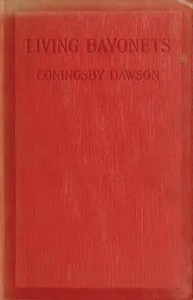
Living Bayonets: A Record of the Last Push — Inside the Classic
(0 User reviews)
3704
Project Gutenberg
2016
Not confirmed
World War, 1914-1918 -- Personal narratives, English
Readers of public-domain and historical texts
Project Gutenberg digital edition
en
Edition facts
Words
52,142
Reading time
227 min
Text sections
5
This digital edition of Living Bayonets: A Record of the Last Push — Inside the Classic is described by source-level measurements including 52,142 words, 3 hr 47 min estimated reading time, and 5 detected text sections.
The text analysis averages about 17.6 words per sentence, while the detected sections provide another way to judge how the source is divided.
Project Gutenberg metadata also associates the work with “World War, 1914-1918 -- Personal narratives, English,” connecting these edition facts with the source record’s subject description.
Source:
Project Gutenberg record #52451
Coningsby Dawson's letters from the Western Front, edited by his sister, capture the tension between domestic longing and combat duty, the shift in American sentiment after entering WWI, and the soldier's pride in a humble role over literary ambition.
Editorial Edition Score
4.7/5
★★★★★
★★★★★
Calculated from edition completeness, EPUB availability, text structure and catalogue metadata. Not a user rating.
How this score is calculated
- Description quality20 pts
- Title & short description10 pts
- Source metadata20 pts
- Text length15 pts
- Chapters / structure15 pts
- EPUB file integrity20 pts
Total of 100 points, scaled to a 2.5-5.0 range. Editions with an empty description or a missing EPUB file are not scored.
Edition quality
Read the Text
ss the lawn from England, the nearest of near neighbours. I wish with all my heart that I could drop in on you for a day and just sit down on the sunny verandah and talk and talk. There’s so much I want to hear and so much I want to understand in the changed attitude of America. I’m sure everyone must be much more happy now that the cloud of reproach has lifted and the brightness of heroism is in the air. It shines in my imagination like the clear blueness above the white towers of New York. There’s one thing certain; now that the President has made up his mind, the country will go as baldheadedly for war as it has for everything else it ever set out to attain. The real momentousness of this happening hasn’t been appreciated by the fighting men out here yet. With a sublime arrogance they feel themselves quite capable of licking Germany without the assistance of anyone.
France April 17, 1917
Last night I was out on a working party—a moonlight night with sleet falling, and did not get back till past two. The first thing my flash-light fell on as I entered my dug-out was a pile of letters from home. At past 3 a.m. I was still reading them, when H. and B. woke up and asked if there was anything for them. There was. So there we were all lying in our bunks and reading our love-letters till nearly 4 a.m.
Yesterday I had a very exciting time. I was doing some reconnoitring along the front when a bullet whizzed by and almost scorched the ear of my sergeant. We hopped into a trench about two feet full of water. But whenever we showed ourselves the sniping started up again. At last we got tired of wading, so climbed out and made a dash across the open. None of us was caught, but by pure bad luck another sergeant of mine, who was waiting quite 300 yards away, got it in the back. He was a big, heavy chap, and we had quite a slippery time carrying him out on a stretcher to the dressing-station. That’s the second N.C.O. who’s been hit with me in the last ten days. The other chap got it in his side.
Either of these wounds would have been nice to get for anyone who wanted a rest. But I don’t want to get out yet; all the really sporting part of this war will be this summer. We are praying that we may come into action at the gallop, “Halt, action front!” bang off our rounds and follow up again.
For some reason, to-day my memory has been full of pictures of that wonderful leave we had together in London. Things have come back that I’d forgotten—visits to theatres, to restaurants, rides in taxis, so many things—all the time there’s that extraordinary atmosphere of intense love. I suppose I must have spent the night dreaming of you. Living in the daylight hours in this deep dug-out makes spring seem like winter; I expect that helps me to remember. How I wish I could have those ten days again. Perhaps our next will be in New York, when I come back in khaki for an odd week. The thought of such a happening in the future and the recollection of the meeting that is past are like coming to a fire out of a dark, cold night. This war is so monstrously impersonal; the attachments one forms with those among whom he lives are so few, that the passionately personal affections of the old days shine out like beacon fires. It will be wonderful when the war ends and one can sit still in a great hush.
Coningsby Dawson's letters, edited by his sister Muriel and published as a sequel to Khaki Courage, open with the writer lighting a candle in a bunk recently vacated by a German soldier. The date is April 14, 1917, and America has just entered the war. Dawson's voice immediately registers the shift: he imagines returning to New York in khaki, no longer slinking in as a civilian. The letters are not retrospective; they are written in the moment, from dugouts, cottages, and saddle, with the guns audible in the background.
Domestic Intimacy Amid Gunfire
Dawson's letters weave together the mundane and the violent. In one passage, he describes the smell of sweet myrtle drifting through a cottage window, mixed with the croaking of frogs and the distant pounding of guns. He writes of a toddler named Tinker who refuses to sleep until he kisses her goodnight; after he leaves, the family pretends he is entering the hall to calm her. These details—a child pointing to the window and saying “Dorn walk in park”—ground the narrative in a specific, affectionate domesticity that contrasts sharply with the surrounding war. Dawson notes that the love of a little child is more truthful than that of a woman, and he cannot lie to her. The letters thus become a record of how a soldier maintains emotional continuity with home while facing an uncertain future.
Pride in Soldiering Over Writing
Dawson repeatedly measures his worth by his military role, not his literary career. In a letter from May 1918, he states flatly: “I'm only a subaltern—and far prouder to be that than a writer.” He adds that he is estimated by none but his soldiering qualities and “power to show guts.” This self-assessment is not false modesty; it reflects a deliberate reordering of priorities. Earlier, he contrasts his former self with Hamlet, thinking himself into “a green sickness,” and now sees life in “courageous vistas of actions.” The letters document a man who has shed literary ambition for a simpler, more dangerous code. The editor's foreword notes that these letters were published in response to requests from readers of Khaki Courage, suggesting that Dawson's transformation resonated with a public eager for authentic soldier testimony.
The Moral Weight of America's Entry
Dawson's April 1917 letter treats America's declaration of war as a personal and moral turning point. He writes that the “moral advantage” of having the United States as an ally is “the greatest wound to the spirit of Germany that she has received since the war started.” He imagines New York and the Hudson as “just across the lawn from England,” a striking spatial compression that conveys emotional proximity. The letter also reveals a shift in public sentiment: Dawson is glad that his family feels as they do about his returning to the Front, and he expresses relief that the “cloud of reproach” has lifted. His tone is almost gay, and he predicts that America will go “baldheadedly for war.” This section of the correspondence captures a specific historical moment—April 1917—when the war's moral calculus changed for many English-speaking soldiers.
Dawson's letters resist easy categorization: they are neither pure combat report nor sentimental home-front narrative. Readers will find a writer who is acutely aware of his dual identity as soldier and correspondent, and who uses the letter form to bridge those worlds. The editor has preserved the original sequence and dates, allowing the reader to trace Dawson's shifting moods across the final push of the war. Pay attention to the recurring sensory details—smells, sounds, the texture of a sleeping-sack on a tiled floor—as they often carry more weight than the strategic commentary.
Some evenings I think of Dawson’s letters, that ache for home beside the mud’s grind. Beside them on my shelf sits The History of the 36th (Ulster) Division — Inside the Classic, and I see how both books hold a similar quiet — men who wrote their pride not in grand phrases, but in what they endured together.
There are no reviews for this eBook.
There are no comments for this eBook.
Reader reflection
What did you think of this book?
Answer a few questions and save a private reflection on this device.
Your progress
0
/
10
2
Did this book hold your interest?
3
Would you pass this book on to a friend?
4
How much effort did this book require?
5
How valuable was this book for your own interests?
6
What did you appreciate most?
7
Could you see yourself revisiting this book?
8
How clear did the writing feel?
9
In one sentence, what did you learn?
10