1

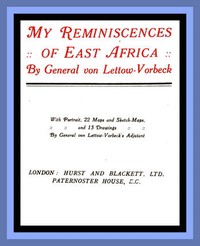
My Reminiscences of East Africa — Context and Discussion
(0 User reviews)
57
Project Gutenberg
2016
Not confirmed
World War, 1914-1918 -- Campaigns -- Tanzania
Readers of public-domain and historical texts
Project Gutenberg digital edition
en
Edition facts
Words
118,358
Reading time
515 min
Text sections
41
Before opening My Reminiscences of East Africa — Context and Discussion, the edition data offers a quick orientation: 118,358 words, 8 hr 35 min estimated reading time, and 41 detected text sections.
The text analysis averages about 21.3 words per sentence, while the detected sections provide another way to judge how the source is divided.
Project Gutenberg metadata also associates the work with “World War, 1914-1918 -- Campaigns -- Tanzania,” connecting these edition facts with the source record’s subject description.
Source:
Project Gutenberg record #51746
General von Lettow-Vorbeck's firsthand account of the East African campaign in World War I, based on memory and lost records, emphasizing German colonial defense, native troop loyalty, and chivalrous enemy relations.
Editorial Edition Score
4.9/5
★★★★★
★★★★★
Calculated from edition completeness, EPUB availability, text structure and catalogue metadata. Not a user rating.
How this score is calculated
- Description quality20 pts
- Title & short description10 pts
- Source metadata20 pts
- Text length15 pts
- Chapters / structure15 pts
- EPUB file integrity20 pts
Total of 100 points, scaled to a 2.5-5.0 range. Editions with an empty description or a missing EPUB file are not scored.
Edition quality
Public-domain source text
Read the source text
The source text is kept in the dedicated reader, separate from this catalogue record and its commentary.
The preface immediately frames the narrative as a defense of German colonial administration and the loyalty of African troops, whom Lettow-Vorbeck calls 'these very natives.' He acknowledges the account's incompleteness, relying on memory and personal experience due to lost records. This sets a tone of both justification and limitation, preparing the reader for a perspective shaped by wartime exigency.
The opening also reveals the author's intent to counter allegations of German cruelty, using the Askari's continued service as evidence. Readers should note that the preface is a retrospective argument, not a neutral report.
Memory as a Source and a Constraint
Lettow-Vorbeck states plainly that his 'own records have for the most part been lost,' and he had no leisure to prepare a detailed description. He warns that 'errors in detail are unavoidable.' This admission is crucial: the narrative is not a comprehensive operational history but a personal reconstruction. Readers will encounter gaps and potential inaccuracies, especially in dates, unit movements, and enemy strength. The author's reliance on memory also shapes the emotional register—events are recalled with the clarity of personal significance rather than archival precision. For instance, the Christmas Day bombing mistaken for cigarettes is a vivid anecdote that likely stuck in memory precisely because of its ironic humor. The reader should weigh such episodes as illustrative rather than definitive.
The Askari as a Central Argument
Throughout the excerpts, Lettow-Vorbeck repeatedly emphasizes the fidelity and effectiveness of his African soldiers. In the preface, he asserts that the force 'faithfully followed its German leaders throughout the whole of the prolonged war against a more than hundredfold superiority.' Later, he describes Askari clearing their way with bayonets at Behobeho. This is not merely tactical reporting; it is a rhetorical pillar of the book's defense of German colonial practice. The author presents the Askari's continued service as proof of just administration, even as he acknowledges that they fought 'without immediate payment.' The reader should note that the Askari's own perspectives are absent; their loyalty is inferred from their actions. This asymmetry is a key feature of the colonial memoir genre.
Chivalry and Mutual Esteem Across Enemy Lines
One of the most striking passages recounts a personal letter from General Smuts informing Lettow-Vorbeck of his award of the Order Pour le Mérite, with 'cordial congratulations.' The author cites this as 'a proof of the mutual personal esteem and chivalry which existed throughout.' He also mentions that the enemy 'intimated his great appreciation of the achievements of the German forces.' These claims of honorable warfare contrast with the brutal realities of ambushes, bayonet charges, and the death of the hunter Selous. The reader should consider how this chivalric framing serves to humanize the conflict and perhaps to deflect from the war's destructiveness. The letter from Smuts is a specific, verifiable detail that anchors the broader assertion of mutual respect.
Strategic Assessment and the Limits of Knowledge
At the end of 1916, Lettow-Vorbeck judged the military situation 'remarkably favourable,' believing South African troops were worn out and Indian units reduced. He admits, however, that he 'did not know' that the enemy had already brought in reinforcements, including a Nigerian brigade. This retrospective confession of ignorance is a recurring motif: the author repeatedly acknowledges that his information was incomplete. The reader should track these moments of uncertainty, as they reveal the fog of war that shaped German decisions. The narrative thus becomes as much about what the commander did not know as about what he did. The loss of the field howitzer at Behobeho, after the detachment was killed, exemplifies the cost of such informational gaps.
This memoir is best read as a commander's personal defense and a record of what one man remembered, not as a complete operational history. The reader should cross-check dates and unit movements with other sources where possible. Pay attention to the tension between the author's claims of chivalry and the harsh realities of bush warfare. The Askari remain a silent presence throughout; their story is told only through German eyes. Lettow-Vorbeck's voice is confident, but his own admissions of lost records and incomplete knowledge invite a critical reading.
Reading von Lettow-Vorbeck’s careful, almost tender recollections of his askari, I remembered my grandfather’s old copy of Anecdotes of the great war, gathered from European sources — Story, Setting & Ideas, which I opened as a boy. Both books left me with the same quiet ache—how wars are remembered in fragments, and how loyalty can outlive the empire that demanded it.
There are no reviews for this eBook.
There are no comments for this eBook.
Reader reflection
What did you think of this book?
Answer a few questions and save a private reflection on this device.
Your progress
0
/
10
2
How much did you enjoy the reading experience?
3
Would you encourage someone else to read it?
4
How much effort did this book require?
5
Would a second reading be valuable?
6
Did you gain anything practical from the text?
7
Did this book create an emotional response?
8
Did any part of the book feel personally relevant?
9
What is the main idea you are taking away?
10