1

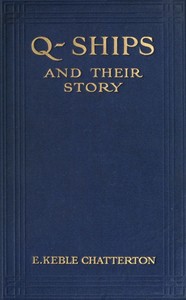
Q-Ships and Their Story — Inside the Classic
18
3
Project Gutenberg
2017
World War, 1914-1918 -- Naval operations; Q-ships
Readers of public-domain and historical texts
Project Gutenberg digital edition
en
Edition facts
Words: 85,401
Reading time: 372 min
Text sections: 11
Source:
Project Gutenberg record #54338
A detailed account of British Q-ships in World War I, based on the author's firsthand experience and diaries, focusing on the cat-and-mouse duels between disguised merchant vessels and German U-boats off the Irish coast.
Editorial Edition Score
4.9/5
★★★★★
★★★★★
Calculated from edition completeness, EPUB availability, text structure and catalogue metadata. Not a user rating.
Edition quality
E. Keble Chatterton's Q-Ships and Their Story opens with a striking claim: that the deeds of these mystery ships form 'one of the most glorious chapters in the chronicles of the sea.' The author, a naval officer who served off south-west Ireland during the submarine campaign, draws on his own diary and friendships with Q-ship crews. The catalog subjects—World War I naval operations and Q-ships—accurately frame the book, but the excerpts reveal a narrower focus: the tactical duel between a disguised schooner and a U-boat, described in minute, tense detail. Chatterton's voice is that of an insider, not a distant historian.
A Duel of Deception and Patience
The extended excerpt from the action of HMS Prize against U-93 exemplifies the book's core drama. Chatterton emphasizes the psychological ordeal: the crew lay 'immobile, unseen' for twenty minutes while shells struck the ship. The author notes that the submarine commander, von Spiegel, was a 'star-turn' artist, framing the encounter as a contest between two skilled deceivers. The description of the patent log being carried away as the U-boat closed to 70 yards is a precise, sensory detail that grounds the narrative in physical reality. Chatterton's language is technical but vivid—'the inboard end of a patent log fits into a small slide'—and he repeatedly stresses the discipline required to remain hidden under fire.
The Author's Embedded Perspective
Chatterton's preface reveals that he was at sea off Ireland during the period he describes, keeping a diary and noting details 'that would otherwise have been forgotten.' This personal involvement shapes the book's authority and its limitations. He claims 'complete opportunities for acquiring authentic information,' yet the excerpts show no broader strategic analysis; the focus stays on individual ship actions. The catalog subject 'World War, 1914-1918 -- Naval operations' is accurate but broad—Chatterton's lens is tightly trained on the Q-ship service, not the wider war. His dedication to Admiral Sir Lewis Bayly, who 'did so much to thwart the operations of the enemy,' hints at a partisan, admiring tone that runs through the narrative.
Structure and Voice in the Excerpts
The excerpted action is built around a clear temporal structure: the submarine's approach, the Q-ship's concealment, the moment of revelation. Chatterton uses short, punchy sentences for climax—'Down screens! Open fire!'—and longer, cumulative ones for tension. He frequently addresses the reader directly ('you will remember she was built of iron and steel'), creating a conversational but authoritative tone. The catalog lists 'music' as a secondary topic, but the excerpts contain no reference to music; this may reflect a minor theme elsewhere in the book. The text's word count (85,401) suggests a substantial work, but the excerpts offer only a single, extended episode, leaving the book's overall structure unclear.
Readers should approach Q-Ships and Their Story as a participant's account rather than a comprehensive history. Chatterton's diary-based narrative offers granular detail on specific engagements, but the excerpts do not reveal how he handles the broader campaign or the strategic context. The book's value lies in its immediacy and technical precision, not in detached analysis. Those interested in the mechanics of deception at sea will find the core action compelling, but the work's scope may be narrower than its catalog subjects suggest.
Reader reflection
How did this book work for you?
Your answers remain private and are stored only in this browser.
Your progress
0
/
10
2
How did the book work for you overall?
3
How likely are you to recommend this book?
4
Did the language feel accessible?
5
Did anything about the book feel genuinely new?
6
Was the book easy to understand?
7
How personally connected did you feel to the book?
8
Did the book deliver what you hoped for?
9
What changed or sharpened your thinking?
10